
Reducing the energy gap to avoid losing industry
Abete: 'Competitiveness at risk, relaunch on renewables and nuclear'. Verdi (Italcer): 'Unsustainable costs and EU rules on Ets to be reviewed'.

3' min read
3' min read
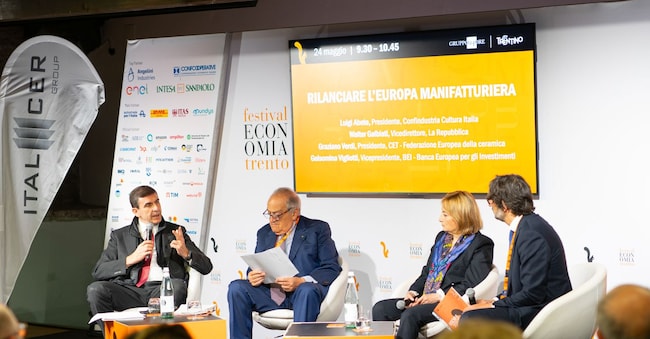
"In March, a Spanish ceramic company paid an average of 8.1 cents per kWh for electricity, while we paid 14.5 cents, 79% more: how can we compete like this?". The bills received by Graziano Verdi, number one of Italcer and President of the European Ceramic Federation, summarise at a glance the key issue of the sector, as well as of the entire national economy: the abnormal difference in energy (in this case gas) prices between Italy and other countries.
And at an event dedicated to the relaunch of European manufacturing, it is inevitable that the topic is immediately central to the debate. 'Our two big competitors, America and China,' explains the president of Confindustria Cultura Italia, Luigi Abete, 'structurally have an energy cost 2-3 times lower, and the answer should be very simple: to relaunch European manufacturing, we must find a way to reduce this competitive gap on energy, and we do it with renewables and nuclear power, there are no other solutions'. If in the past, he explains, the issue was mainly relevant for energy-intensive companies, today with these new absolute levels and relative gaps, the knot is visible for everyone. A double displacement, of Europe towards the rest of the world and of Italy towards Europe, which puts the system at risk. "If the incidence of energy on costs goes from 3 to 6 per cent, in the presence of a limited Ebitda, companies go from an area of competitiveness to one of low, very low competitiveness".
"Costs that for the tile sector are now unsustainable," adds Verdi, "with the additional problem of the Ets system, which imposes further burdens. There is no lack of innovation, and we for example have developed a system to fully capture fumes and Co2 but we must have the time to implement it. At the moment we are defending ourselves with design and innovation, but how long can we hold out? These are unfair rules that must be changed as soon as possible'. For Italy,' adds Abete, 'another issue that is often underestimated is the valorisation of intangible assets, a significant part of the value of what is sold. 'We must be able to read and build the foundations of an industrial policy in which we go to value the intangible values that are inside the products,' he clarifies, 'tangible because it is on those that we play the game, as Italians and Europeans. And on this we Italians have a double advantage'. At the same time, 'alongside the 15% of GDP' represented by manufacturing there is 'another 15% that is cultural and tourist services', which in turn 'are potential manufacturing'. Another structural limit for Italy is the scarcity of capital for new initiatives, a gap that the EIB is now trying to bridge by launching a maxi funding programme of 70 billion for innovation over the next three years, from which it expects a leverage effect for investment of 250 billion.
"The objective,' European Investment Bank Vice-President Gelsomina Vigliotti explained on the sidelines of the event, 'is to bring European industry to make a major technological leap, international competition is very strong, the Letta and Draghi reports have shown us how we are lagging behind on many fronts, and therefore, as the EIB, we want to provide subsidised finance for those researchers or start-ups that want to become bigger and cannot find the appropriate funding.


