
Reforms, from 'Italy on stage' to digital notification and new Unesco nominations
The art market and the Cultural Heritage Code are the focus of the work of the Chamber's Culture Commission, led by President Mollicone

5' min read
Key points
5' min read
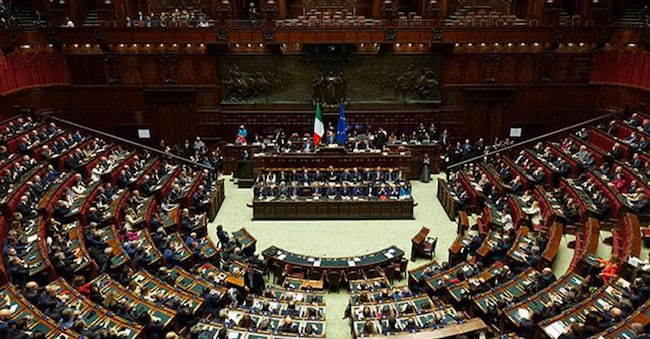
After his victory on the 5% VAT for the trade in works of art in Italy, the Honourable Federico Mollicone continues to keep the Culture Commission, which he chairs, working. During his speech at the reopening ceremony of the Museum of Saved Art in the Aula Ottagona of the Baths of Diocletian, he spoke about the work on the Commission's table, including the 'Italy on stage' bill, which provides for a digital notification for market operators and new Unesco nominations.
Italy on Stage
.The proposed law 'Italia in Scena' - of which Mollicone is the first signatory - aims to introduce, with articles 121-bis and 121-ter to the Code of Cultural Heritage and Landscape, a digital registry of the institutes, cultural places and cultural assets belonging to the public at the MiC. The registry would have the task of recording information on the forms of management and compliance with the quality levels of the valorisation of the cultural heritage, in order to collect and make the relevant data accessible, as well as to monitor management, also assessing the adoption of alternative forms and the participation of private entities, either individual or associated, in the valorisation activities of the cultural heritage itself in accordance with the principle of subsidiarity. In essence, the registry should collect, from the various public institutions, data on the nature of the property, its management (direct or indirect), related legal acts and quality indicators such as accessibility, effectiveness, efficiency and economic sustainability. Article 121-ter then establishes the Digital Register of Horizontal Subsidiarity, a section of the registry intended to register private actors interested in the indirect management of public cultural goods, ensuring transparency, competition and quality. The registration criteria and operating methods will be defined by ministerial decree, but registration remains open. For the purposes of implementing the provisions, an expenditure of €5 million is authorised starting from the year 2025, for which the 'Fund to cope with unavoidable needs', or the Fund referred to in Art. 1, paragraph 200, of Law no. 190 of 23 December 2014, intended to cover unforeseen and urgent expenses to prevent significant damage or the blocking of essential services, from which so much had been 'scraped' in the Budget Law for the current year, will be reduced.
The digital 'notification' for the Italian art market
.One of the main innovations of the 'Italia in Scena' reform law, which will soon be discussed in the Chamber of Deputies (and which does not yet appear in the proposal), concerns the introduction of a 'digital notification' for the transparency of the art market. "Digital notification," announced the president of the Culture Commission, Federico Mollicone, during the presentation of the reopening of the Museum of Saved Art at the Aula Ottagona of the Baths of Diocletian, "is designed to offer institutions a useful tool for monitoring the official market, and at the same time to support archives and auction houses in guaranteeing legality and transparency for the entire system. "With this rule - again according to Mr Mollicone - auction houses and private archives will have to send a simple Pec to notify works put up for auction and new attributions, especially those made by archives. It will be a 'silent' notification, just for knowledge, without any new bureaucratic fulfilment or burden: on the contrary, it will serve to protect those who work in transparency, offering a direct information tool to the MiC and the Carabinieri Command for the Protection of Cultural Heritage". Mollicone emphasised that 'informal forms of collaboration and notifications already exist, but this represents a step forward towards systematic digital monitoring for the benefit of a transparent art market'. The measure goes hand in hand with the recent introduction of the 5% VAT for art sales, brought forward together with the Minister of Culture Alessandro Giuli, "which has made Italy the most convenient country for buying and selling art," Mollicone added, "and we want it to be able to be said to be 'in total transparency' as well. Lastly, Mollicone announced that the Carabinieri's Nucleo TPC would be convened for a hearing as part of the cognitive investigation on 'digitalisation and the use of artificial intelligence', launched at the start of the legislature.
Humanity Heritage nominations
.On 25 June 2025, the VII Culture Commission of the Chamber of Deputies approved the resolution, signed by the Honourable Federico Mollicone (Fratelli d'Italia), which commits the government to actively support the candidatures of the 'Etruscan Places' and the 'Via Francigena' for inclusion in the UNESCO World Heritage List, established by the 1972 UNESCO Convention. This is an eagerly awaited recognition, both for the enhancement of the Etruscan civilisation - unanimously considered the most significant in pre-Roman Italy - and for the ancient medieval route linking Europe to Rome and winding for about 1,200 km through seven Italian regions, studded with places of worship, defensive structures, settlements and medieval infrastructures. On 17 June, the Culture Commission held a hearing devoted to the Unesco candidacies for the Via Francigena and the Etruscan sites, hearing among others Ledo Prato (Maecenas 90),Jacopo Caucci von Saucken (University of Florence), Sara Tognini (Leonardo Association), Luca Bruschi (AEVF) and Eugenio Giani, president of the Tuscany Region. Subsequently, on 19 June, the memorandum of understanding was signed in Perugia between the municipalities participating in the unitary candidacy project of the 'Spur - Etruscan cities' for inclusion in the Unesco World Heritage List. The document formally kicks off the drafting of the candidacy dossier and follows an initial agreement in 2017 between Perugia and Orvieto, now joined by Arezzo, Formello (Rome), Piombino, Marzabotto, Tarquinia and Volterra.
The operational programme will consist of four stages, from the establishment of the working group to the drafting of the management plan and the final delivery of the dossier in French or English to the competent bodies. The scientific direction is entrusted to Professor Mario Torelli, supported by Paola Falini for the coordination of the group. The ambition is high: to get people to recognise the exceptional nature of the Etruscan urban model, the 'Spurs', cities that summarise three fundamental elements - fortification, religiosity and engineering - which represent, according to Torelli, 'an indestructible urban ideology', to which the participating cities are living witnesses. Perugia stands out for its walls, Orvieto for its Fanum Voltumnae, Marzabotto for its regular plan, Populonia for its productive character, Veio for its cults, Gravisca for its port, Volterra for its acropolis, and Arezzo-Castelsecco for its suburban temple-theatre complex.

