Fleeing the war

Refugees from Ukraine: 4.2 million under temporary protection in the EU

In Italy there are 165,225 Ukrainians accepted. Germany leads the way with over a million.

by Davide Madeddu (Il Sole 24 Ore), Maryna Svitlychna (OBTC, Italy) and Petr Jedlička (Denik Referendum, Czech Republic)

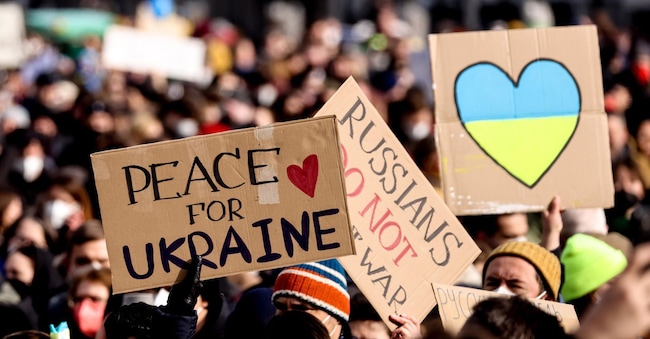
Una foto di repertorio mostra una moltitudine di persone che partecipano a una protesta chiamata “Stop alla guerra. Pace per l’Ucraina e per tutta l’Europa” a Berlino. (EPA/Filip Singer)

3' min read

3' min read

Fleeing the war and looking for a new life. Facing this situation are non-EU citizens who have left Ukraine precisely as a result of the Russian invasion. According to Eurostat, on 31 March 2025, slightly more than 4.26 million non-EU citizens who fled Ukraine as a result of the war had temporary protection status in the EU: people who fall under the procedure that is provided only in the case of a mass influx or imminent mass influx of displaced persons from third countries who are unable to return to their country of origin.

In Germany the highest numbers

.

"The EU countries hosting the largest number of temporary protection beneficiaries from Ukraine," the document reads, "were Germany (1,184. 890 people; 27.8 per cent of the EU total), Poland (997 120; 23.4 per cent) and the Czech Republic (365 055; 8.6 per cent).

Loading...

When comparing the second and third month of this year, a downward trend emerges. "Compared to the end of February 2025, the total number of persons under temporary protection in the EU at the end of March decreased by 45,455 (-1.1 per cent)," it further reads. The largest decreases were recorded in the Czech Republic (-32,695; -8.2 per cent), Sweden (-20,505; -43.2 per cent) and Lithuania (-4,845; -9.9 per cent). These decreases are largely explained by temporary protection statuses ending in March 2025. Some individuals may be temporarily excluded during renewal'.

Increased numbers in 18 EU countries

.

The number of persons under temporary protection increased in 18 EU countries with the largest absolute increases observed in Germany (+7,090; +0.6%), Poland (+2-330; +0.2%) and Spain (+2,275; +1.0%). Italy is in the middle positions with 165,225.

'Compared to the population of each EU country,' the paper continues, 'the highest ratio of temporary protection beneficiaries per thousand people was observed in the Czech Republic (33.5), Poland (27.2) and Latvia (26.4), while the corresponding figure at EU level was 9.5 per thousand people'.

As of 31 March 2025, Ukrainian nationals accounted for over 98.4% of temporary protection beneficiaries in the EU.

Women and youth

At the end of March 2025, adult women accounted for 44.7 per cent of the beneficiaries of temporary protection, 54.6 per cent of whom were women aged between 35 and 64. Minors accounted for 31.7%, while the proportion of adult men in the total number of temporary protection beneficiaries was 23.6%. The proportions of boys and girls under the age of 18 are close, with 16.7% for boys and 15.0% for girls

Italy: between renewals, support and bureaucratic challenges

On 4 March 2022, the European Council had approved the activation of temporary protection. The extension to 4 March 2026, decided on 25 June 2024, coincided in Italy with the start of the first real physical renewal of residence permits. Previously, renewal was automatic and many residence permits carried a formal expiry date that was not up-to-date, generating practical problems: difficulties in accessing public services, misunderstandings with the authorities and even refusals to enter other EU countries, such as Germany.

Ukrainian refugees can access the public reception system (first the Civil Protection, then the SAI - Reception and Integration System). Those who leave these structures can receive an extraordinary contribution of 250 euro per person for the transition to independent living. However, access to the facilities is limited and often tied to personal networks. Many, despite applying, are never confirmed to be actually available.

The temporary protection permit allows refugees to work. From 2023 it is possible to convert it into a work permit, thanks to regulatory changes such as the Decreto Milleproroghe and the Budget Law 2024. In addition, those with professional qualifications in the health or social welfare sector can work until the end of 2025, subject to certification.

Access to school education is guaranteed. Special university announcements with scholarships for Ukrainian refugees have also been activated, such as that of the University of Trento. Italian language courses are available in various institutions (CLA, Dante Alighieri Society), along with vocational training programmes.

Ukrainian refugees are guaranteed access to the healthcare system in the same way as Italian residents. Until 2025, many regions applied the x22 exemption for healthcare costs, but this was not renewed everywhere, as in the case of Trentino.

Those who received their permit before 31 January 2025 can still apply for the EUR 300 monthly contribution for a maximum of three months (two if they are working). Those who receive it after that date are no longer entitled to this benefit. In some regions, such as Trentino, there are measures such as regional free movement.

*This article is part of the European collaborative journalism project "Pulse".


Copyright reserved ©

Brand connect

Loading...

Newsletter

Notizie e approfondimenti sugli avvenimenti politici, economici e finanziari.

Iscriviti