The interview

'The relaunch of Liguria from major works, healthcare and a technological breakthrough'

Marco Bucci, the President of the Region, at the forum organised by Il Sole 24 Ore and Radiocor, outlines the guidelines for a sudden change of pace: infrastructure and population growth among the key hubs of the plan

by Luca Benecchi

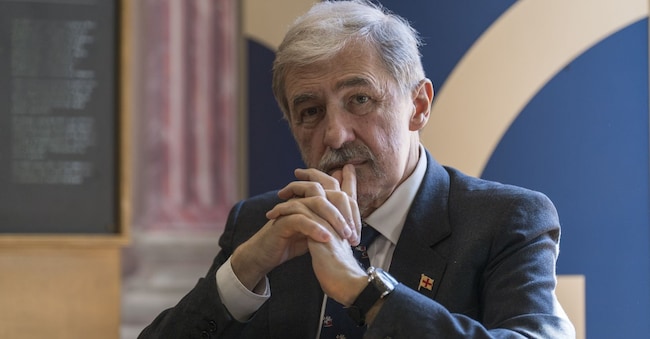
Marco Bucci, Presidente della Regione Liguria (Imagoeconomica)

7' min read

Translated by AI
Versione italiana

7' min read

Translated by AI
Versione italiana

"High quality of life thanks to the sea, housing prices that in Genoa are the lowest among the northern Italian metropolises, large companies looking for professionalism, and the fast train that from the end of 2027 will connect the capital with Milan in no time at all". This is how Liguria's President Marco Bucci relaunches the ambitions of his region "which," he emphasises, "will be able to return to being the leader of Italy's economic growth, even by increasing its population, as the latest demographic trends are telling us".

A new image and role for a region whose image is often linked to summer tourism, the decline of heavy industry and an ageing population.

Loading...

Ligurian President Marco Bucci's priorities and projects were the focus of the forum organised by Il Sole 24 Ore and Radiocor.

So where does the work to relaunch Liguria's role start ?

For someone like me who was mayor of Genoa for seven years, it is inevitable to say that we have to start from here. Years that, also because of the Morandi bridge tragedy, have tied me indissolubly to the city. And many have not forgiven me for leaving it to go to the region, so much so that they did not even go to the polls in the subsequent municipal elections.

But it is unquestionable that a regional president has much more capacity to influence strategic decisions than a mayor, if only because of his spending capacity and wallet. Moreover, you are also commissioner for reconstruction, so not a few revitalisation projects, from the breakwater to the waterfront, pass from your desk.

In fact, of the three priorities I have given myself, between infrastructure, health and work, we are beginning to see the fruits of the work of these years precisely in the major works that will change the face of the city and its economy. I would start with the port and therefore with the new dyke that will allow, once the work is completed within two or three years, to increase the surface area of the docks by three million square metres, making Genoa the true great hub of the Mediterranean and, thanks to the high rail capacity, a formidable international logistics hub. Moreover, we should not continue to think of the port's development only as a centre for maritime traffic; the big game today is the submarine cables for data traffic. With the platforms that are being set up, the natural outlet area will be North Africa, which in recent years is experiencing a real explosion in internet traffic. We have brought the world's most important companies for submarine cables to Genoa. All the main lines are there, even those coming from Asia. From Africa every year we quadruple the data.

Then there is the issue of what is called the Gronda, i.e. the east-west crossing of the city to the north of the current ring road, which has become inadequate for the current and future volume of vehicle traffic. The city's east-west axis is the one that has become inadequate for the current and future volume of vehicle traffic

This does not depend on the regional president but on the ministry, which is seeking an agreement with Autostrade per l'Italia, both on the final route and on the more thorny issue of return on investment. So most probably on the question of tolls. However, I can say that, from what I have been told, the agreement is now very close. The announcement could be a few weeks away. For the rest, on the other hand, the funding of one billion eight hundred thousand euro that arrived as compensation to the city for the Morandi was invested in increasing the efficiency of the road system towards the sea. Our big problem, both for businesses and for those who want to live or be tourists, is infrastructure. We need large investments, as well as strategic and modern concepts. Not to mention the maintenance of bridges and tunnels. A flood of major works. And I have really seen the unease in the citizens. Major works are perceived as a source of unease. At the beginning there is little to do, but in the end they are useful.

Logistics and viability are clearly also linked to the attractiveness for new economic activities. Just think of the whole Cornigliano area where once there were steelworks and today only part of it is occupied by the former Ilva plants. This area, moreover, has a dedicated berth at sea where semi-finished products now arrive directly from Taranto. Therefore a highly valuable environment for new settlements, not only logistic but also manufacturing.

On labour we start with the former Ilva, although Genoa is not just former Ilva. The first issue to be clarified is that Italy cannot do without steel. It is a strategic supply chain that no one can give up. So let's wait to see how things will go at a national level before, if necessary, trying to put in place a project that can in any case strengthen Cornigliano.

Have you ever thought of involving private entrepreneurs who could, let's say, replace the supply of coils from Taranto, in order to relaunch production, which is currently at rock bottom, with obvious repercussions on employment too. Badly said, one could think of an ex-Ilva in the north with even the construction of an electric furnace in Genoa, even though scrap is a matter of great shortage.

The ideas are there, in the past I had contacted entrepreneurs who said they were ready to invest in Cornigliano. Some even from abroad, in particular from Turkey. Even the areas surrounding the plant, which the programme agreement assigns to the former Ilva for many more years, have been the subject of much business interest because of their strategic location. I think, however, that until the issue is clarified, either through new ownership or in another situation, it is correct to move the ball. We therefore await the decisions that will be taken at headquarters.

The present of heavy industry, of which Genoa has remained the most important centre in the country, passes through Fincantieri, with the large cruise ships. Another pillar is Ansaldo Energia. This company specialises in the design of nuclear plants in various parts of the world. This is precisely in the context in which Italy has announced that it wants to re-launch the nuclear industry also by looking at new technologies and the Smr. modular

Ansaldo, which has historically been involved in nuclear power, could now become the linchpin, together with the Milan Polytechnic, of the new Nuclear Agency. Genoa's candidature is going ahead and, again, the announcement could be official within a short time.

With nuclear power, the technological and artificial intelligence game is also open, in which Genoa has been in the field for many years with the Italian Institute of Technology. And here, too, it is a question of gaining further space.

Italy will have a European location for the gigafactory, and Genoa wants to be part of it. We have made the offer, we are in connection with Leonardo and the IIt is part of the artificial intelligence project. A decision to this effect is expected by 2027.

But if we talk about the present, in the immediate future much of the added value comes from the blue economy. 

A sector that is already worth 20 per cent of GDP and which, in addition to bathing and beaches, sees boating and cruising increasingly connected with industry and new technologies.

The idea is therefore to use all the necessary tools to make Liguria an industrial and technological centre that can compete in the coming years. But as mentioned earlier, real estate, which is now a bargain compared to Milan or Turin, could experience a small revolution.

With the third pass, according to the estimates we have, the value of houses will grow by 60 per cent. Currently the average in Genoa is 1,900 euro per square metre, a luxury house with a sea view goes from 3,000 to 3,500 euro per square metre. Which, of course, is undervalued. And this is a central issue for the future.

So real estate attractiveness could also be a sign of population growth for his region.

This is a trend that is already happening. If we think that after 25 years of decline, the population here is growing. A little, around 1 per cent, but it has been growing year after year for three years, which means it has become a trend. One of the issues is the cost of housing, along with the quality of life. The population is increasing and this increase is not generated by Ligurians, but we have significant immigration from Italy but also from abroad. It is true that salaries are lower than in Milan, about 15-20 per cent, but we have an extremely lower cost of living and less turnover for companies.

But if the population increases, there remains a high percentage of elderly people in Liguria who need an organised health service. Moreover, the many mountain areas that are more difficult to reach create a problem of management and cost efficiency. In this sense, a few days ago the Regional Council approved the reform of the regional health service. A reform that aims to reduce organisational dispersion with a centralised model that overcomes the previous health companies on a provincial basis. The new socio-healthcare company is essentially a single body, with a single director, that incorporates the five current ASLs. Liguria Salute will instead be in charge of centralising administrative services for recruitment, purchasing, logistics and diagnostics.

We started from the premise that we had to free up resources to be allocated to citizens and patients. To do this, we introduced a more managerial concept of managing the whole back office part, effectively eliminating offices dedicated to the same job that were duplicating costs. To give an example, each local company used to have an office of dozens of people to do the payroll. Now it will all be centralised and, considering that we have 27,000 employees, the calculation of the savings we achieve is soon done. Similarly, we will try to reduce waiting lists as much as possible, not through medical management, but through maximising the use of machines, not just at certain times of the day, but over the whole day and the whole week.

The new general manager will be Paolo Bordon, who has had experience in Emilia-Romagna and Trentino-Alto Adige. What model have you been inspired by.?

We were inspired by the experience of healthcare in Lombardy and the United States. I am very keen on the establishment of community houses, which, I hope, will become the new territorial garrisons even in areas that are less well served by the region's large hospitals. Finally, I think it is right to equalise the salaries of Ligurian healthcare employees regardless of where they work, whether in large or small facilities. Some are penalised today but this will no longer be the case.

Copyright reserved ©
Loading...

Brand connect

Loading...

Newsletter

Notizie e approfondimenti sugli avvenimenti politici, economici e finanziari.

Iscriviti