
Relive the Odyssey by following in the footsteps of the journey through the auction
Scattered amongst the delights of antiquity – though not exclusively – one can find works of art and jewellery from the age of myth or inspired by it

_1904-U52735832510lQS-1440x752@IlSole24Ore-Web.jpeg?r=650x341)
Key points
The scene is unmistakable. A man, clinging to the belly of a massive ram, allows himself to be carried away by the animal: it is Odysseus – ‘Ulysses’ in Latin – on a daring escape from the cave of the cyclops Polyphemus. The story is told by Homer (8th century BC) in the Odyssey, whose collective appeal certainly does not depend on the – albeit thrilling – film by Christopher Nolan (‘The Odyssey’, released in cinemas on 16 July 2026). This is perhaps the episode from the poem that has most captured the collective imagination, which is ever eager for adventures and twists: it is depicted on numerous occasions on terracotta and pottery from the Greco-Roman period, artefacts that occasionally feature at ancient art auctions.
The myth of the Odyssey also up for auction
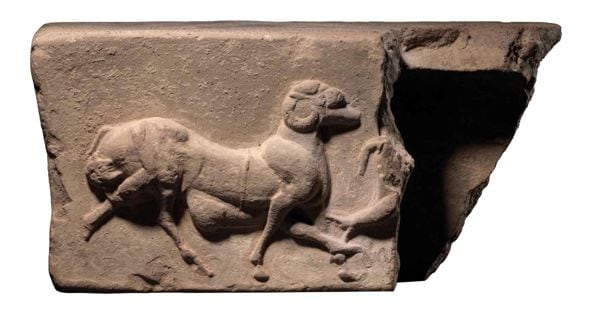
Take, for example, the 6th-century BC relief, which was sold at auction by Christie’s for $40,320 in 2024: here, in addition to the muscular king of Ithaca draped in the fleece, one can also see Polyphemus seated on a rock with a club in his hand, completely unaware of the cunning Odysseus’s deception. The ‘lekythos’, λήκυθος, was a type of vase – with a cylindrical body and narrow neck – which in ancient Greece was mainly used to store perfumed oils and ointments. The scene of the escape from the cave of the one-eyed giant also appears in relief on a terracotta piece from the same period (550–500 BC) – a fragment of a Greek altar in Sicily – purchased for £27,500 in December 2017 at Christie’s London, during the ‘Antiquities’ auction.
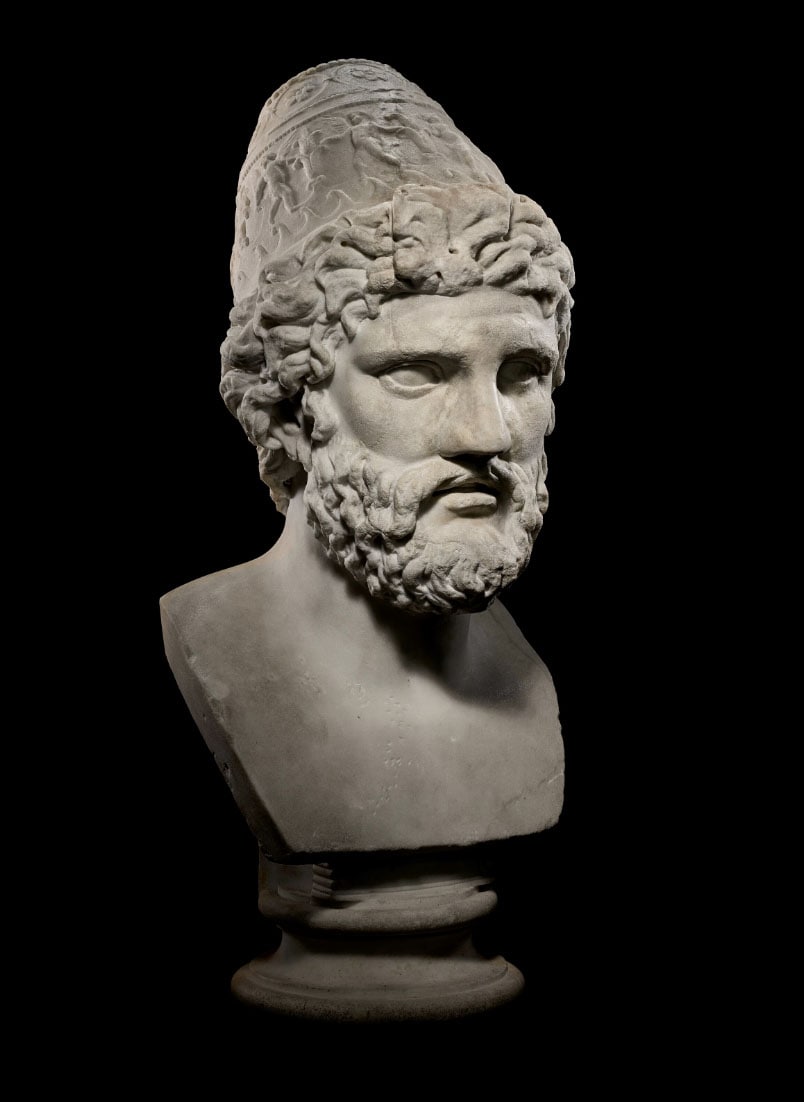
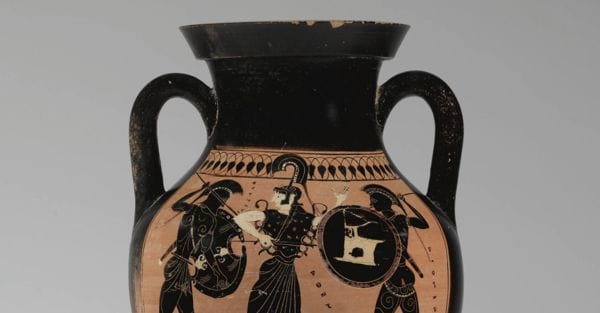
But there are also busts and heads of Ulysses, such as the 50 cm-tall marble sculpture (circa late 1st – early 2nd century AD), which sold for $189,000 at the ‘Important Classic & Decorative Art’ auction (February 2025, Christie’s New York); the hero displays his unmistakable traveller’s attributes: a beard and a pileus (πῖλος, ‘pilos’), a typical pointed headdress of antiquity, certainly not regal, but the hero of the Trojan Horse was (also) a seafarer (the Greeks attributed him not only to Odysseus but also to Hephaestus, the Dioscuri and Diomedes). The first known owner of the bust was the Earl of Bristol Frederick Augustus Hervey (1730–1803). The sculpture bears traces of restoration, probably by Bartolomeo Cavaceppi (1716–1799), a friend of the noble collector who was passionate about antiquities. On an amphora in the style of the Painter of Lysippus (second half of the 6th century BC), Athena makes her appearance: the goddess stands proudly amongst her beloved heroes, Odysseus and Diomedes (whom Dante, in *Inferno*, would place in a single forked flame). Back in 2007, someone at Sotheby’s paid $97,000 for this vase; adjusted for purchasing power, that would be around $156,000 today.
Antique jewellery inspired by Homer’s epic
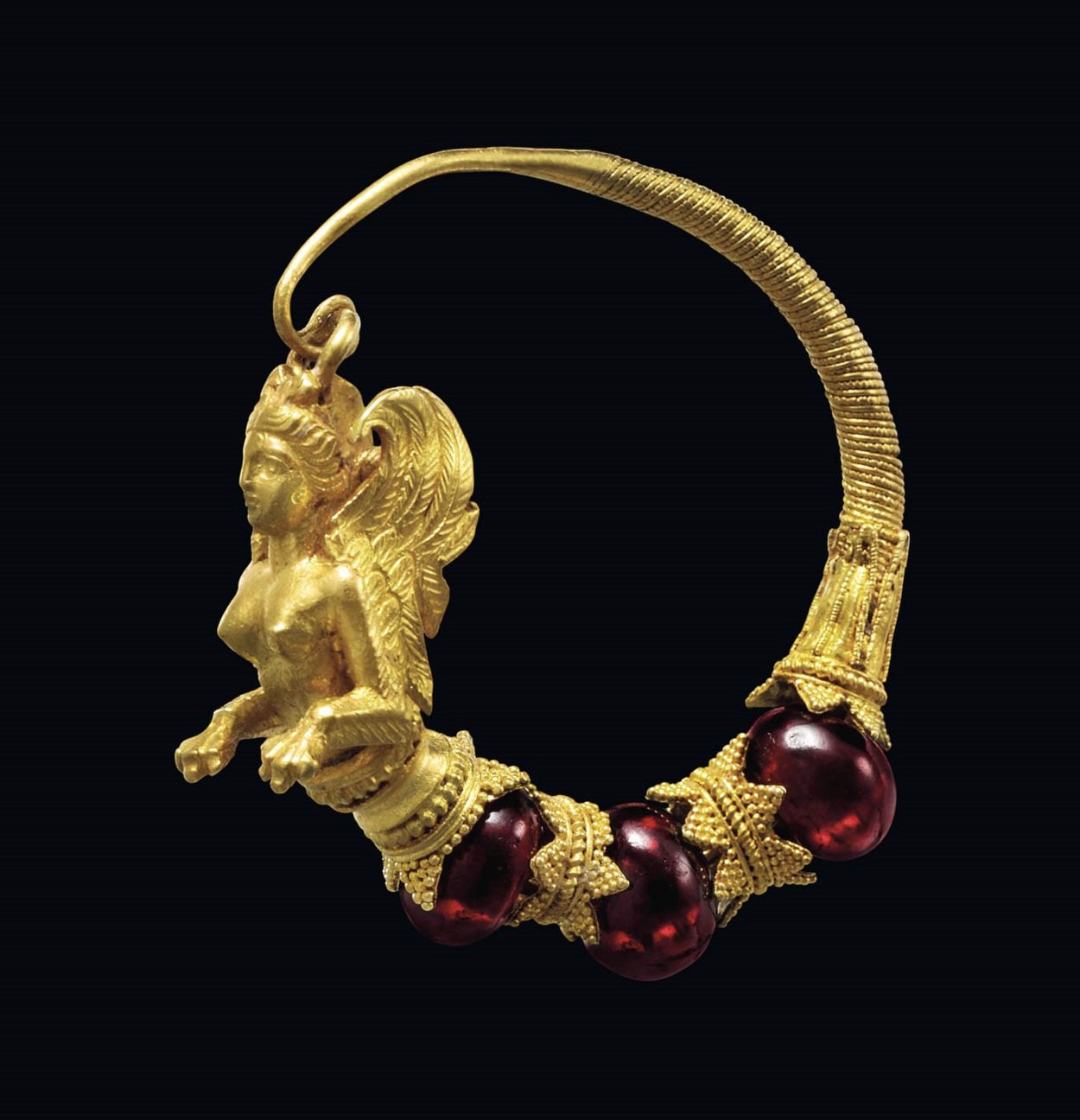
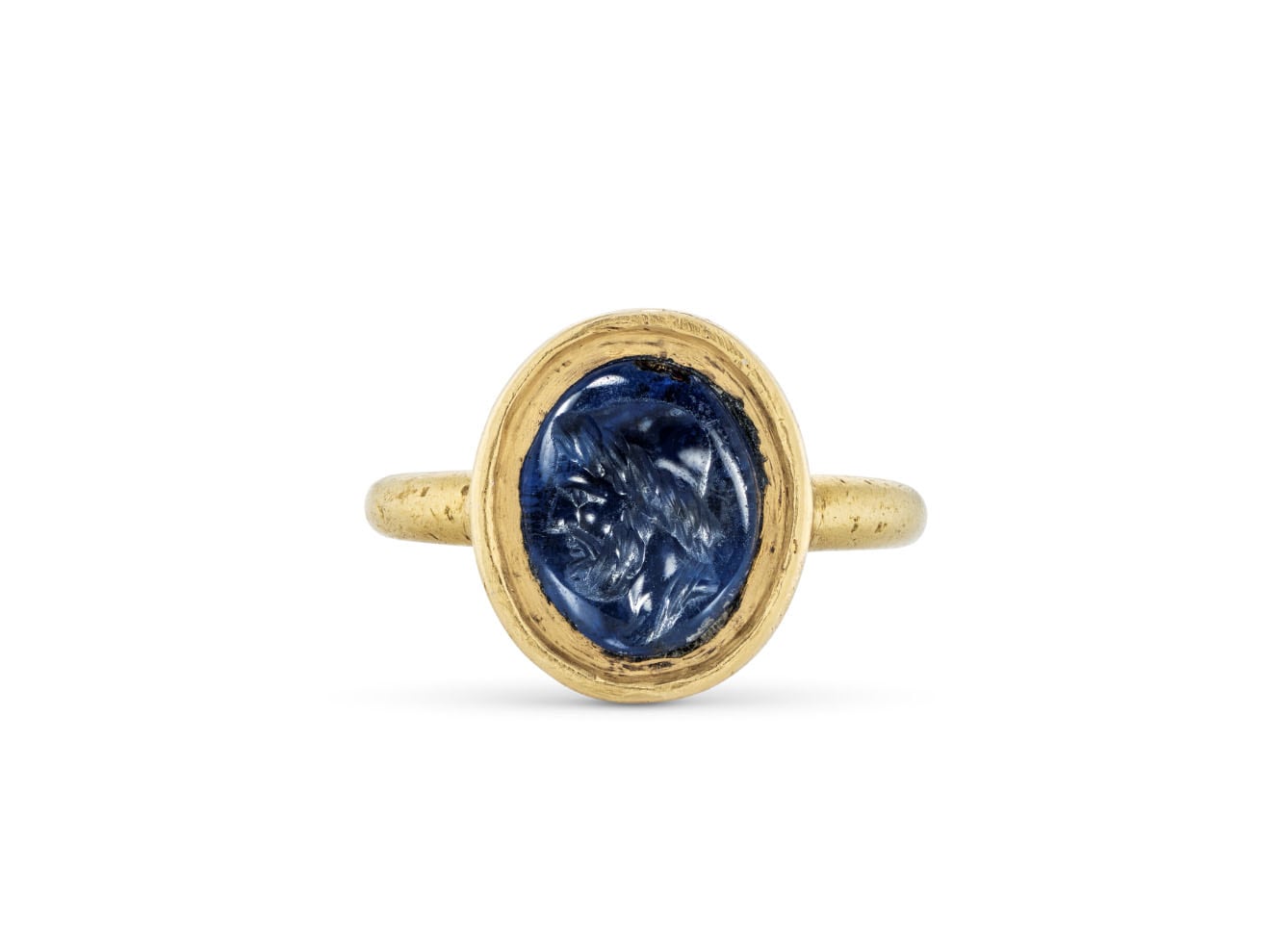
But Athena also appears in all her splendour in a fragment of an onyx cameo (approximately 7.3 x 1.5 cm), which Sotheby’s London sold for 56,250 pounds in 2017 (the auction was titled ‘Ancient Sculpture and Works of Art’). The goddess, depicted in left profile, wears a scaly aegis bearing the head of the Gorgon Medusa; a pair of dangling earrings and a particularly elaborate helmet, on which one can admire: a crouching sphinx supporting the crest, Pegasus and four pawing horses. It is possible that the cameo was part of a larger composition. Ulysses reappears amongst the gemstones: a Roman-era sapphire (1st–2nd centuries BC) bearing his embossed effigy is set in a 19th-century ring (sold for 21,420 pounds at Christie’s London in December 2024, during the major auction ‘Antiquities from the Mougins Museum of Classical Art’). The allure of jewellery goes hand in hand with that of the Sirens, one of whom takes the form of an earring 3.3 cm wide dating from the Hellenistic period (c. 4th–3rd centuries BC): winged and with outstretched claws, the mythological creature is adorned with pearl-encrusted gold threads and three spherical garnets. An objectively marvellous piece of jewellery, yet one which failed to find a buyer at Christie’s ‘Antiquities’ auction on 2 April 2014, despite its attractive estimate of 1,000–2,000 pounds.
Inspiration in the modern world
As we move into subsequent eras, Homeric and Odyssean influences become ever more prevalent. Three thousand years after the fall of Ilion, the mythology surrounding those events still resonates in the inspiration of artists. Leaving aside for the moment the works of Mannerism and Neoclassicism, echoes of the myth reverberate even in more recent eras. Consider, for example, the oil on canvas ‘Odysseus and Calypso’ (1929) by Newell Convers Wyeth (1882–1945), which sold for $581,000 at Christie’s New York American art auction (May 2014); previously, in 2008, Sotheby’s had sold it for $397,000 (even taking inflation into account, the work has appreciated in value). From a few years later (1931–1932) is the pastel on paper by Georges Braque (1882–1963) ‘Odysseus’, 181 x 74 cm, which sold for $475,000 at Christie’s New York’s ‘Impressionist and Modern Art Works on Paper’ auction (November 2021).

