
Renato Del Din, the 'perfect' partisan
Carlini reconstructs the biography of the 20-year-old patriot who fought for a better Italy
4' min read
Key points
4' min read
8 September 1943 as the extreme opposite to 2 June 1946, the birth of the Italian Republic: two dates about two years apart, between dusty chaos and the need to rebuild a political and social order, but more, ethical and moral. General Badoglio's proclamation announced a bloody 'everybody go home', to quote Comencini's film, when the second lieutenant played by Sordi, under German fire, declared in total bewilderment: 'The Germans have allied themselves with the Americans'. A choked sentence that revealed the state of disorientation of the Italian army, but also of the frightened population, alluding to the civil war to which the most heated phases of the Resistance up to the Liberation led. There were those who joined the Republic of Salò and those who categorically refused, ending up among the more than six hundred and fifty thousand soldiers interned in the Reich concentration camps. In the same context, there were also those who decided to fight in the field.
Patriots
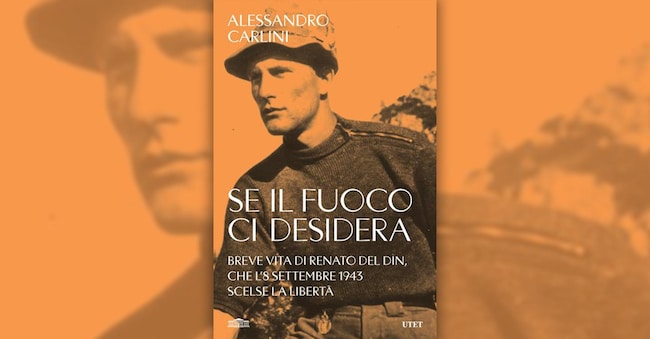
.Se il fuoco ci desidera. Breve vita di Renato Del Din che l'8 settembre 1943 scelse la libertà (Utet, 2024, pp. 192, euro 19) is the title of the fictional biography that Alessandro Carlini has dedicated to the tragic story of the Alpini second lieutenant who, with his sister Paola, voted for resistance. Not to mention that Carlini has already published Code name: Renata (2023) on Paola Del Din, a living gold medalist for military valour. What moved the two brothers were family and territorial reasons, properly patriotic. They were the sons of an Alpine lieutenant colonel, their father Prospero, assigned to the Austrian border after the assassination of Chancellor Dollfuß in 1934. The Alpini have always been a corps with a marked sense of duty to the homeland, an unfailing sense of responsibility, and anti-German sentiments dominated among them, which matured following the Don retreat where they were abandoned by the Nazi allies.
Commander Anselmo
."Your sacrifice will be useless, not only that, but people like you will be judged as enemies of the fatherland and look that it is not the foreigner's judgement that counts, but that of our people," wrote Del Din in his last letter to his officer friend who, as a comrade in the Julia Alpine Division, had followed the fascist regime and become an enemy. After the fateful armistice, Renato first fought with a shareholder formation, then with Garibaldi's troops in the sabotage of a bridge, until he took on 'commander Anselmo' as his battle name and wore the green kerchief of the Osoppo Brigade, so similar to the blue one of the Badogliani who liberated the Langhe. He was a 'Fenoglio-esque' perfect figure, as Carlini points out in the book, pursuing the series of parallels between the life of the second lieutenant, who did not fire a shot in the war except as a partisan, and that of Fenoglio's Johnny. They were united by a determined loneliness, capable of countless renunciations, and by having put the fight for a better Italy before everything else.
The moral corruption of the fascists
.For the first time, moreover, the writer and journalist printed the sub-lieutenant's writings and letters, which, although not inspired by any particular ideology, showed a visceral contempt for fascism, the black shirts 'ready to sell their sister to the highest bidder' and Mussolini, going so far as to call for a united Resistance led by the army together with the parties. "The still-alive spirit of the army among the peasant masses prevents (together with the communist spirit for the workers, the theories of the various parties for the members) fascism from taking hold again, so here is the army still efficiently in line in the anti-German and anti-fascist struggle". He died symbolically on 25 April 1944, at the age of twenty-one, in the Osoppo assault on the Tolmezzo militia barracks, which had previously been a primary school, where the hated Duce had taught between 1906 and 1907. However, the epic dimension of his story went beyond a barrage of bullets.
The Rebel's Body
.In the archive photos, the dead guerrilla's body looks like that of a Che Guevara, stripped naked by the Nazi-fascists and thus deprived of identity. It was the republican investigators who had him photographed, in case any of the relatives came forward to recognise him. But this did not happen and allowed the people of the village to idealise him as a fallen son, from family to family, to awaken their consciences. On the day of the funeral, 27 April, hundreds of women accompanied the coffin and wept for him, like nameless Antigones within a sort of civil ritual, but also a religious one, and at the same time with a profound meaning of rebellion against the oppressor.

