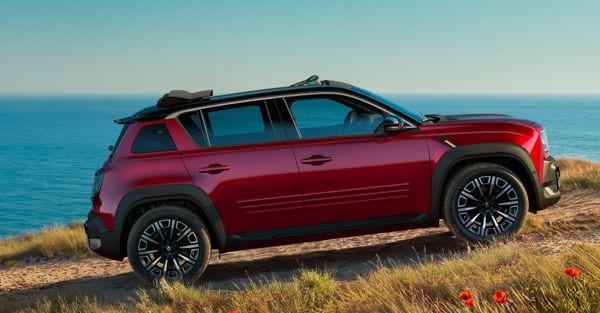
Renault 4 E-Tech Electric Plein Sud, more than just an electric convertible
The open-air version of the electric Renault 4 adopts a large, electrically opening fabric roof, without penalising boot space and roominess. Two versions, one engine. We drove it around Barcelona.
Key points
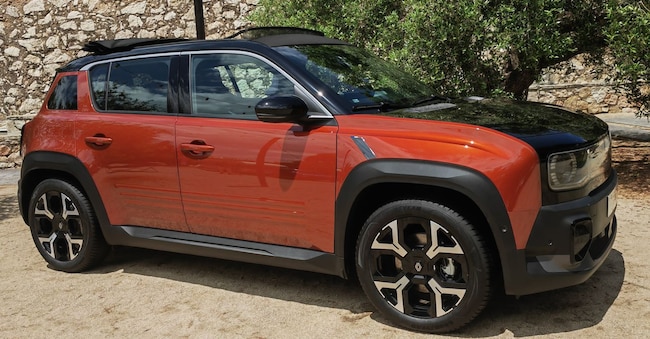
Renault extends the range of the 4 E-Tech Electric with a variant revolving around a single element, the fabric sunroof. It is called the Plein Sud, a name that winks at the Plein Air of the original 4L, the fully open version from the 1960s. Here the choice is less extreme, because it is not a true cabriolet but a large electrically opening canvas roof, yet the declared intention is the same, to bring the sensation of open-air travel on board.
The fabric roof can be adjusted to any position
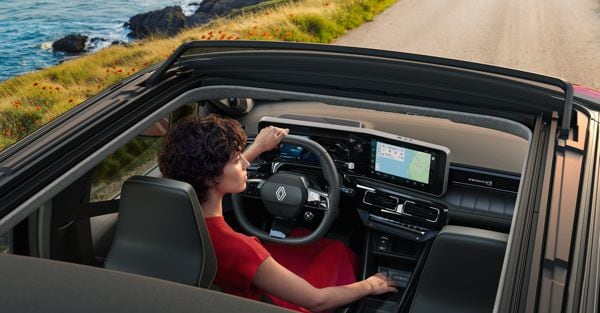
The roof opens electrically in just under ten seconds, either by push-button or voice command. The opening measures 92 centimetres long by 80 centimetres wide, and can be adjusted to any position in between. To keep weight and bulk down, the French engineers have adopted a premium curtain that folds in three folds instead of the usual four, with structural elements in composite material instead of metal. Compared to solutions that fold down electrically, the roof in the boot has the advantage of keeping its capacity unchanged, which remains at 420 litres. The R4's structure has however been reinforced in the upper part of the bodywork so as not to compromise torsional rigidity, a measure that weighs 19 kilograms more than the fixed-roof version and translates into just 7 kilometres less range, for a total of 395 kilometres in the WLTP cycle (always optimistic compared to real values).
Not excessively noisy even when uncovered
Tested in the hills behind Barcelona, the Plein Sud proved quite quiet. With the roof closed, the perceived noise on board only increases by 4 per cent at 130 kilometres per hour compared to the standard version, a difference measured in the most unfavourable condition. With the roof open, a small fabric flap comes into operation that lifts up and deflects the airflow, so the wind remains contained and not particularly annoying. It is possible to listen to the radio or talk to the passenger even when travelling outdoors, and the roof can be manoeuvred with the car in motion at up to 90 kilometres per hour.
Some technical notes
The Plein Sud is offered with a single motorisation, a 110 kW (150 hp) electric unit, combined with a 52 kWh battery. The 'sprint' from 0 to 100 kilometres per hour takes 8.2 seconds and the top speed is 150 km/h. Full recharging on alternating current at 11 kW takes just over four and a half hours, while on direct current, at 100 kW, the 15 to 80 per cent charge takes half an hour.
AC charging is bi-directional (V2L): it is possible to power 220 V to 3,700 W appliances via the car battery. Also convenient is the Plug & Charge function that makes recharging at compatible DC stations as easy as possible: once registered, it dispenses with the use of specific badges and credit cards to pay for recharging.