
Renault Clio, behind the wheel of the sixth generation with truly hybrid engines
The compact saloon changes completely outside and inside, becoming a little bigger, adopting technologies from Renault's higher class and new engines.
Key points
The new Clio gets back into the game by staying true to the compact saloon sector, unlike some Renaults that have turned into SUVs and without giving in to the temptation to become a 100% electric model. However, it has little in common with its predecessor: from the body style to the dimensions, from the presentation of the cabin to the repertoire of technologies to the range that includes new engines. Summing up, one would think that the new series is also intended to appeal to those who can no longer find a saloon in the Renault range with engines with pistons in the bonnet.
Renault Clio, revised platform and new engines
The renewal of the Clio starts with the Cmf-B architecture. In fact, it supports track widths that are 4 centimetres wider at the front and 1 centimetre at the rear and has a 1 centimetre longer wheelbase. The new dimensions are not only intended to improve dynamism and comfort, but also inspire the new styling definition that is based on more balanced proportions and larger dimensions than those of all previous Clios. Also new is the range of engines, made up of proposals in which petrol travels alone or is combined with LPG or, again, interacts with electrons in the case of the full hybrid E-Tech 160. The self-charging system, in practice, is still the three-engine system of the previous Clio, but now has 160 instead of 145 horsepower. It is made up of a 1.8-litre four-cylinder with 109bhp and 172Nm of torque from Horse Poswertrain (the joint venture between Renault and Geely) together with an electric unit with 49bhp and another with 20bhp that acts as starter, generator and synchroniser for the electro-actuated gearbox without synchronisers, which dedicates four gears to the petrol engine and two to the more powerful electric. Its operation is orchestrated not only by the car's configurations, but also by numerous strategies defined by the electronics that tend to favour driving under the impetus of the electricity stored in the slower gears in a battery now 1.4 instead of 1.2 kWh. The result of these innovations detracts an average consumption of 3.9 litres per 100 kilometres. The other two units are both 1.2-litre turbocharged three-cylinders. That of the Tce with 115 horsepower is powered only by petrol and is mated to a six-speed manual gearbox, while the Eco G-120 bifuel LPG unit with 120 horsepower, which will arrive after next summer, will only be offered with a six-speed dual-clutch gearbox. This version promises an autonomy of 1,450 kilometres, thanks to a 50-litre LPG tank in addition to the 39-litre petrol tank also common to the other two Clios.
Renault Clio, upgraded electronics with practical solutions
The new Clio has a line-up of Adas comprising twenty-nine devices, resulting in a Level 2 semi-assisted driving system. The systems, as required by regulations, are activated each time the Clio is started, but with a button to the left of the steering wheel, some previously set in the infotainment display can be engaged and disabled. A solution that avoids some haunting audible alarms, for example, that of speed limit changes. Also making its debut with this Clio is Smart Mode, which senses your driving style and automatically engages the car's configuration (Eco, Comfort, Sport and Personal) most suited to the situation, even if, in our opinion, not always smoothly.
Renault Clio, has a sleek line
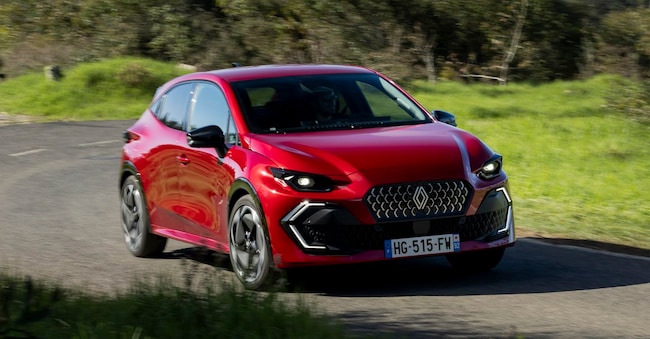
Stylistically, the new Clio is the child of an evolution of Renault's stylistic language, which in this case does not want to convey SUV suggestions as is rampant in the rest of the range but, almost, coupe-like. The connotation is benefited by the remodelling of proportions and dimensions, since the new Clio is 4.12 metres long, i.e. 7 centimetres more than the old one, 1.77 wide, i.e. 4 centimetres more, 1.45 metres high and has a wheelbase of 2.59 metres. Its appearance is characterised by an aggressive front end featuring a hexagonal grille, original headlamps consisting of small-diameter full-LED headlamps set in shiny black plastic frames and a muscular bonnet lid. From the side, the appearance is reminiscent of a coupé with a high beltline, a roofline that descends towards the tail and a massive spoiler covering the steeply raked rear window, which sharply cuts the vertical line of the lower part of the tailgate. The picture is completed by the sculptural tail, defined by concave and convex surfaces.
Renault Clio, nice inside, hi-tech but only wide in front
The new body dimensions are not reflected in the interior, creating a larger space than in the previous Clio. Thus, in the rear area the space is adequate for two people but they can only fit their legs properly if the front seats are not too far back, while in the front there are no problems thanks in part to the resizing of the console between the seats that enhances the width of the area.

