
Renewables, Italy record: close to 44% in 2023. But Europe runs faster
Terna data reveal that the growth of wind and solar power and falling demand have pushed the weight of green sources in the electricity fed into the grid to an all-time high. Germany and Spain above 50 per cent

3' min read
3' min read
Italy set a record for renewables in 2023. The total net production of electricity, as reconstructed by Il Sole 24 on the basis of public Terna data, came to43.8% thanks to green sources, namely hydroelectric, wind, solar, biomass and geothermal. This is an encouraging figure, especially since it arrived immediately after the Russian gas crisis, but one that should not lead to excessive enthusiasm. For three reasons. Firstly because it was favoured by the drop in production, estimated at under 260 GW, at the lowest since 1999. Secondly, the comparison with European partners weighs heavily: net of the foreign balance, Germany and Spain, also favoured by the collapse in demand for electricity, have surpassed the 50% threshold of renewables, while Great Britain has reached 47%; France is at 27%, but reclassifying low-carbon sources with nuclear power would leapfrog it with 93%. Third point: widening the comparison to the last decade, the Italy-Europe comparison is even more emblematic: in 2014 our country produced between wind and photovoltaic 37 GW and in 2023 it will reach 54 GW; in the same period France has surpassed us (going from 24 to 68 GW) and Great Britain outclassed us (from 36 to 109 GW), Spain is over 100 GW, Germany dominates with almost 200 GW.
Wind and solar at the top
.According to Nicola Monti, CEO of Edison, reaching 44% of net production from renewables (the share of demand will be much lower) means "going in the right direction, even if we are far from cruising speed. We need a more systemic vision that includes storage, grids, innovation and the relaunch of hydroelectric investments'. Another key element: last year, out of all green generation, wind and photovoltaics accounted for 20.7% and 27.2%: together they therefore beat hydroelectric (33.9%), long the true pillar of Italy's renewable portfolio. In 2023, it produced around 40 GW, but the 27 GW in 2022 (due to drought) had lowered renewable generation to 35.6% of the total. In 2014, on the other hand, it was again the super performance of dams (58 GW) that brought the overall figure to 43.3%. A number that, although determined by exceptional factors, is unfortunately close to the record of 43.8% with which 2023 ended. Ten years lost, then? "Renewable installations have travelled at a slow pace due to the end of incentives, bureaucracy and a lack of responsiveness on the part of policy makers - emphasises Alessandro Marangoni, Ceo of the Althesys think tank - the 5 GW of new installations in the last 12 months have contributed to the latest setback". Davide Tabarelli, President of Nomisma Energia, urges caution: "The 2023 record is linked to the trend of structural reduction in our industries and energy efficiency: it will be very difficult to hit the target of 60% from renewables by 2030".
The leap of Germany and the UK
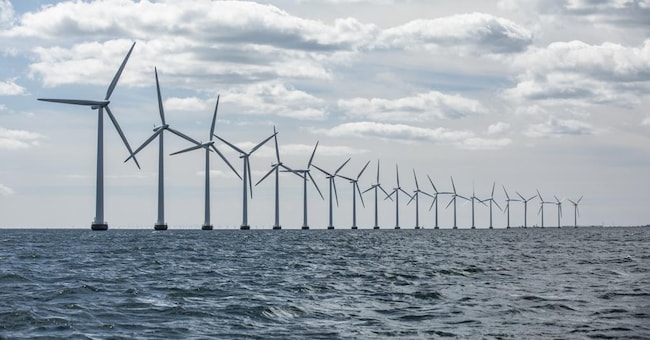
.The evolution of installed capacity from 2014 to today speaks for itself: between wind and photovoltaics, Italy has gone ahead at 1.5 GW per year (when 10 would be needed), France and Great Britain at 2.8, Spain at 3.6 and Germany even at 7.5. Turning the hands back to 2010, it jumps out that Germany has wiped out nuclear power (worth 22% of generation) and almost halved coal (to 26%), bringing renewables from 18% to 52.6%. Italy, on the other hand, has gone from 27% to 43% on green, but remains the most dependent in Europe on gas and hydro, which is subject to greater volatility due to climate change. "In 2023 for Germany and Great Britain, wind power, particularly off shore, made the difference," Tabarelli points out. "Berlin has done a lot on renewables: between subsidies, permitting, electricity prices and land confirmation, the context has been very favourable. The winds of the North Sea have also pushed the British off shore: in 2023 London set a record for renewables with 47%. In just a few years, Britain has moved away from coal (worth 30% in 2014), replacing it with green sources, with nuclear and gas together just under 50%. Same reasoning, with different numbers, for Spain.
The nuclear node
.A final thought on nuclear power, which, net of the safety issue, remains a low-carbon source. Reclassifying the European energy mix, France dominates with 93% of electricity produced with low emissions, followed by Spain (70%), Great Britain with 61%, Germany with 54% and Italy with 43.8%. "In the next 10 years this gap is bound to narrow because several countries will have to close some old generation plants, while renewables will grow: the real crux for Italy remains the dependence on thermoelectric," concludes Umberto Quadrino, president of Tages Holding.


