
Renewables, Legambiente: 5.79 GW of new installations in 2023, solar photovoltaics leading the way
Slower growth for wind power, distributed in 1,043 municipalities, meeting 7.6% of Italy's electricity needs

3' min read
Key points
3' min read
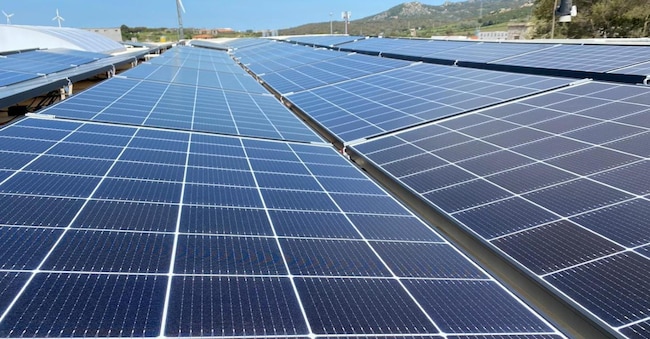
With 5.79 GW of new renewable energy installations in 2023, in Italy after 12 years of low and insufficient installations, renewable energy sources are growing again, registering +5.1 GW compared to 2012 and + 2.6 GW compared to 2022. The driving force is solar photovoltaics, with 5.23 GW of new installed power, followed by wind power, which recorded, albeit at a slower pace, an increase in power of 487 MW. Taking this picture is the 19th edition of Legambiente's Comuni rinnovabili (Renewable Municipalities) report, presented on Tuesday 28 May in Rome at the headquarters of the Gestore dei Servizi Energetici (GSE), the report's partner.
The environmental association emphasises that while the 5.79 GW of new installations represent an important growth and step - witnessed also by the first figures for 2024 with +52% of renewable capacity in operation compared to the figure recorded in the same period of 2023 - on the other hand they are still not enough to meet the 2030 targets. Based on the average installations of the last three years, Italy at this rate will only reach 100% of the targets in 2046 - a full 16 years later than 2030 - and meet the 90 GW quota of installed renewable power.
The Italy of Renewable Municipalities
.From the North to the South of the Peninsula, renewables are now present in almost all Italian municipalities, i.e. in 7,891 municipalities out of a total of 7,896. 2023 is the year of solar photovoltaics: 7,860 municipalities (+560 compared to 2022) have chosen this clean source, bringing the total power capacity to 30.2 GW. A significant growth of more than 5 GW in just one year, characterised mainly by the construction of small plants.
Rome, Padua and Ravenna the cities in the front row
.Among the large cities, Rome, with 4,890 solar plants and 32.05 MW of installed power, Padua (1,918 plants and 15.03 MW) and Ravenna (1,519 plants and 11.07 MW) are those that supported the largest realisations of photovoltaic solar power in 2023. Slower growth for wind power, distributed in 1,043 municipalities, capable of satisfying 7.6% of the country's electricity needs. 101 new plants will be built by 2023, involving 61 municipalities in Puglia, Basilicata, Sicily and Sardinia. Positive data also for hydroelectric with 1,971 municipalities (+398 compared to 2022) that have at least one plant for the production of electricity using this technology. In 2023, 72 new plants were built, of which only one was large, involving 68 municipalities, an increase of 30.89 MW. Slight growth for municipalities using biomass plants, they are 1680 (+29 compared to 2022). Geothermal energy is at a standstill, with no new plants at the moment, pending the construction of the new medium-enthalpy plants already authorised.
The 13 Good Practices
.These good practices join the 326 mapped in recent years by the Report. Among the virtuous experiences, Ravenna stands out, where the Dante Alighieri Theatre of Tradition in the historic centre is the first to be powered, in agreement with the Superintendency, by solar energy for 25% of its energy consumption. An example of how photovoltaic systems are an opportunity not to be overlooked in historic centres. The biomethane plant in Ostra (AN) is able to exploit a gas naturally produced from 32.5 tonnes of organic waste, meeting the heating needs of about 3,000 homes. In Pavia and Vercelli there are two examples of participatory photovoltaics where local communities have supported part of the construction of solar parks. Renewable energy plants that, as in the case of the agri-voltaic plant in Tarquinia (VT), have been developed respecting the territorial vocation of the places and, in some cases, as happened in the industrial area of Villacidro (province of South Sardinia), have contributed to the redevelopment of old and abandoned industrial sites.

