
Renzo De Felice: the doubts and uncertainties that make a historian great
Here is an excerpt from Paolo Mieli's essay 'The Price of Peace' published by Rizzoli

3' min read
3' min read
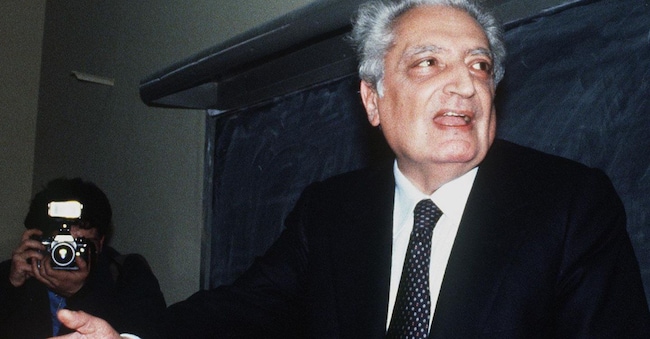
This book - like everything I have written in the past years - owes much to a historian, him in the full sense of the term, who was my teacher. He taught me to distrust 'revealed truths', to question the official version of past events. A version that is useful to reconcile accounts, to corroborate judgements about the present. From him, I learnt that the first commandment for those concerned with history is to take seriously documents and books that pose problems. In particular, those documents and books that put me at odds with what I thought until a minute before I looked at them. That provoke doubts.
Renzo De Felice was born in Rieti in 1929 to a customs officer who had fought as a volunteer in the Great War and suffered permanent disability due to gas damage. Having moved to Rome with his family, he had studied at the Mameli High School where - recalls Francesco Perfetti in Per una storia senza pregiudizi. Il realismo storico di Renzo De Felice - he was repeatedly put off in various subjects and flunked his high school exams twice. He then wanted to enter the Faculty of Letters, which his father considered 'a real economic disaster'. So he enrolled in Law but soon switched to Philosophy (not Literature 'to avoid the terrible Latin exam written with Paratore'). A start to his studies full of uncertainties. Which, Perfetti points out, would not prevent him from becoming 'one of the most important, most influential, most authoritative historians of his generation'.
Before he turned 20, he joined the Italian Communist Party after a meeting - writes Paolo Simoncelli in Renzo De Felice. La formazione intellettuale - with Piero Melograni. Who, like him, would leave the PCI after the Soviet repression of the Hungarian uprising (1956), and who was also destined to become a distinguished historian. He was, De Felice, a very peculiar young communist: on his bedside table he kept a biography of Lev Trockij from 1879 to 1921 - The Armed Prophet by Isaac Deutscher - which party leaders strongly advised against reading.
In any case, before his detachment from the PCI, he did not shirk the duties of a militant: in 1950 he was stopped by the police during a pacifist procession against the atomic bomb and was later arrested, in 1952, for a demonstration against the Korean War. Together with Sergio Bertelli, he too was destined to follow a similar itinerary to that of the two aforementioned historians. He graduated in 1954 with a thesis on the First Roman Republic in the period between 1798 and 1799 (supervisor Federico Chabod). He attended as a scholarship holder the Italian Institute for Historical Studies named after Benedetto Croce (directed at the time by Chabod himself) where he met Rosario Romeo. And he bonded with another very important historian: Delio Cantimori, considered at the time - in De Felice's words - 'the master, the patriarch of Marxist historiography at the Italian university'. Although, De Felice recalled, 'especially in private', Cantimori often polemised what he called 'sublime moralism'. And to the young De Felice he appeared as a 'dilapidated, problematic, divided man'. Chabod, Cantimori and, shortly afterwards, Don Giuseppe De Luca had an extraordinary influence on De Felice, each for his part. The lesson he learnt from his militancy in the PCI and from Cantimori was to 'never moralise about historical events'...
In recent years the extraordinary influence on De Felice had been George Mosse - The Nationalisation of the Masses. Political Symbolism and Mass Movements in Germany (1812-1933) - and Zeev Sternhell - Neither Right nor Left. The birth of fascist ideology - were increasingly replaced by François Furet and his Criticism of the French Revolution. Dino Cofrancesco noted this. But Perfetti definitively explains how the meeting with Furet was decisive in a long period of the last phase of De Felice's life. Which ended prematurely in 1996. He had just turned sixty-seven. But his name still resonates today in every debate on the issues he dealt with. A great teacher.

