
Reply reopens the former De Sonnaz Barracks to the city. Turin’s new headquarters: a blend of history and AI
13 million was invested in the purchase of the former barracks and over 34 million in its restoration. The new headquarters, dedicated to technological innovation, combines the restoration of this historic building with contemporary spaces for work and research

Key points
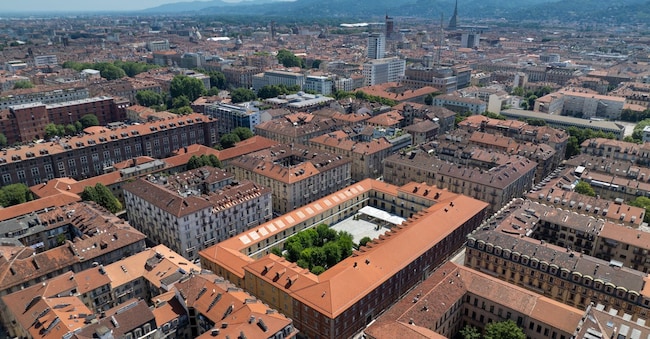
A section of the Renaissance wall of the Citadel, linked to the memory of Pietro Micca, has been brought to light in the auditorium created beneath the former Ettore De Sonnaz Barracks. Above, within the spaces of a late 19th-century military building that had been cut off from the city for decades, algorithms, artificial intelligence models and immersive technologies are now at work. It is here that Reply has opened Reply House, the new Turin headquarters of the group founded in Turin in 1996 and now a multinational listed on the Milan Stock Exchange, with companies in Europe, the United Kingdom, the United States and Asia. The project required an investment of around 13 million for the purchase of the former barracks and over 34 million for its refurbishment.
A new office for 800 people
The new headquarters, covering approximately 20,500 square metres, is set to accommodate around 800 people. The same number work at the Lingotto site, where Area42’s activities in robotics and industrial systems are concentrated. Meanwhile, the former barracks on Via Revel house an entire wing dedicated to applied artificial intelligence, home to Reply House of Models and Area73. This marks an investment that links the group’s growth to one of the most significant urban regeneration projects of recent years in Turin’s historic centre.
The former De Sonnaz building, a listed property restored according to a design by ACPV Architects (Antonio Citterio Patricia Viel), retains the original layout of the nineteenth-century barracks, reinterpreting it as a contemporary campus dedicated to research, innovation and collaboration. The project has worked with the building’s layered history without erasing its memory. The barrel vaults have been restored, the interior facades redefined, the roofing and façade systems reconfigured, and the historic galleries brought back into use. In the 100-seat auditorium, situated in the basement, a section of the 16th-century wall of the Citadel – unearthed in collaboration with the Superintendency – has become an integral part of the architecture. The space is the subject of an agreement with the City Council, which will use it for initiatives dedicated to innovation and digital technology through a joint committee. “Working on the built heritage means recognising the value of the existing city and its ability to adapt over time,” observes Antonio Citterio. “The project demonstrates how buildings of great historical value can accommodate new functions without losing their identity.”
The sustainability of the new project
Sustainability also depends on construction choices. The building site, managed by Costruzioni Gilardi, which acted as the main contractor, prioritised reversible solutions: the wooden floors are assembled using a system of magnetic planks that can be completely dismantled, thus allowing for future alterations without the need for demolition. The air-conditioning system utilises a geothermal system that reduces energy consumption, whilst the interior furnishings, developed in collaboration with UniFor, favour natural materials and flexible systems. Outside, the inner courtyard – once a manoeuvring ground for the Savoy cavalry and bordered by a ring of lime trees – has been restored as a garden.
The role of AI
Artificial intelligence is not only the focus of research carried out within the building, but also forms part of the architectural design. The AI Generated Marbles, developed by Reply in collaboration with Acpv and Marazzi, are large ceramic stoneware panels that reinterpret marble through patterns generated by algorithms, thereby reducing the need for rare natural stone. This experimental project brings together digital design, manufacturing and materials.
Brand connect


Newsletter RealEstate+
La newsletter premium dedicata al mondo del mercato immobiliare con inchieste esclusive, notizie, analisi ed approfondimenti
Abbonati