
Report case, Privacy Guarantor President Stanzione: 'Totally unfounded accusations, nobody resigns'
Oppositions continue to call for the dissolution of the Authority

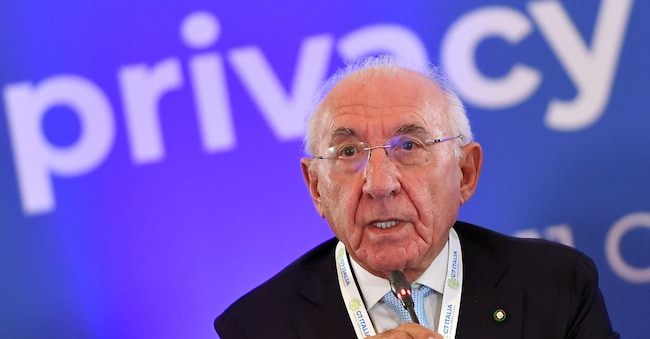
FdI opened up to the resignation of the Privacy Guarantor requested by the oppositions. But the president of the authority, Pasquale Stanzione, ruled it out: 'The college will not resign, the accusations are totally unfounded,' he clarified in front of the TG1 cameras. And then, reiterating: 'When politics cries for the dissolution or resignation of the authority, it is no longer credible'.
In the last few hours, especially in the centre-left, there has been a growing conviction that new rules are also needed for the choice of who is to be a member of the data protection body. Currently, two members are elected by the Chamber and two by the Senate. Constitutionalist Stefano Ceccanti, a former PD deputy, suggested introducing 'a quorum of three fifths of Parliament'. Avs agreed: 'It is clear,' said Angelo Bonelli, 'that a qualified majority is necessary'. The centre-right froze: 'When the PD was in the majority it did not occur to anyone,' recalled FdI group leader in the Senate Lucio Malan.
The Report case
The controversy over the Garante stems from the Report case. The programme hosted by Sigfrido Ranucci accused the current members of the authority of contiguity with politics and conflicts of interest. First in the crosshairs was a member of the panel, Agostino Ghiglia, for his relations with FdI, which Report linked to the fine imposed by the Garante on the programme after airing an audio between former minister Gennaro Sangiuliano and his wife. "The narrative of a Guarantor subordinate to the government majority,' Stanzione said, 'is a mystification that aims to delegitimise its action, especially when decisions are unwelcome or inconvenient. The Garante takes decisions that are sometimes contrary, sometimes favourable to the government, this is the story of autonomy'.
Among the most convinced supporters of a change of method for the election of the Authority is the Pd senator Dario Parrini, vice-chairman of the Constitutional Affairs Commission. "It would be a common-sense choice," he explained, "to establish the rule that one cannot become a member of an independent authority if one does not obtain the approval of at least three-fifths of the eligible voters, as is the case for the lay members of the Constitutional Court, or of the voters, as is the case for the lay members of the Csm. Parrini recalled the state of the art: in 2020, when at Palazzo Chigi there was Giuseppe Conte at the head of a centre-left government, 'the two members of the current Garante della Privacy elected in the Senate, Ghiglia and Stanzione, obtained just 123 and 121 votes, i.e. a consensus of less than 40% of those entitled. The two elected members of the Chamber, Guido Scorza and Ginevra Cerrina Feroni, obtained just 237 and 209 votes, i.e. a consensus of 33% and 37% of the eligible voters respectively'.
Oppositions call for the dissolution of the Authority
The opposition, however, continues to call for the dissolution of the Authority. Of 'resetting' Giuseppe Conte spoke on DiMartedì. "It has no more credibility to go on," said instead the M5S group leader in the Senate Stefano Patuanelli. But neither the government nor Parliament can intervene. The step backwards can only come by choice of those directly involved. 'The only hypothesis,' recalled jurist and former RAI president Roberto Zaccaria, 'is that the majority of the components, so three out of four, resign. I don't see any others at the moment. I think it is an act of pressure'. For the MEP Sandro Ruotolo, responsible for Information of the PD, it is a paradoxical situation: 'We have the possibility of making the Head of State resign,' he said, 'but not the board of the Privacy Guarantor. In the meantime we need to take a step back, and then we will see together what can be done, if we need to change the law for the choice of the guarantor. Although no one had any objections to the previous presidents. The issue is the quality of these gentlemen'.

