
REPORT: The Region's challenges to enhance the marble and stone sector

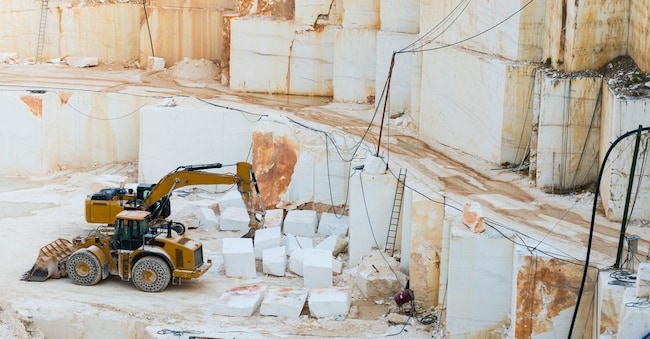
From limestone to granite, passing through basalt and marble, finishing with trachyte and sandstone. And a new supply chain in which the internationalisation of companies goes hand in hand with the circular economy and innovation. These are the challenges that the Region of Sardinia, with the Department of Industry, is pursuing to enhance the marble and stone sector, which has 73 active quarries, of which 48 are granite, 12 limestone and marble, 10 basalt and trachyte, 2 slabs and one sandstone, looks to international markets and aims for growth. "Italia is the world's second-largest exporter of stone materials and the first in terms of technology, a sector that generates a turnover of more than 4.5 billion euro, with 3,200 companies that employ about 34,000 people," says Emanuele Cani, Regional Councillor for Industry. "In this context, the Region intends to promote a sector that even in Sardinia, after a past crisis in the sector, promises highly encouraging development projections.
For this reason, the regional executive emphasises that work is underway to 'strengthen and relaunch this sector'. "We have reached an agreement with the relevant sector operators and started a process that aims precisely at enhancing this sector," he says. "The objective is to strengthen our presence in the reference markets that are the American, Chinese, Indian. And then the Arab one and others where the use of fine stone is quite widespread'.
There are also other measures to support the sector. "One concerns the energy efficiency of these activities distributed throughout the region," he continues, "which is why we are considering providing financial support for any modernisation activities. That is not all, however. "Our goal is to go beyond marketing,' Cani adds, 'and create a real supply chain in the sector, so that we can then access the markets with a range of superior and, of course, high-quality products.
This also includes the initiative to recover offcuts, i.e. processing scraps. "The aim is to reuse what was once considered processing waste and therefore waste to be discarded as a resource," he continues, "there are studies that show that what is considered waste can become added value for the supply chain and for the products. This is also a positive element in business. As well as an important building block for the circular economy'.

