
REPORT: The challenges facing the Region in promoting the marble and stone sector

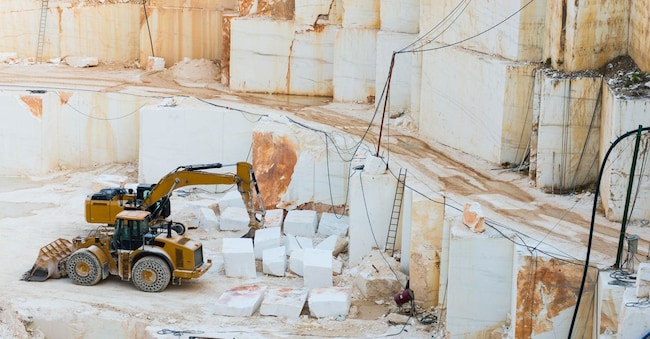
From limestone to granite, via basalt and marble, and finally trachyte and sandstone. It is a new supply chain in which the internationalisation of businesses goes hand in hand with the circular economy and innovation. These are the challenges facing the Region of Sardinia, which, through its Department of Industry, is working to promote the marble and stone sector, comprising 73 active quarries – 48 of which are for granite, 12 for limestone and marble, 10 for basalt and trachyte, 2 for flagstones and one for sandstone. The region is looking to international markets and aiming for growth. “Italia is the world’s second-largest exporter of stone materials and the leading exporter in terms of technology; this sector generates a turnover of over 4.5 billion euros, with 3,200 companies employing around 34,000 people,” says Emanuele Cani, Regional Councillor for Industry . “In this context, the Region intends to promote a sector which, even in Sardinia – following a past crisis in the industry – promises highly encouraging growth prospects.”
For this reason, the regional government representative emphasises that work is currently under way to ‘strengthen and revitalise this sector’. “We sought an agreement with key operators in the sector and have embarked on a process aimed precisely at promoting this sector,” he says. “The aim is to strengthen our presence in key markets, namely the American, Chinese and Indian markets, as well as the Arab market and others where the use of precious stone is quite widespread.”
There are also other measures in place to support the sector. “One concerns improving the energy efficiency of these businesses, which are spread across the entire region,” he adds. “For this reason, we are considering providing financial support for any modernisation projects.” But that is not all. “Our aim is to go beyond simply marketing the products,” adds Cani, “and to create a fully-fledged supply chain for the sector, so that we can then access markets with a range of superior and, of course, high-quality products.”
This framework also includes the initiative to recover offcuts, that is, production waste. ‘The aim is to reuse what was once considered production waste – and therefore rubbish to be sent to landfill – as a resource,’ he continues. ‘There are studies showing that what is regarded as waste can become added value for the supply chain and for the products. This is yet another positive aspect, particularly from a business perspective. As well as being an important building block for the circular economy.”

