
Restoration reveals the true appearance of the Holy Face
The cross, original from the 9th century, is unique and now the Christ has regained its colours, including the precious pictorial layer of lapis lazuli

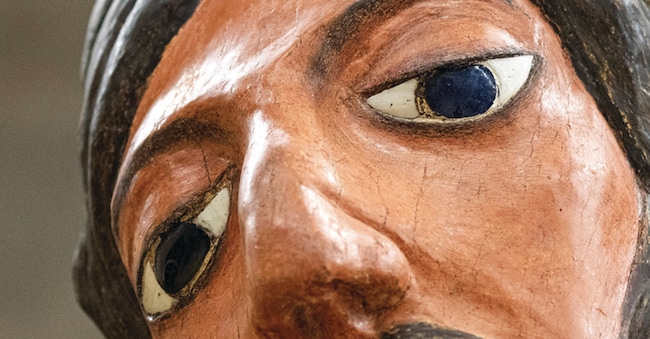
He looks at you from on high, with a gentle, human gaze. His face leans much and seems to whisper: "Stop and listen to words of life". The Holy Face has regained its enchantment and incarnation. His eyes shine so expressive, his magnetic force that has brought pilgrims and believers, tourists and passers-by to the Cathedral of San Martino in Lucca from the 9th century to today. The sculpture's new life was made possible by the four-year restoration, supported by a 600,000 euro investment by the Fondazione Cassa di Risparmio di Lucca: the Christ, also sung by Dante in the Inferno, is now back among us.
The figure of Jesus, carved in walnut wood, is wrapped in a long tunic with sleeves, unlike the crucifixes of the Middle Ages and later periods characterised by loincloths and suffering. This one from Lucca is a Christ Saviour triumphans, the Crucified victorious over evil and death. In terms of the construction of the work, the wood is hollowed out at the back along its entire length and the head is closed by a chestnut wood lid, formerly covered with red fabric, in which an ancient compartment for relics may have been placed.
In previous years, carbon 14 analyses on some wood fragments had led to a 9th century date being proposed, and now the dendrological analysis of the wood of the cross confirms a date around 860 and confirms that the assembly between the two parts is original and coeval. This is new information acquired thanks to the restoration directed by the Polychrome Wooden Sculpture Restoration Department of the Opificio delle Pietre Dure and carried out by Francesca Spagnoli. The state of preservation of the crucifix, placed since the end of the 15th century inside the small temple built by Matteo Civitali in the Cathedral, was so precarious that the intervention was necessary: an uneven layer of dirt all over the wooden surface had changed the colours of the masterpiece and some cracks made one fear for the health of the wood. Now, a previously unpublished image of the work has re-emerged: in the earliest known testimony to date, dating from the early 14th century, a miniature of the Codice Tucci Tognetti showed it in blue. In addition to the recovery of an alpha and omega in gold leaf on a blue background, on the top of the cross, two earlier polychromes in shades of red and blue, enriched with decorative motifs in bands and palmettes, can be appreciated. In the robe there is a pictorial layer of lapis lazuli of very high quality and some stratigraphic samples show that over time the gilding of the robe was repeated, using the same technique of overlapping gold leaf. In addition to the care of the wooden surface, it was decided to reinforce the structure by placing a metal support on the back of the cross and inside the Christ, to distribute the forces evenly and ensure that the body does not rest solely on the six original wooden pins.
As it is today, no one had ever seen the Holy Face: "We are in front of an original 9th century cross, one of only three early medieval wooden sculptures, together with one in Belgium and the one in the Cathedral of Sansepolcro, that exist in the world," explained Francesco Niccoli, head of the scientific secretariat of the Cathedral of Lucca, during a visit to the site. "Now we can admire the true face of Christ, born in a Carolingian/Benedictine culture, the one that brought thousands of pilgrims from all over Europe since the 11th century. Believers came to Lucca from France and Scandinavia, from Iceland and England to venerate the cross that - so says deacon Leobino in the Leggenda - had arrived from the Holy Land to Luni, to then follow the Via Francigena from Luni to Lucca. The fame of that wooden masterpiece was so great that from 1030 to 1140 many hospitals were founded in the city, both by ecclesiastical and secular initiatives: in 1260 there were thirteen hospitals within the walls and, at the end of the 13th century, there were forty in the diocese. And the Holy Face is also signum peregrinationis, that is, an image of devotion for wayfarers, so much so that one was even found on Senya, an island in Norway, and one, touching, can be seen until 7 January 2026 in Rome, at Villa Farnesina, in the exhibition On the Routes of the Jubilee. Pilgrims, trains and popes.
Pilgrims on their way to St. Peter's stopped at the Cathedral of San Martino, the only sacred building in Lucca with a portico: they went to kneel in front of the Holy Face, which continues to look at us with millenary eyes. His irises, obtained by modelling scrap glass from the Roman era (pre-V century A.D.), have the depth of the Mystery in which to lose oneself in order to find oneself again.


