
Back to Venice, with Monia Ben Hamouda, Lotus L. Kang and Lara Favaretto
Away from the non-stop stream of openings and events, three artists and three opportunities to reflect on the present. To be discovered whilst strolling at a leisurely pace through the Biennale Gardens and the Marciana Library.

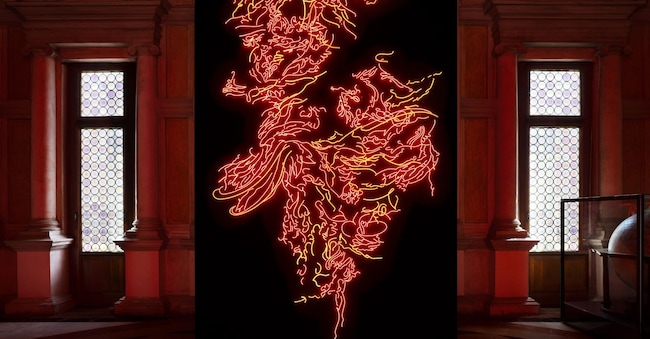
Among the Italian artists of the 1990s generation who are enjoying the greatest international success is Monia Ben Hamouda. A 35-year-old Milanese of Tunisian origin, over the last four or five years she has held one exhibition after another, mainly in Europe, but also in the United States and Asia, and has been awarded the 2024 Maxxi Bulgari Prize, a biennial award created through a collaboration between the jewellery house and the Roman museum to support the creativity of young Italian artists. The jewellery house has also chosen her to mark the launch of its multi-year partnership with the Venice Biennale. The daughter of an Islamic calligrapher, she draws on her cultural heritage, whilst also reflecting on the encounter and clash between different cultures, their mutual influences, misunderstandings and stereotypes. Her creativity takes the form of large, often suspended sculptures, made up of laser-cut steel plates that cast their shadows around them, and coloured, fragrant spice powders such as paprika, hibiscus and cinnamon, which engage all the senses. At other times, they take the form of stone blocks emerging from the ground, occupying the entire exhibition space and filling it with shapes, colours and scents, as in the current exhibition at the space owned by the collector Ivo Barth. Bulgari, through its Foundation which acted as curator, invited her to exhibit both in the garden of the Milanese hotel and in Venice. The installations centre on language: in Milan, the work Ya’aburnee (Untranslated Fragment I & II) consists of fragments of stone on the ground bearing the inscription You Bury Me, which alludes to the connection between love, death and continuity. In Venice, however, the artist has created an installation within the Monumental Halls of the 15th-century Marciana National Library, designed by Sansovino, a place dedicated to the preservation of knowledge. In the vestibule, Monia Ben Hamouda has created two large neon installations, entitled Fragments of Fire Worship, which display indecipherable and fragmentary signs, evoking a form of writing that has lost its communicative function to become a gesture, a trace, a scar. In their form, they resemble two flames and evoke the destructive power of fire, but also its capacity to illuminate and purify. In a world riven by conflict and dominated by the destruction of memory, her work represents a form of resistance and survival. The artist’s international profile is set to grow further: two solo exhibitions are scheduled for next year, one at Kanal – Centre Pompidou in Brussels and the other at Gasworks in London; furthermore, her works will be included in group exhibitions at the Schirn Kunsthalle in Frankfurt and at the Centrale Fies, near Trento. On the art market, she is represented by the Berlin gallery ChertLüdde, where her drawings start at 2,000 euros, whilst her paintings and sculptures start at 12,000 euros. She also collaborates with Selma Feriani.
Also at the Marciana Library, the Bulgari Foundation is curating another exhibition by an Italian artist, this time from a different generation: Lara Favaretto. Born in 1973 and based in Turin, she is already well known both in Italia and abroad (she is represented by Franco Noero, and her iconic cubes made of confetti – ephemeral minimalist sculptures, which were also exhibited at Art Basel Unlimited a few years ago and sold for 220,000 euros) are particularly notable. In the Salone Sansovino, the artist presents the seventh and final edition of Momentary Monument – The Library, previously shown at major events such as documenta 13. At its core is the idea of reactivating the book as an epistemic infrastructure and a critical space for verification and transmission.
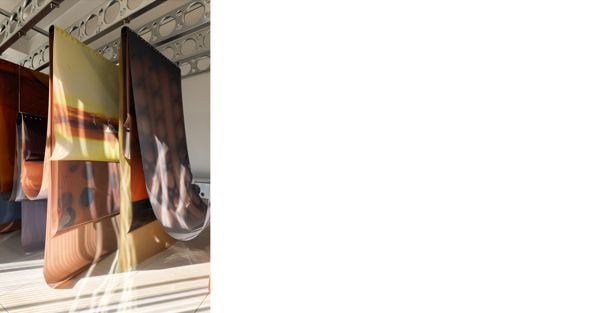
At the Giardini, meanwhile, the Spazio Esedra is hosting an international artist, Lotus L. Kang, born in 1985, a Canadian of Korean origin, born in Toronto and now based in New York. Here too, non-linear time, memory and heritage lie at the heart of the work. The new commission, entitled The face of desire is loss, is an immersive installation comprising sheer films – which the artist calls skins – which hang from the ceiling and surround the pavilion, reacting to light and humidity throughout the duration of the Biennale. The title is inspired by a line from the book Thresholes by the poet and writer Lara Mimosa Montes, which deals with absence, death and loss. ‘I have always thought of my work as site-responsive rather than site-specific,’ explains the artist. ‘It is not anchored to a single place, but continues to change in dialogue with its surroundings. The works retain traces of different landscapes, whether it be my studio, the greenhouse or the tidal flats in South Korea captured on 35mm film. As the works are not fixed, they continue to accumulate traces of every context, and the work is constructed over time.’ 2026 was an important year for Lotus L. Kang, not only for her collaboration with Bulgari at the Biennale, which brought her significant visibility, but also for being included on the shortlist for the prestigious Sobey Art Award, the leading prize for Canadian art. Furthermore, during Singapore Art Week 2026, two of her works were acquired for the permanent collection of the Singapore Art Museum by the Los Angeles gallery Commonwealth and Council. Since she began exhibiting, around 2013, she has enjoyed rapid success both critically and in institutional exhibitions (she currently has a solo exhibition on at the Frye Art Museum in Seattle). The art market has also shown its appreciation for her work, as evidenced by the many galleries that now represent her, ranging from the Canadian gallery Franz Kaka to the Korean Kukje Gallery, from the Berlin-based Esther Schipper to the New York-based 52 Walker; however, there is no disclosure regarding prices.

