
Subdued: revenue of around 240 million, driven by the US and Asia

Key points
Expanding the boundaries of their business has enabled fashion companies to grow rapidly in the wake of globalisation, but overseas operations set up too hastily or without due care have proved fragile within a few years, compounded by the international situation, which has become increasingly complex since the Covid-19 pandemic.
Those who have decided to embark on a path towards internationalisation in recent times have had to carefully weigh up strategy and investment, and tailor their approach (and, in some cases, their product) to each market. And they have had to tackle all manner of obstacles: from the energy crisis to Trump’s tariffs (which were subsequently lifted). Among the companies that have followed this trajectory is Subdued, a firm founded in Rome in 1994 following an idea by Enrico Maria Sconciaforni and Alessandro Orsini, who at the time decided to stake their claim on ‘teen fashion’. Thirty years on, having survived the cut-throat competition from fast fashion, it has decided to embark on the complicated journey of expanding abroad, aided by the financial boost provided by the entry of partner Nuo into the company (with a 30 per cent stake). The results look promising: “We’ll close 2026 with revenues of 240 million euros and EBITDA holding steady. In fact, we hope to do even better on the revenue front: it will depend on the last two months and also on the weather,” explains Sconciaforni.
Focus on Asia, which is set to generate around 30 million in revenue by 2026
Europe remains Subdued’s main market; however, in recent years the company has invested in two directions: Asia and the United States. “Asia is not an easy market, but having entered it two years ago, we can say we are pleased. In China, we have a direct presence and a very clear strategy: to avoid competing with local brands, we’ve focused on a middle ground between budget and premium. Our more international customers have welcomed us very warmly: turnover at the Shanghai shop, which opened in 2024, doubled within a year. We’re now targeting the more local Chinese market and have opened a pop-up in Shenzhen, a city that has pleasantly surprised me,” he says. When Sconciaforni talks about Asia, he is not referring solely to the People’s Republic, but also to the south-east of the continent, where the company operates through a partner (JLL) with one shop in Seoul (South Korea), two shops in Bangkok and two in Singapore. Overall, the expected turnover in APAC for 2026 will be around 30 million euros, with positive EBITDA.Seven new openings are already planned for 2027: two in Hong Kong, one in Beijing, one in South Korea, and the brand’s debut in Tokyo, Jakarta and Kuala Lumpur.
The US: from New York to California, Subdued’s big gamble
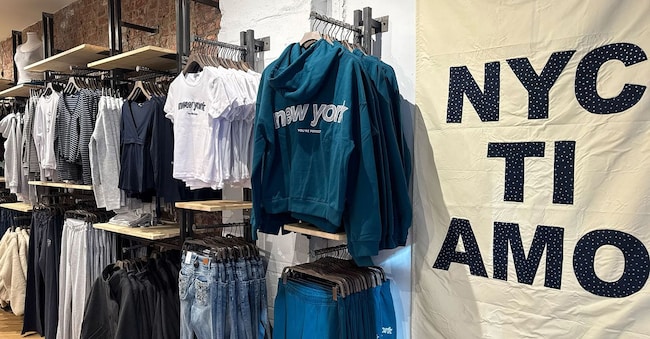
The other major growth area for Subdued is the US, which accounts for around 15 million euros in revenue (this is still an estimate for 2026, ed.) and is currently the priority in Subdued’s strategy. ‘We were planning this expansion, which began on 25 November 2025, when President Trump announced tariffs on imports and we found ourselves at a crossroads. We chose to press ahead without raising our prices, and we were right to do so. What’s more, we were even reimbursed for the tariffs.” Subdued currently has three shops in New York, the latest of which, opened on 24 October, is in the Flatiron District, and it plans to open two more in Miami by the end of the year. “We’ve had an excellent response in New York. 2027, on the other hand, will be the year of California: we have signed two contracts for two shopping centres in the Los Angeles area. It’s a complex market, partly due to climate-related issues, for example, but one from which we expect a great deal.” Alongside the shops, investments in the e-commerce channel are also progressing: “Online sales are growing in line with the rest of our revenue,” notes Sconciaforni. “We are now considering a localised strategy in the US, and we have opened operational and logistics centres both there and in China.”

