The event

Riccione hosts Walk & Run for Women, between sport and challenges for gender equality

The Romagna city hosts an event to celebrate women in sport and promote equality and inclusion

by Dario Ceccarelli

4' min read

Translated by AI
Versione italiana

4' min read

Translated by AI
Versione italiana

Run girl run. Don't turn back. Don't stop to rest. Although you have already come a long way, overcoming many obstacles, you still have some more to go to reach new, equally important goals.

In the wake of the last winter Olympics in Milan Cortina, and the summer Olympics in Paris 2024, the women's sports movement has taken a historic boost. And not only for the rich medals won in both Games, but also for participation and enthusiasm. An overwhelming wave that cannot be dismissed as an episodic phenomenon. That it is a consolidated trend is also borne out by the numbers. In Paris the golds were 7-3 for the Italian athletes, in Milan Cortina, the balance is statistically more balanced (12 to 12 with 6 mixed medals), but the most striking feats (6 golds to 3) were achieved by the girls. From Federica Brignone to Francesca Lollobrigida, from Arianna Fontana to Lisa Vittozzi, from Flora Tabanelli to Michela Moioli, not to forget the formidable girls in luge. A long wave that, by 2025, had already touched volleyball, athletics, swimming, fencing, gymnastics, tennis and so on, with astonishing numbers even in the least performing specialities.

Loading...

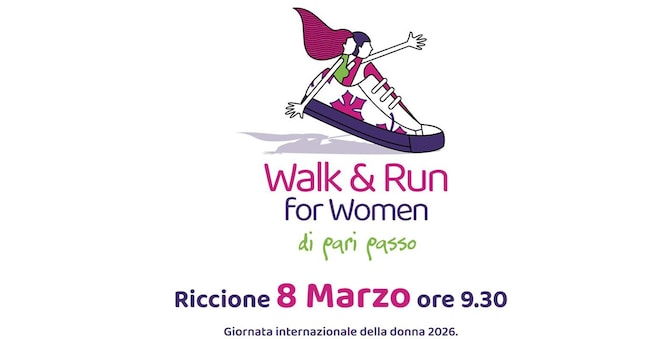
We are returning to the subject because this Saturday 7 and Sunday 8 March, in Riccione, to celebrate International Women's Day, the first edition of the "Walk & Run for Women" will be held, an initiative promoted by the National Association of Women Athletes, with institutions, the third sector and unforgettable sports stars: canoeist Josefa Idem, cyclist Antonella Bellutti, volleyball player Manuela Benelli, and basketball player Stefania Passaro. Stars of the first magnitude with Stefania Bianchini (boxing) Luisella Milani, Alice Pignagnoli (footballer), Brigitta Grandia (handball) and Paralympic athlete Valentina Petrillo, the first Italian transgender athlete to compete in women's athletics. A party to do sport but also to discuss gender equality and the prejudices that still persist at the Palazzo del Turismo (Saturday 7 March).

The heart of the event will be on Sunday 8 March with 2-5 km walks and a 10 km non-competitive run with trails accessible to runners of all levels with special attention to disabilities, in tune with the start of the Milan-Cortina 2026 Paralympic Games.

"A collective commitment that is on the march," emphasises Riccione Mayor Daniela Angelini. 'We need the courage to rewrite a way of being together and build equal relationships in every field,' comments two-time Olympic champion, former pistard and road cyclist, Antonella Bellutti.

A parity (sportingly) achieved

Equal relations, yeah. If we want to talk about gender equality in competitions, we can say that, apart from a few specialities, it is now achieved. Even in numbers, since, at the next Olympics in Los Angeles (2028) there will even be an overtaking with more women registered (50.77) than men ((49.3). Thus concluding a run-up that has lasted more than a century because at the first Olympics in 1896 no women were allowed to participate on the precise instructions of Pierre de Coubertin, the creator, as is well known, of the modern Games, but firmly against ("a really unsightly thing...") the practice of sport by women. 'Certainly in competitions much has been done,' says Josefa Idem, a former canoeist with 8 Olympics behind her and 38 medals between Games, World and European Championships. "From the point of view of sports policy, on the other hand, we are still light years away, despite the appointment of a woman, Kirsty Coventry, at the head of the IOC. A big step forward, but as there are few women in other positions of power, what changes are always courtesy of men. Another raw nerve is that of educators: they have to be up to the task, to know how to transmit passion to young people who are no longer what they used to be because society has changed so much'.

Few female coaches and very few female leaders. Suffice it to say that out of 50 federations, only two have a female president. Another handicap is the very high average age - 71 - of sports managers. 'It is not possible for men to continue explaining to us how the world is made,' Josefa Idem points out again. 'The problem is that men run for office even if they have no competences; a woman if she is not at least 110 per cent prepared does not even present herself.

Wages and salaries

This weekend, with races, walks and workshops, Riccione's seafront becomes an important stage in a journey that focuses on health, rights, sports education and social inclusion. In addition to the problem of facilities (in Italy, only two schools out of 10 have a gymnasium that is fit for use), the problem of fees and salaries will be addressed. There are sports such as volleyball and tennis that have earnings and visibility almost equal to those of men. In others, however, such as football and cycling, the differences are glaring. A volleyball player earns more than three times as much as a female footballer, who earns no more than 35,000 euros a year compared to the average of one million for footballers.

"Gaps, stereotypes, and cultural barriers persist and require coherent public policies," said Roberta Frisoni, councillor for tourism and sport in Emilia Romagna, also referring to another burning issue: that of rights, such as maternity, accidents, and welfare. Unfortunately, for many female athletes, being good is not enough. They must also learn to be union leaders. Not exactly an Olympic speciality...

Copyright reserved ©
Loading...

Brand connect

Loading...

Newsletter

Notizie e approfondimenti sugli avvenimenti politici, economici e finanziari.

Iscriviti

Tutto mercato WEB