
Rice, quality and hail-frozen yields
The increase in production with the new 9,300 hectares of cultivated area went up in smoke due to bad weather in September

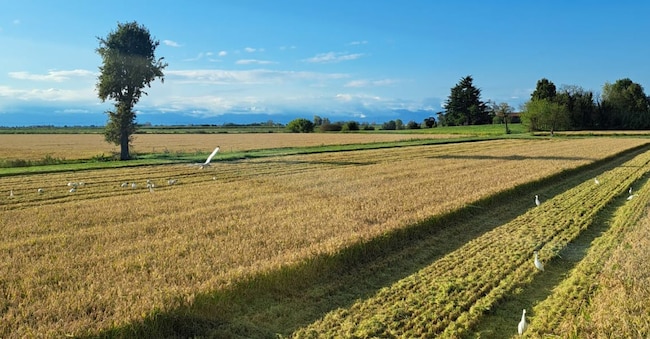
While the area under rice cultivation is expected to increase in 2025, production does not look set to increase compared to last year due to hail damage.
With just a few days to go before the end of the harvest - concentrated in the three provinces of Novara, Vercelli and Pavia, and in the province of Ferrara - this is the picture that is emerging, as confirmed by category representatives who report the discontent of rice growers. "In the last ten days of September, we recorded three hailstorms that hit the Vercelli, Novara, Milanese and Lodigiano areas, which will not only result in a lack of production but also affect quality and therefore yields," explains Manrico Brustia, head of the rice sector at Cia Piemonte. The year got off to a good start, with an increase in the cultivated area of 3.8% (Pavia + 5,900 hectares, Vercelli + 100 hectares, Novara + 2 thousand hectares, Ferrara + 1,300 hectares) compared to 2024, a positive figure compared to the drop in 2022 and 2023 due to the drought. In the spring, the rains allowed the water table to be recharged, prompting more companies to invest in rice-growing areas. The very warm end of June and beginning of July allowed late sowings to gain in the crop cycle and this brought us to mid-September with the impression that we would have a good harvest. Then unfortunately, due to some violent hailstorms around 20 September, there was significant damage, especially in the Vercellese, Milanese and Lodigiano areas, which will have a negative impact on production, both in terms of quantity and quality. For the rest, good and better milling yields than 2024 seem to be expected for inland rice. On the other hand, for long A parboiled rice, a lack of production is expected due to the weather pattern. Against the National Rice Board's estimates of a 2025 production of 1.5 million tonnes, to which 120,000 tonnes of unsold carry-over should be added, there is now a risk that the increase in production will be cancelled or go below 2024'.
Giovanni Chiò, president of Confagricoltura Novara-Vco, emphasises that 'after a particularly torrid month of June, temperatures dropped dramatically in July and early August and this temperature range led to a slowdown in the growing cycle. In particular, in the Novara and Vercelli areas, where sowings are concluded by mid-May, there has been a drastic drop in production yields, especially for varieties in the long rice sector A Ribe and for internal rice (Carnaroli, Arborio, Roma and Sant'Andrea), for which almost half of production could be affected. Added to this are the hailstorms that devastated the Novarese and Vercellese areas between August and September, where it is estimated that 2 million in field production could be lost. Thus, a disappointing situation at the production level is expected. On the market front, remunerations are too low for sustainability, with long A Ribe at 37 euro quintal and long B, such as indica, struggling to reach the 40 euro threshold, values far from the breakeven estimated at around 50 euro for paddy rice. Producers are also being penalised by imports. The only positive note to be recorded is an increase in rice consumption of 6.9% in 2025 compared to 2024 according to data from the National Observatory on Rice Consumption'.
Natalia Bobba, president of the Ente Nazionale Risi (National Rice Board), also confirms the seriousness of the hailstorm damage: 'The expected increase in production following the increase in the cultivated area of 9,300 hectares compared to last year, we have 'eaten' it with the hailstorms. In particular, those of 24 September caused considerable damage, with vast areas in which nothing remained. Maturing rice is particularly fragile, so quantities will certainly be reduced. Added to this is the reduction due to the particularly cold nights in July at the very sensitive time of pollen differentiation. The round rices, due to their conformation, have held up better while the indoor varieties, the medium and long A varieties have suffered more. With this picture, it would already be a good result to maintain the same production level as in 2024. For hail, rice growers are insured but for damage from temperature fluctuations they are not. The problem is that faced with increasingly violent and sudden weather phenomena, insurance companies are pulling the reins in the boat and no longer want to follow this branch. On the price front, we are seeing a slight upturn, especially for round and some indoor varieties for which there seems to be more market demand. The decrease in production has reduced the typical supply that used to take place under cutting to empty the silos to make room for the new harvest. Help for rice producers, who have to cope with rent and supplier payments in November, should come from an advance payment of the CAP this month. We hope that the upward trend in rice consumption in Italy will continue.

