Richemont slips on the stock market after disappointing half year
The Swiss luxury group reported a 1% drop in revenue and a 17% drop in operating profit as a result of the slowdown in Chinese demand

4' min read
4' min read
Richemont shares slid on the stock market following a disappointing half-yearly report. On the Zurich stock exchange, the share price dropped more than 5% in the early hours of the trading session following the release of figures for the period ending at the end of September. In the first six months of 2024, the Swiss group posted a net profit of EUR457m, down sharply from EUR1.505bn in the same period last year. The slowdown in Chinese demand in the watch segment weighed on the results. On the revenue side, the trend resulted in a slight decline of 1% to EUR 10.077 billion (EUR 10.221 billion in the same period of 2023), while profitability was more affected, with group operating profit down 17% to EUR 2.206 billion and the operating margin down to 21.9% from 26% in the same period last year. Gross profit for the period decreased by 3% to EUR 6.771 billion.
'In the first half of this fiscal year,' commented Group President Johann Rupert, 'we continued to benefit from sustained resilience in a world where uncertainty has become the norm. We saw solid sales growth in most of our regions, offsetting the continued weakness in Chinese demand, which will take longer to recover and is affecting our watch business in particular."
The Weight of China
.Richemont, which counts brands such as Cartier, Vacheron Constantin and Van Cleef & Arpels in its portfolio, is suffering from the cautiousness of Chinese consumers, following the trend already seen by other luxury groups such as LVMH and Kering. Indeed, demand for high-end watches has subsided after a boom during the pandemic. According to Bernstein analyst Luca Solca, Richemont's jewellery segment held up well, while the watch segment 'weighed' on overall results.
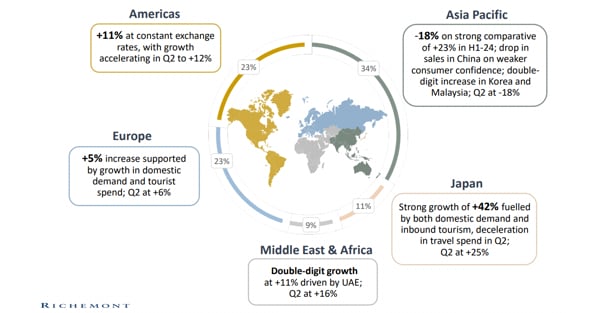
Sales growth in the US, Europe and Japan was offset by an 18% drop in the Asia-Pacific region, including China, where sales fell 27%. President Johann Rupert said that the recovery of Chinese demand for luxury goods will take longer, particularly affecting the watch segment.
Sales of luxury watches contracted 16% during the period, a decline that exceeded analysts' forecasts. Jewellery sales, on the other hand, met estimates, growing by 4% at constant exchange rates. The company also pointed out that limited price increases were not enough to offset the rising costs of raw materials such as gold.