
Rick Owens between classicism and subversion
The designer's AW 26-27 collection is brutal and rugged, with a rough beauty that does not conciliate but incites confrontation
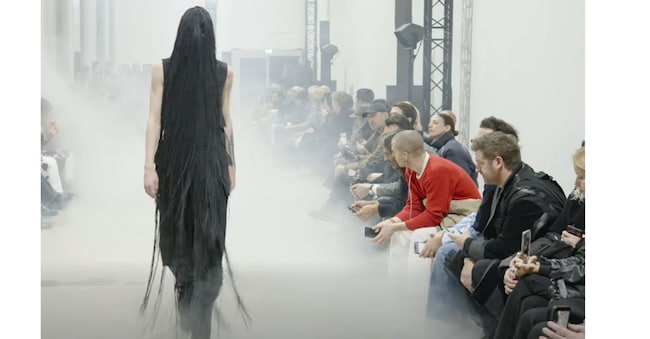
In spite of the galloping homogenisation, there is no shortage of authors in Paris, each with a very personal point of view, each with his own idea of the masculine. We are seeing them in these days of fashion shows. After the Tatlinian and expressionist explosions of last season, fresh from the successes of the Temple of Love show, Rick Owens reduces the theatre and increases the sense of reality - his reality, let's be clear: brutal and blunt, of a rough beauty that does not reconcile but incites confrontation. The rehearsal is entitled Tower and indeed towering is the most apt adjective to describe the irremissibly vertical silhouettes, made even longer by the extremely high heels and wedges, but also evident in a central passage that, surprisingly, involves bare calves and shoes that are just off the ground.
Owens does Owens, always and in any case: he has a sign of absolutist strength that advances by millimetric leaps. This season, everything seems particularly compact, cohesive, functional, with a hint of punk that dirties and reminds us how Owens balances between classicism and subversion.
On its third release, IM Men, the project led by the trio composed of Sen Kuwahara, Yuki Itakura and Nobutaka Kobayashi, appointed to represent the world of Issey Miyake on the Parisian men's fashion catwalks, strikes a particularly convincing balance between abstraction of form, extension of textile research and concreteness of use, moving intelligently from the maison's inestimable heritage - at Miyake the archive is as alive as ever, a place of preservation and experimentation - towards new destinations: light but thoughtful, ancestral and futuristic. These are multifunctional clothes that rewrite categories in the name of the only true character that defines the contemporary: nomadism, a condition of thinking even before existing.
Kartik Kumra is only at his second Parisian show with his Kartik Research label, but he is establishing himself as one of the most interesting new designers on the international scene. He combines infinite grace and thoughtful lightness, a sense of colour, a taste for pure form and the exquisiteness of Indian decoration. His fashion is gentle, but it has character, and is not reminiscent of anything already seen, which is not a secondary aspect.
Julian Klausner is also a champion: without too much fanfare or overstated protagonism, he continues to stamp his mark on Dries Van Noten, faithful to the brand's identity but capable of refreshing the formula in ineffably. This season follows an exciting narrative thread, expressing itself in a dry rather than sentimental manner - therein lies the difference. Imagine the moment when you leave home to embark on new adventures, or to go to university, and you take with you clothes that are friends, souvenirs, good luck charms. It mixes capes, kilts, long, tight coats, sweaters of all kinds, boarding school blazers, leather jackets, with exquisite taste. It is to all intents and purposes grunge: painterly and spontaneous rather than dirty and slabby, and the result is exhilarating.

