
Rimini lifeguards strike, one hundred parade along the beach
Service suspended for the entire shift
3' min read
Key points
3' min read
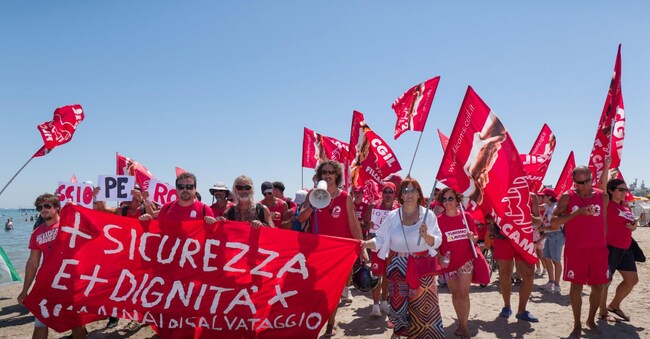
On Saturday 9 August, on the weekend before the mid-August holiday, Rimini lifeguards will strike for their entire shift, leaving the beaches without their 'baywatchers' on their towers and parading along the Romagna beach, from bathing establishment 36 to Piazzale Boscovich overlooking the port.
A mobilisation to protest against the organisation of work during the lunch break during which the lifeguard (as it is technically defined on the Rimini coastline) has to check 300 metres of beach against the 150 of normal service. The demonstration, explained the Flcams-Cgil organisers, aims to demand greater safety, but also more rights for those who guarantee the safety of bathers every day during the summer.
Red flags, red T-shirts and red shorts like the rescue uniform, they unfurled a banner at the foot of the anchor symbolising the sea which read 'More safety and more dignity, the rescue sailors go on strike'. A parade in the midst of bathers and a crowded beach. "Today they tried not to let us go on strike," said the organisers, "but instead we have put a stop to it. Today's strike has not been called off, but we have been pre-empted'.
"Lifeguards precepted" but the Prefecture of Rimini denies it
On the eve of the protest Filcams-Cgil had spoken of a precept for about 200 workers. However, this was denied by the Prefecture of Rimini, which recalled that it had merely requested that the minimum essential service be guaranteed during the strike. Moreover, the Prefecture also pointed out, the same CGIL-Filcams, when it announced its intention to go on strike on 10 July, cited the resolution of the Guarantee Commission that establishes the minimum essential services to be ensured in the public rescue service in the event of a strike.
The presidium halved during the lunch break
.The protest and the union's stance are linked "to the dispute" that for a couple of seasons "has been affecting bathing safety on the coasts of the province of Rimini, in the deafening silence of politicians and public administrators". In particular, it is pointed out, "for the last two years, to give the appearance of greater safety, the service break in the central hours of the day has been eliminated, i.e. from 12.30 to 14.30, the hours also used for lunch, "but only guaranteeing a halved presence. Each lifeguard thus finds himself having to watch over twice as much water, 300 metres instead of the 150 normally provided, with obvious risks to the safety of bathers and rescuers'.

