
Rio nell’Elba rediscovers St Augustine’s *Lectio*
The 10th-century parchment that has reignited the debate over the Commentary on the Psalms is on display

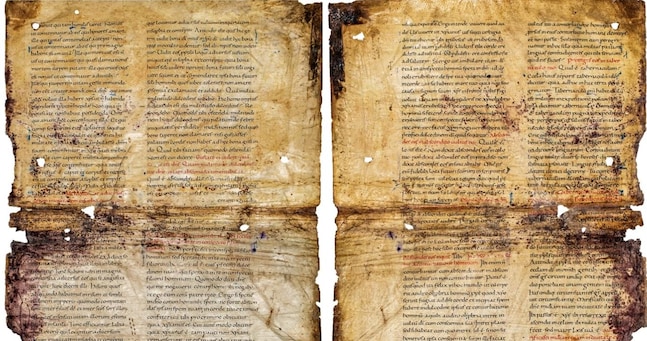
A discovery made in a remote municipal archive on the island of Elba has helped to rewrite a passage from the manuscript tradition of Saint Augustine and continues to this day to represent one of the most emblematic examples of the historical and scientific value preserved in local archives. From the outskirts of the empire to the heart of Europe, the Municipality of Rio has placed a faithful reproduction of the parchment fragment on permanent display; it will be presented and discussed during the twelfth edition of the Elba Book Festival. Its display in a glass case within the Cathedral of Saints James and Quiricus the Martyrs will be unveiled immediately after the round-table discussion. The story began in the autumn of 1991, when the mayor of Rio nell’Elba, Franco Franchini, took the German professor Peter Zahn and his son Philipp to the Municipal Historical Archive to show them one of the most precious documents preserved by the Elban community, the Statuta Rivi.
Praise from Pope Benedict XVI
Whilst examining the volume, Zahn was immediately drawn to two parchment flaps reused in the binding of the manuscript, instantly noting “their beauty, antiquity and uniqueness”; what appeared to be a mere structural component of the compendium would prove to be a crucial semantic turning point. A turning point that even Pope Benedict XVI endorsed in a letter, dated 16 June 2018 – which had remained in a drawer for far too long – in which he commended the scholar’s work: “Thank you for your important work”. Exactly thirty-five years after the discovery, the significance of the parchment appears even more striking; one need only consider the reinterpretation of Augustinian spirituality that Pope Leo XIII recently advocated in his latest encyclical, ‘Magnifica Humanitas’. The Pontiff, in fact, urges us not to delegate our discernment to technology – and in particular to artificial intelligence – lucidly highlighting the need to safeguard personal dignity and collective memory against all forms of algorithmic reduction. The Church, His Holiness affirms, must remain “on a journey through human history”, reconciling the dialogue between wisdom and knowledge without losing sight of the primacy of the human.
Inside the Exhibitions on the Psalms
Research continued and led to the text being identified as part of the *Enarrationes in Psalmos*, St Augustine’s *Commentaries on the Psalms*, which influenced the whole of Western Christian literature. The fragment, dating from the 10th century and written in Carolingian minuscule, was immediately recognised as being of palaeographic and philological interest. Among the most significant passages is a textual variant unknown to the main modern editions of his treatises. It reads: “Ubi est Deus vester? Quid colitis? Quid videtis? Creditis et ambulatis, certum est quod laboratis”. Which Zahn translates as: “Where is your God? What do you worship? What do you see? You believe and walk your path (towards God); it is certain that you labour, you suffer”. For centuries, the passage had been handed down in the form “creditis et laboratis”; whilst the discovery in Rio proved decisive in demonstrating the authenticity of the reading “creditis et ambulatis”. It is no coincidence that the expression “believe and walk” relates to the symbol chosen by Benedict XVI for his papal coat of arms: the shell, which evokes the legend of Augustine.

