
‘Road haulage: with the ETS2, diesel is 40 cents more expensive’
President Russo: the new European tax risks causing the system to collapse

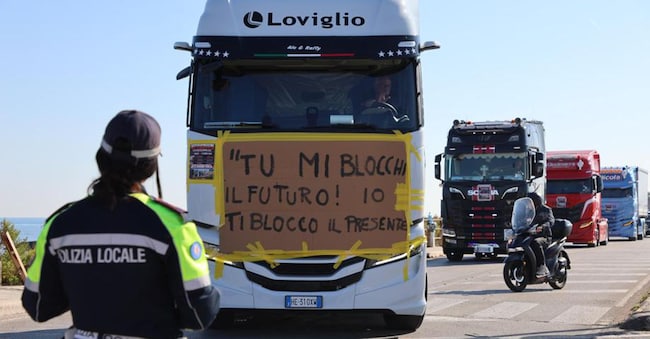
Freight transport cannot be left to face this storm alone, which combines high fuel prices, rising energy costs, a shortage of drivers, geopolitical crises and infrastructure under strain. In the case of road haulage, the price of diesel ‘has already risen by more than 50 cents per litre since the start of the US-Iran conflict’. With diesel approaching 2.3 euros per litre at self-service motorway service stations and reaching peaks of 2.257 euros per litre on the general road network, one in five companies risks going bankrupt by the end of the year, according to hauliers. The outlook is bleak. From 1 January 2028, the extension of the ETS2 to road transport ‘will cause further price rises of up to 30–40 cents per litre for diesel’. And if road haulage grinds to a halt, the entire economy will be thrown into crisis, given that in Italia around 90 per cent of goods are transported by road.
Pasquale Russo, president of Conftrasporto-Confcommercio, says: “What is at stake,” he warns, “is not just the survival of the national logistics sector. At stake is Italia’s ability to ensure the supply of industrial supply chains, safeguard the competitiveness of businesses and remain connected to European and international markets.” This is the appeal that Russo will make at the 11th Conftrasporto-Confcommercio International Forum, scheduled for Wednesday 21 October in Rome.
Meanwhile, the government is stepping up its efforts. Today, Tuesday 20 October, the Minister for Transport, Matteo Salvini, will meet representatives of the road haulage sector at an emergency summit at the Prefecture in Milan – a week ahead of the official round-table meeting convened by the Ministry of Infrastructure and Transport (MIT) for 27 October in Rome. Russo comments: “We hope that the meeting with Minister Salvini will yield concrete and immediate responses to the difficulties facing the road haulage sector, creating the conditions for the swift removal of the blockades and the restoration of the normal distribution of goods.”
The president of Conftrasporto continues: ‘The sector is facing a serious liquidity crisis, with fuel now accounting for over 40 per cent of companies’ overall costs. At the summit on 22 May at Palazzo Chigi, the government had guaranteed companies a series of support measures, amounting to over 400 million euros. However, to date, road haulage companies have not yet received any financial relief due to bureaucratic complications. Meanwhile, the diesel crisis is worsening, and a further 40–50 million euros would be needed to cover the additional costs for November and December. The spontaneous protests of recent weeks, which are paralysing southern Italia, make the situation even more worrying, as they indicate that business owners are being driven to desperation.
The other flashpoint is the standoff with Europe over the ETS (Emissions Trading Scheme), the European mechanism governing the trading of CO₂ allowances. Russo says: ‘The ETS system, created to encourage independence from fossil fuels, has proved to be utterly harmful, as it damages Italian industry and transport without delivering the expected benefits in terms of decarbonisation. In the case of maritime transport, the result of the ETS – which is, to all intents and purposes, a tax borne by shipowners – has been the collapse of the ‘motorways of the sea’ and the return of freight to the roads’. The most sensitive issue, however, remains the application of ETS2, from 2028, to buildings and road transport, with direct effects on households and consumption.


