
Roadblock case goes to the Constitutional Court: penalty deemed too harsh
The investigating judge in Turin has accepted the Public Prosecutor’s position. Possible misuse of the decree

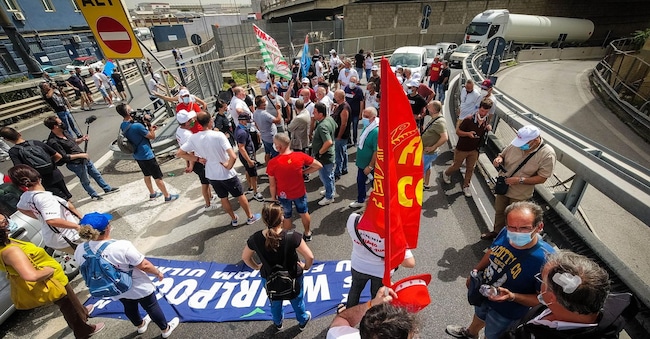
Issues of form and issues of substance. The Preliminary Investigating Judge in Turin, granting the Public Prosecutor’s requests, has decided to raise the issue of constitutional legitimacy regarding one of the most controversial provisions of the 2025 Security Decree, namely the one that imposes criminal penalties roadblocks. Thus, Order 16522/2026 challenges, first and foremost, the failure to comply with the limits on the use of emergency decrees: indeed, the decree-law – whose content largely mirrors that of the bill then under discussion in Parliament – does not appear to have been adopted to respond to an extraordinary and unforeseen situation, but rather to convert a bill already under consideration by the Houses into a source of law with immediate effect.
The abuse of decree-making
In this way, the investigating judge emphasises, the procedure provided for in Article 77 of the Constitution risks being used to replace the ordinary legislative procedure rather than to deal with exceptional circumstances. Moreover, the conversion bill is subject to the constitutional 60-day time limit, a circumstance which inevitably affects the timing and procedures of the parliamentary debate.
Physiological block
On this point, the order notes the possibility that, during a demonstration, there may be traffic delays or temporary disruptions, a situation that is ‘naturally linked to the exercise of the freedom of assembly in a public place, both in static demonstrations, such as sit-ins, as well as in dynamic ones’. Freedom of assembly, in fact, is not limited to the mere collective and simultaneous presence of several people in a given place, ‘but encompasses the possibility that the demonstration may be organised in a manner that is effectively suited to making the collective message perceptible. It follows that the temporary disruption to the free flow of traffic may constitute a normal, and not necessarily pathological, consequence of the exercise of the right guaranteed by Article 17 of the Constitution’.
Conditions of illegality
Not every disruption or obstruction of traffic can therefore automatically be equated with conduct found to be unconstitutional. A distinction should be drawn between the ordinary disruption caused by the holding of a demonstration and independent conduct that is intentionally and specifically aimed at paralysing traffic to a disproportionate extent, for a prolonged period or in a dangerous manner. The Security Decree, on the other hand, punishes anyone who obstructs free movement on ordinary roads or railways, by obstructing it with their own body, providing, if the offence is committed by a group of people, for imprisonment for a term of between six months and two years without any explicit criteria to allow for the grading of the criminal severity.


