
Robots in factories, challenges and rules of the new humanoids
.

3' min read
3' min read
The moment when in factories we will see robots like those of Boston Dynamics or start-ups like Sanctuary AI, similar to humans, and in addition capable of reasoning with an autonomy like that of the most advanced generative artificial intelligence bots, is just around the corner.
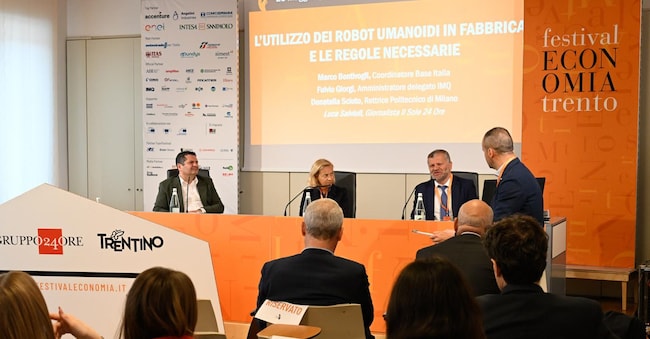
"If today an AI agent is able to compete with the cognitive capabilities of a human being, paradoxically a robot has difficulty performing manipulation tasks that are within the reach of a child. The point is that when AI has to come to terms with physical reality, the gap that the technology shows with respect to human capabilities is still significant,' explained Donatella Sciuto, Rector of the Politecnico di Milano, among the speakers on the panel 'The use of humanoid robots in the factory and the necessary rules' at the Festival of Economics currently underway in Trento.
But if robots based on artificial intelligence are the next frontier, the manufacturing industry has been using automation for many years, and in this Italy is the sixth largest market in the world, the second largest in Europe (World Robotics 2023). "The history of robots is very long. The application of humanoid ones is still partial even if there has been an acceleration,' comments Marco Bentivogli, coordinator of Base Italia, former leader of Fim Cisl. 'Robots are very good for work, just think that the countries furthest ahead in robotics are those with the lowest unemployment rate. Today the most valuable things from a professional point of view are left to the human. For example, there are many girls in metalworking companies in assembly, because the robotics part cancels out the most tiring part. Innovation in these cases wears out those who do not do it. Technophobia is stronger the further you move away from a factory. There they are happy for machines to come in'.
Fulvio Giorgi, managing director of Imq, a conformity assessment company, gives an overview of the rules: 'In the more traditional field of robotics, the rules are well defined, albeit evolving. The second area, that of Ai, on the other hand, is somewhat less defined and above all characterised by very rapid developments, which the rules struggle to keep up with. Here the effort is to build trust in Ai, to ensure its reliability and social acceptance. The third level is that of anthropomorphism: in this case there are no specific regulations or standards, other than those referring to the safety of the materials used to give the robot a human appearance'.
On the subject of training, Donatella Sciuto observes how the development of these complex technological platforms requires engineering skills of the highest level: 'The expert must be able to dialogue with those who have in-depth knowledge of adjoining disciplines, in order to grasp the consequences of individual design choices: legal, ethical, socio-economic aspects.


