
Robots and sensors for the over-50s: the model for an ageing workforce
These are collaborative robots that do not have the safety barriers found on traditional industrial robots; these have been replaced by sensors that stop them in the event of a risk, and they are capable of slowing down when the operator shows signs of fatigue

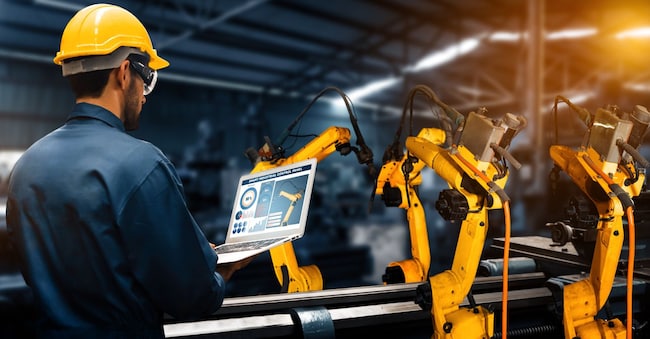
On a production line in Cittadella, it is no longer the operators who have to adapt to the robots’ pace, but the other way round. This is the principle behind CoAdapt, the project funded by the European Union through Horizon 2020, which has led BNP – a company specialising in ergonomic solutions for industrial production – to develop, in collaboration with the University of Padua’s Lab Village, cobots – collaborative robots without the safety barriers found on traditional industrial robots, which are replaced by sensors that stop them in the event of a risk – capable of slowing down when the operator shows signs of fatigue.
A second project, funded by the Veneto Region and currently in its start-up phase, will extend the research to humanoid robots, which are capable of replicating the movements of the human body and moving autonomously through space.
The response to the rising average age in companies
These solutions, which have already been adopted by companies in the automotive and household appliances sectors, have been developed to address a demographic challenge: the rise in the average age within organisations, a consequence of the demographic winter and the trend towards later retirement.
“The demographic winter and the trend towards later retirement have led to a rise in the average age within companies, with positive consequences – such as greater experience amongst staff – but also negative ones, linked to the physical strain on workers, who often face limitations on their work, sometimes even certified by medical prescriptions,” explains Carlo Pettenon, CEO of BNP.
“Thanks to our collaboration with the iNest Consortium, and in particular with HtLab at the University of Padua, we have designed innovative production lines that turn the traditional paradigm on its head: people set the pace and the robots adapt.”

