Hospitality

Rochon’s pencil redraws the Danieli

The renowned designer breathes new life into the history of the iconic hotel, now part of the Four Seasons collection

Il nuovo volto del Danieli

5' min read

Translated by AI
Versione italiana

5' min read

Translated by AI
Versione italiana

It is Venice’s salon, which once hosted George Sand, where Balzac wrote impassioned letters and where Casanova — who was a regular at Palazzo Dandolo, the hotel’s oldest section — lived out his adventures. The Danieli is a place steeped in history, having gathered for over seven hundred years stories of different eras and souls, all housed within three buildings overlooking the Grand Canal. And in the coming weeks, it is reopening with a new look.
The famous Venice hotel is being reborn under the Four Seasons banner, with the creative touch of Pierre-Yves Rochon, the French designer who has reimagined its very essence. Rochon has already made his mark in Paris, from the Ritz to the Crillon and the Four Seasons George V, as well as at the Four Seasons in Milan. The Danieli will be the fourth Four Seasons in Italia, following Milan, Florence and Taormina.

Loading...

“I’ve been fortunate enough to work on a number of hotels that are described as iconic,” says Rochon in this exclusive interview. “Generally speaking, these are restoration projects, because these hotels have a long history behind them. When I’m asked to work on a place with a significant history, what matters is respecting it. You mustn’t approach it with the ‘wow effect’ in mind or follow the latest trends. What matters is the legacy, the heritage. In Europe, and especially in Italia, the true value lies in savoir-faire.”
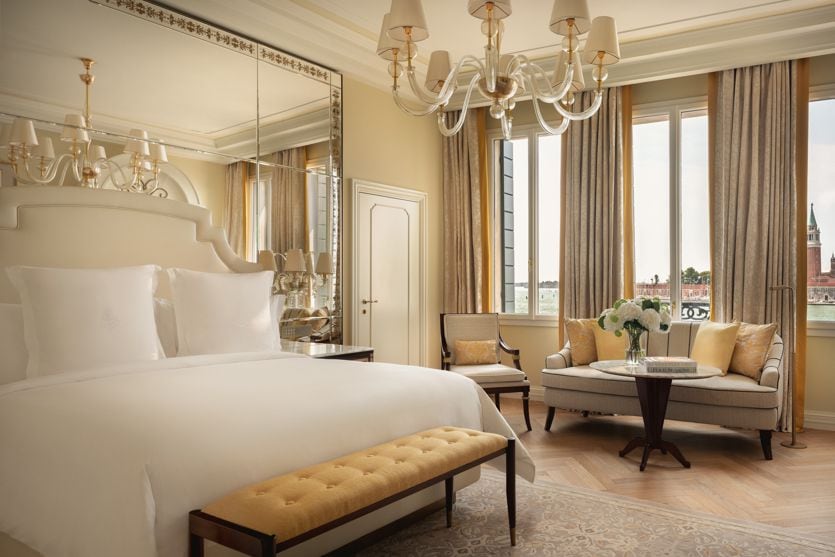
Casanova, it is said, used to vanish at dawn from Venetian palaces without a trace. Rochon did the opposite: he tiptoed in and left everything exactly as it was. Making the whole scene all the more luminous.

Born in Brittany in 1946, he founded his practice in Paris in 1979 — now part of the American group Perkins&Will — and, over a career spanning more than fifty years, Rochon has designed some of the world’s most famous hotels, working for major international luxury brands (including Four Seasons, Ritz-Carlton, Waldorf Astoria, Fairmont, St. Regis and Shangri-La) and has designed restaurants for chefs such as Joël Robuchon, Alain Ducasse and Jean-Georges Vongerichten. In 2025, he was inducted into the Interior Design Hall of Fame.
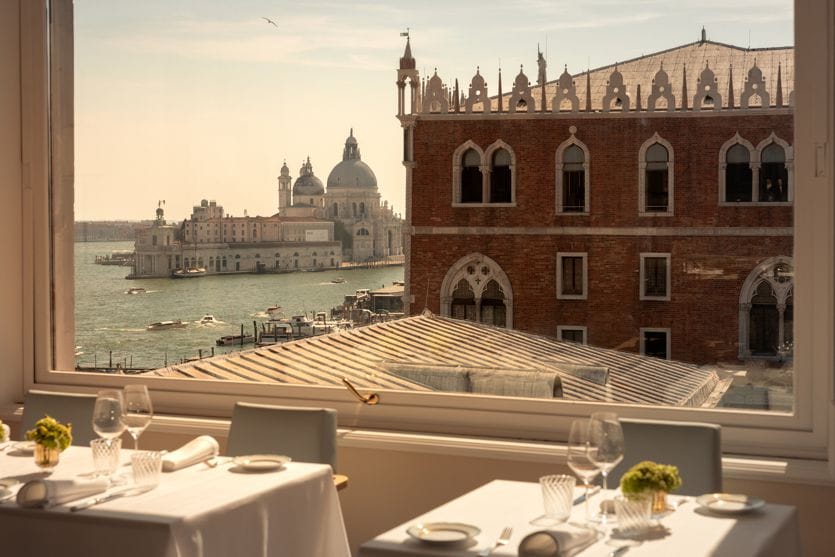
In Italia, the most famous project – prior to the Danieli, which celebrated 200 years of hospitality in 2022 – is the Four Seasons in Florence, housed in a 15th-century palace. With the Danieli, however, the collaboration dates back to the period between 2008 and 2012, when he designed the hotel’s most iconic suites. This time, the project was more far-reaching, as Rochon not only had to rethink the spaces and volumes but also find colours that would give the hotel a modern and fresh feel. ‘You have to study, observe, be curious and understand the history of Venice. You need to work out whether, over time, some of that Venetian spirit has been lost in these grand hotels, and try to bring it back to life.’

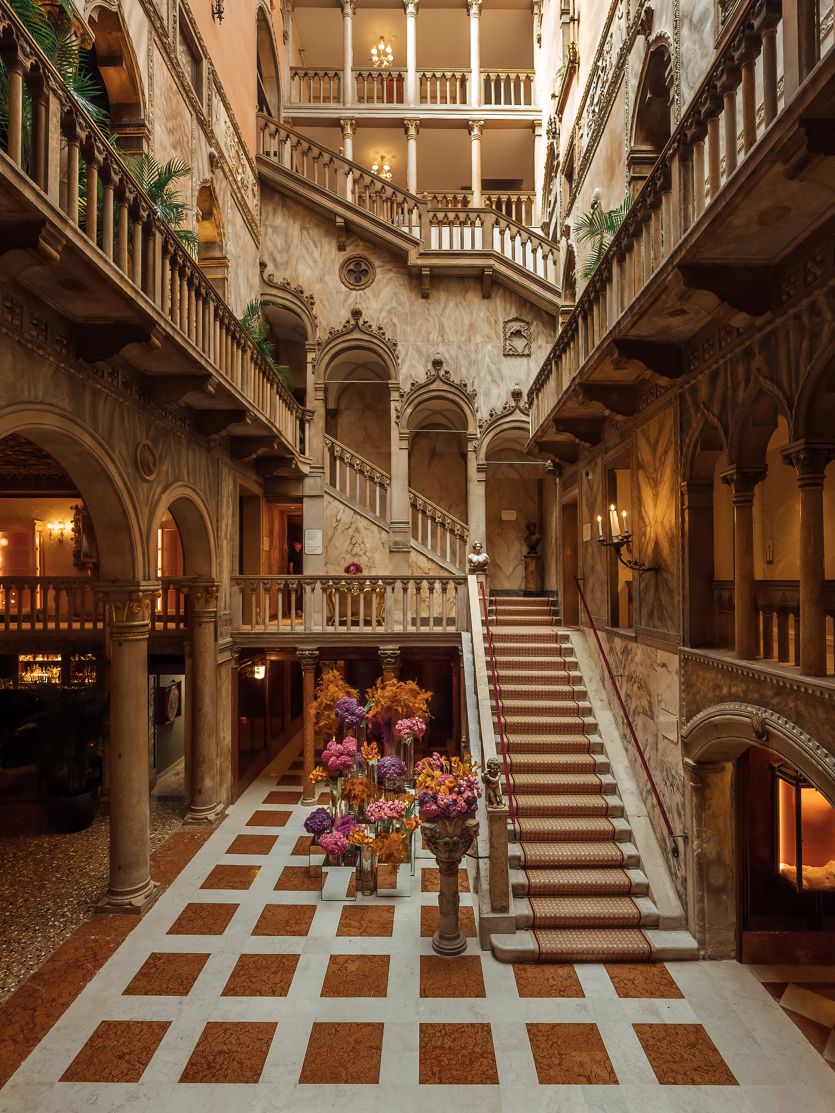
The Danieli comprises three interconnected buildings: Palazzo Dandolo, the oldest; the Excelsior wing, which dates from the 1930s and 1940s; and a third section that completes the complex. But it was the grand, monumental staircase that Rochon felt he had to preserve above all else. ‘Everyone knows it,’ he says. ‘When you arrive at the Danieli, it’s the first thing you see. It’s theatrical, spectacular.’ The staircase has remained intact. What has changed is the function of the surrounding spaces: the reception, which was previously wedged beneath the grand staircase and detracted from its grandeur, has been moved to a more intimate and refined room. The bar has remained in its original place. The entrance from the water has been redesigned, as most guests now arrive by water taxi. Rochon is keen to emphasise that many original elements have been reused, even if they’ve been moved to ensure respect for the past. He goes on to share an anecdote. ‘You know, I also designed Palazzo Parigi in Milan, which features in the film *The Devil Wears Prada*. There’s a grand staircase there too, and the client told me at the time: “Don’t copy the Danieli, but take inspiration from its extraordinary staircase. It’s theatrical, spectacular.”’

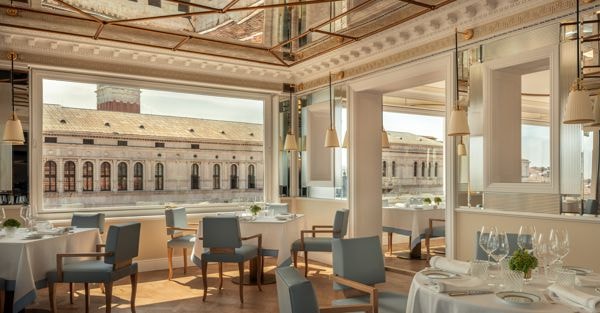
The colour palette is entirely Venetian and draws inspiration from Murano glass and the colours of the lagoon. ‘When you look at the Grand Canal, you see blues, reds and golds. We took our inspiration from the blue of the canal and the sky. In the hotel, we’ve worked with golden tones, inspired by Murano glass and those crystalline reflections,” he explains. In the grand lobby, Murano chandeliers adorned with flowers — in blue, pink, aqua and yellow — set the tone for the colours of the armchairs and fabrics. Up above, on the restaurant terrace—a space not subject to heritage restrictions, which allowed for greater creative freedom—the blues of the Grand Canal blend with the reds and golds of the Venetian sunset.

The rooms are bright, with large windows and mirrors that bathe them in soft, soothing colours.

Even the materials have a Venetian feel. Rubelli, the city’s historic textile manufacturer, “plays a major role in the project,” says Rochon. “We’ve carried out research and I believe we’ve also produced reissues of historic fabrics.” Engraved mirrors, Murano glass, restored and repositioned period furniture, Barovier for the chandeliers, as well as Arte Veneziana and Viamancinelli, make up the glassware and lighting elements. ‘For the furniture, we’ll be featuring Medea, Poliform, Pozzoli and Salda,’ he says. ‘We’ve lightened the overall look without making it too heavy. We’ve tried to eliminate the dusty feel, without, however, erasing the history.’

Loading...

Pierre-Yves Rochon

For Rochon, luxury is not about gold. ‘Luxury isn’t gold and silver; it’s the quality of life. In many settings, what brings satisfaction is the view of the Lagoon. I didn’t need to add gold.’ And he adds: ‘I don’t want to be trendy.’ A philosophy that can be summed up in a single word. “Uniqueness. First and foremost, it’s a hotel in Venice. And that’s fundamental. We must never forget that it remains a hotel: it must function properly, welcome guests warmly and be successful. But the Danieli isn’t a newly built resort; it’s a historic palace on the Grand Canal, featuring 15th- and 16th-century architecture. That’s why it’s essential not to get the approach wrong.” On the one hand, therefore, artistic respect for the site; on the other, functionality: this approach has guided the redesign of the rooms and spaces.

Il nuovo volto del Danieli

The Danieli has always been famous for its terrace as well. “It’s a sublime terrace, where the restaurant is located,” he continues. “That space wasn’t listed as a historic monument, so we were able to carry out some work on it, restoring its colour. And we added mirrors. So that you always feel surrounded by Venice.”

That is precisely the point: ‘We are in Venice. Not in Milan, not in Florence. Every city has its own language,’ concludes Rochon.

Copyright reserved ©
  • Paola DezzaCaporedattrice del Lunedì e responsabile del settore real estate per tutto il gruppo

    Lingue parlate: inglese, francese

    Argomenti: mercato immobiliare, architettura, finanza immobiliare, lifestyle, turismo, hotel e ospitalità

    Premi: “Key player of the italian real estate market” di Scenari Immobiliari

Loading...

Brand connect

Loading...

Newsletter RealEstate+

La newsletter premium dedicata al mondo del mercato immobiliare con inchieste esclusive, notizie, analisi ed approfondimenti

Abbonati