
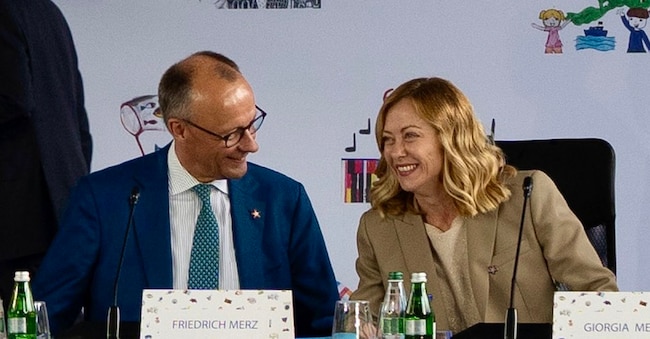
Rome-Berlin, evidence of harmony: what Meloni is playing for today in her meeting with Merz
At the centre of the face-to-face meeting between the Italian Prime Minister and the German Chancellor, who is arriving in Rome to attend the enthronement of Leo XIV, are first and foremost: tariffs, the rearmament plan and immigration

3' min read
3' min read
The denial of Italy's exclusion from Germany's strategic partners in the government pact between Cdu/Csu and Spd revealed by the Welt in recent days has certainly helped. And it is more than likely that there will be a further 'deepening' during the meeting at Palazzo Chigi between Giorgia Meloni and Friedrich Merz. But at the centre of the face-to-face meeting between the Italian Prime Minister and the German Chancellor, who is arriving in Rome to attend the enthronement of Leo XIV, there are first and foremost: duties, the rearmament plan and immigration.
The car sector
.The collaboration between Italy and the new Chancellor is intense and began even before Merz took over as head of government. Meloni confirmed this publicly a few days ago during question time in Parliament, emphasising how Italy and Germany - 'the two main European manufacturers' - can together make 'a concrete contribution to the relaunch of our industrial base, first and foremost the automotive sector'. And indeed it could not be otherwise given the almost inseparable link between German and Italian industry, which are also the countries most at risk of being penalised by the trade war declared by Donald Trump. It is no coincidence that the confrontation/clash with the tycoon has moved in the same register. The objective of both is to find an understanding with the US administration. But not only that.
The Green Deal
.Both Germany and Italy are convinced that some of the rules brought forward in the last parliamentary term by Brussels on the Green Deal, those 'internal tariffs that undermine European competitiveness', summarised the PM. Something is moving, see the postponement of fines on car manufacturers brought forward by Commission President Ursula von der Leyen herself. The other hot topic - as already mentioned - is the rearmament plan.
The rearmament plan
.Berlin was among the European partners that most pushed for the possibility of suspending the Stability Pact constraints on defence spending by adopting the safeguard clause. A choice that instead Rome (despite having proposed it several times) has not welcomed with enthusiasm, so much so that Italy is among those countries that have not presented the request for suspension to Brussels. The choice, however, is only postponed until the end of June, when the NATO summit will be held at which the new expenditure ceiling to be reached will be made official. Trump's US is asking for 5 per cent, Italy will come to The Hague with 2 per cent, which also includes spending on the coast guard. Meloni, however, is aware that the accelerator must be pushed. The risk of marginalisation both from the main European partners and from the US administration itself is real. So are the repercussions on the Italian war industry and not only, given the possible reconversion of production in Germany. The Italian government, however, is aiming at greater European involvement on the financial front, borrowing what happened at Covid with Nex Generation Eu. A hypothesis that has so far been rejected. And among those opposed is Merz's Germany. However, the need to accelerate could also induce the Chancellor to consider a rapprochement.
The immigration dossier
As for the immigration dossier, here the positions are now almost overlapping. Merz - also thanks to the rise of the Afd far-right - has taken the hard line both on entry into Germany and on repatriations, including the idea of examining asylum applications in third countries.


