
Rome's waste-to-energy plant site kicks off: first waste delivery in September 2029
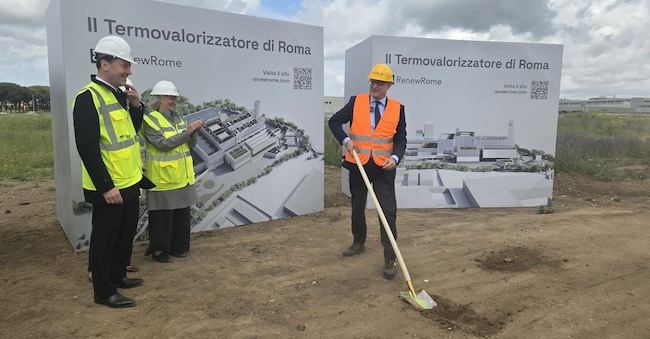
The inauguration of works in the Santa Palomba area with mayor Gualtieri and Acea's managing director Fabrizio Palermo

Key points
- Gualtieri: "The most modern and advanced in Europe"
- In the field the grouping of companies led by Acea Ambiente
- For Rome goal self-sufficiency
- Lower charges of 40 million per year
- Palermo: "Integrate the best engineering solutions"
- A Circular Resource Park
- Anchillary facilities
- Energy for 200,000 households
- Environmental monitoring
Armed with spade and helmet, it was mayor Roberto Gualtieri who this morning inaugurated the site for Rome's waste-to-energy plant in the Santa Palomba area with the first excavation. Next to him was Acea's CEO, Fabrizio Palermo. The investment is worth €1 billion and will allow the treatment of 600 million tonnes per year of undifferentiated and non-recyclable waste. The first delivery is scheduled for September 2029.
Gualtieri: 'The most modern and advanced in Europe'
The venture to equip the capital with a waste incineration plant, which Gualtieri defines as 'the most modern and advanced in Europe, ultra-safe, non-polluting, constantly monitored, equipped with the most advanced technologies available today, and built according to even stricter environmental standards than those required by European regulations, so as to guarantee the highest level of environmental protection,' is now in full swing.
The grouping of companies led by Acea Ambiente is in the field
Also present at the start of the work were Sabrina Alfonsi, councillor for Agriculture, Environment and Waste Cycle of Roma Capitale, Acea president Barbara Marinali and Barbara Maccioni, managing director of RenewRome, the project company set up by the grouping that won the contract, composed of the companies Acea Ambiente, Suez Italy, Kanadevia Inova, Vianini Lavori and RMB.
For Rome, self-sufficiency objective
That the work is strategic is beyond doubt: according to the plan launched by Gualtieri, the plant will allow Rome to close its waste cycle in a stable, efficient and sustainable manner, in the hope of archiving the crises and controversies that have cyclically marked the history of recent years. "With the waste-to-energy plant," emphasises Gualtieri, "the capital will no longer depend on landfills or plants located elsewhere, in Italia and abroad, definitively overcoming a condition that for too long has produced unacceptable and unsustainable economic and environmental costs.
Lower charges of 40 million per year
Once fully operational, the waste-to-energy plant will be able to treat 600 million tonnes of mixed waste each year. The first delivery is scheduled for September 2029, full operation in 2030. The lower costs for delivery and transport are estimated at EUR 40 million per year.


