
Roman sensuality at Fendi; Jil Sander: delicate yet strong
At Antonio Marras’s fashion show, Giovanni Raspini’s jewellery takes centre stage, Etro remains a free spirit, and Missoni’s sparkling desert
by Angelo Flaccavento
 Aggiungi Il Sole 24 Ore
ai preferiti su Google
Finding one’s own voice within a pre-defined framework is a central theme in today’s fashion world, which consists largely of designers working for, and creative directors working on behalf of. The work on identity thus becomes a dialogue and a process, and in some ways, a never-ending one.
Simone Bellotti, from Jil Sander, uses a psychoanalytical metaphor: ‘Creating a collection is like going to therapy: you take things apart to understand what you want to keep. Then you put them back together again.’ This is Bellotti’s third collection for the house known for its precision and vibrant rigour, where subtraction adds aura and power, and it is the one in which his vision, whilst respectful and diligent, finally deconstructs the system.
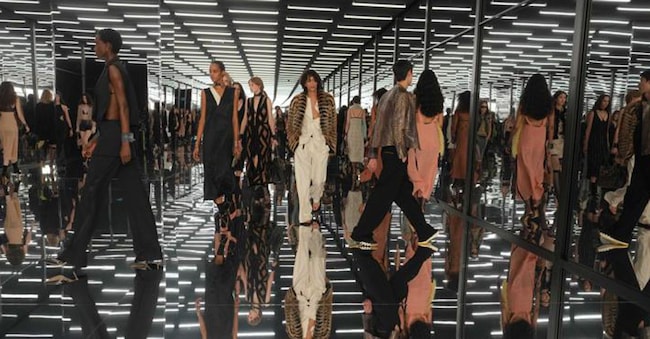
Now you can really hear her subversive, penetrating whisper – subtle yet constant. The fashion show, held in Jil Sander’s usual venue (now part of OTB) but with the seating crammed together to create narrow aisles that push the audience close to the catwalk, almost within touching distance of the garments, opens with a long section that pays homage to the brand’s signature style, lingering on the clean-cut, protective tailoring with its Protestant flavour, and then it unravels.
It is fascinating to follow Bellotti as he pursues his aim: to dismantle the perfection of the uniform in order to find strength in imperfection and fragility, without, however, going over the top. The result is convincing. The silhouettes are not always straightforward or immediately accessible, but the garments possess energy and convey the thinking behind them without appearing unnecessarily conceptual.
Maria Grazia Chiuri, too, of Fendi, is currently in a phase of exploration. The search for a balance between her personal stylistic signature – which tends towards the understated and even austere, somewhat reminiscent of a fashion nun, a schoolgirl or a woman who loves to dress like a man – and the house’s exuberant use of materials and Roman spirit – so wild and free from convention – is still in a phase of settling in. However, whilst last season, for her debut, it was rigour that emerged, and with it black as an unexpected signature colour, this time Chiuri starts afresh with the body – and consequently with lingerie – and discovers a welcome sensuality, steeped in the unbridled spirit of the 1970s without the clichés of sexual liberation, yet without abandoning black. The result is focused and resolute.

