Rome as you've never seen it: an anthropological atlas by Albert Watson
The greatest photographer of stars and personalities turns his lens to the city. Eternal marbles and anonymous heroes, faces and monuments. Between Sorrentino, Zingaretti, the fans of the curva and the Colosseum.

6' min read
6' min read
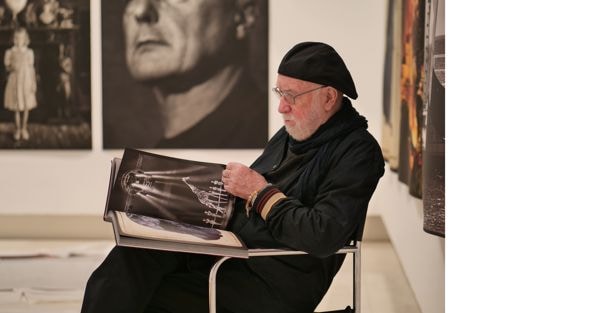
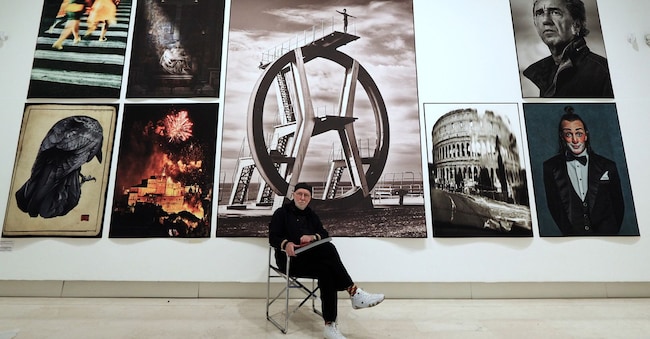
I have been called the photographer who has portrayed almost all the stars of our time. Actually, the stars who come to my studio are often my friends. I have photographed many of them many times, we work quietly, we have lunch together, we chat'. So Albert Watson tells me, as we walk among dozens and dozens of his monumental photographs hanging on the walls. We are in the rooms of the Palazzo delle Esposizioni in Rome, where the images make up the Roma Codex exhibition, open to the public until 3 August. Rome was like another planet for him: empty streets, marble luminescent under artificial light, fountains suspended in time. A transfigured city, because it was between three and five in the morning that Albert Watson, for months, captured the secret soul of the Eternal City. "The steps of Trinità dei Monti were completely empty. Everything seemed slightly surreal. Rome at night is a place that only reveals itself if you have the patience and the right light to look at it,' he tells me. After a career spanning more than half a century, with countless covers for Vogue, advertising campaigns for Chanel, Prada, Levi's and posters for films such as Kill Bill and Memoirs of a Geisha, Albert Watson has also signed some images that have gone down in history: Alfred Hitchcock with a goose under his arm, Steve Jobs in his iconic black turtleneck, Kate Moss on a rooftop in Marrakech. And yet, at the threshold of his 83rd birthday, he remains more than ever a great photographer and above all a man driven by an inexhaustible passion for life and all things creative. So much so, in fact, that he was even awarded the Order of the British Empire by Queen Elizabeth II, an official recognition that rewards his extraordinary contribution to photography and visual culture in over half a century of activity.
Scottish-born and naturalised American, Albert Watson chose Rome as the setting for his latest photo project: the result of seven months of shooting and five of post-production, spread over four intense trips between New York and the Italian capital. During this time, the InterContinental Rome Ambasciatori Palace hotel became his second home. As a sign of gratitude, he donated some of his photographs to the hotel, two of which will be exhibited at the end of the show at the top of the grand staircase from the red carpet.

More than a visual diary, Watson's was a veritable anthropological atlas of a Rome not observed, but experienced: after the capital, the exhibition will travel to the United States, where it will land in Washington at the Kennedy Center, strongly desired by Paolo Zampolli, US Special Representative Ambassador for Global Partnerships. "I did not want to do a coffee table book on monuments. Sure, I photographed the Colosseum, but I was more interested in what goes on between the monuments. The bodies, the faces, the stories. I entered Rome through the back door, not the main hall'. A declaration of intent that becomes a key to reading: Watson seeks what escapes, what moves between one point and another, within the Rome of margins and contradictions. Among the most surprising stories is the woman of prey encountered in Cinecittà World. "All the Romans I told about her didn't even know she existed. Yet it was as important to me as the Colosseum. Maybe more: I have more photos of its birds than of the Flavian Amphitheatre'. The project is constructed in this way, by layers and contrasts. The young actors from the Academy and the 17-year-old dancers who grew up in the discipline. The drag queens from the Muccassassina nightclub and the AS Roma fans on the curve. "I was interested in showing the city suspended between history and hedonism. Between the eternal marble and the fleeting shadows of an underground disco'. Watson alternates between mass and solitude, the club crowd and the furtive kiss of a couple in the street, five thousand delirious fans and an anonymous face in the rain. "I wanted to work on multiplicity and singularity. Two people, eight, twenty, a hundred, a thousand. But also one. A child, a passer-by, then Paolo Sorrentino and Toni Servillo'.
Albert Watson creates a continuous dialogue between opposites: highly detailed, lenticular images, reminiscent of the obsessive precision of Flemish paintings, juxtaposed with more grainy, blurred photographs, like faded memories. This alternation is not random: it is a play of counterpoints, a visual music made up of themes that intertwine and separate. The confrontation of these two universes gives rise to suspended worlds, semantic drifts and musical escapes that involve the spectator in an open narrative without precise boundaries. Watson himself reflects on his personal history: "My father was a boxer, who later became a PE teacher. My mother was a hairdresser. There was already a dialectic between strength and grace in the family. I think this duality has entered my way of seeing and photographing the world'. But what distinguishes Roma Codex is not only the content. It is the form. Watson has a hybrid background, combining film and graphic design: he studied film directing and design at the Duncan of Jordanstone College of Art & Design in Dundee, Scotland, and then at the Royal College of Art. A dual visual matrix that is reflected in every shot. "For me everything always ends up inside a rectangle. Whether it's a poster, a magazine page or a photograph: everything is a rectangle. Inside, there is always a graphic composition. And also a direction. The subject is only the beginning'. In the exhibition, a head of Constantine dialogues with a packet of cigarettes crushed in the mud. A coin from 200 BC is juxtaposed with a contemporary Roman face. "I am interested in the combination of high and low levels. An iconic statue next to a banal, ruined object. Everything has value. Like in a language: you can say Shakespeare or you can say hello. It is the same grammar'. Spontaneity, for Watson, is a cultivated art. "At the beginning of my career I was trying to please. I once distorted an entire photograph to please an art director. It seemed like the right thing to do. But I soon regretted it. I never made that mistake again. Today, if I see something on the street, I shout "stop the car!". Because maybe two hours later, it will no longer be there'.
Instinct and rigour mix in his shots. "It's like going to the gym. At the beginning you hold ten minutes. After six months, an hour. That's how photography is. Instinct trains, like a muscle. But even after fifty years, you can still make mistakes. And sometimes, the mistake is a blessing. I remember one day, in Nevada, I accidentally took a back road. I found a billboard that said God Bless America. I came back at sunset, with the red sky blazing behind. Only the word God remained. That shot would never have existed without the mistake. Chance always plays a role'.