
Rome at Mipim in Cannes, on the hunt for investment
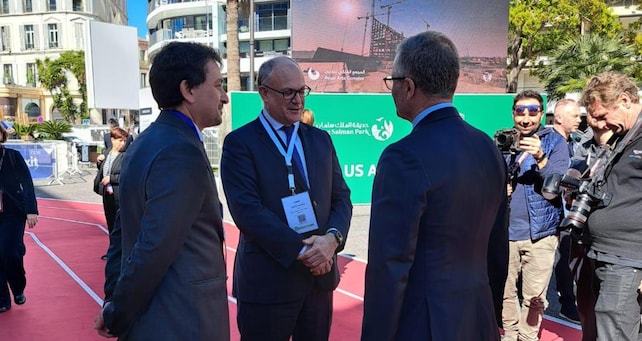
A delegation led by mayor Roberto Gualtieri and town planning councillor Maurizio Veloccia aims to meet capital and investors for projects ranging from student halls to urban regeneration

5' min read
Key points
5' min read
Rome the international capital, for its 477 offices or representations from around the world, but also for the presence of the first three major Italian industrial groups by turnover (Eni, Enel, Gse). Rome is a European city in the top positions for the housing market (Rome is the third city for residents in the European Union), and the second Italian industrial city after Milan, and still a city connected with the world thanks to its two airports (which make up the first Italian hub reaching 35.2 million international passengers in 2023) but also the port of Civitavecchia, sixth in the world for cruises. Rome has landed this year at the Mipim in Cannes, the real estate fair, with the Campidoglio as a protagonist: a delegation led by the mayor Roberto Gualtieri and the town planning councillor Maurizio Veloccia and with a pavilion dedicated to the eternal city that follows those of London and Paris, with one difference: Rome is once again telling its story to international investors and is doing so with its public policies, its construction sites that concern interventions in the squares and along the streets of Rome, but also with operations outside the centre, ranging from housing to services for the neighbourhood.
Yards
.It is an unprecedented tale that Rome, returning to Cannes, gives to the world. Discontinuous and innovative if you look at the utopian innovations of Neom's neighbours with the model of The Line, the ambitious challenges of a country like Oman, or if you walk among the stands of other European countries, where the meeting between supply and demand is set on targeted interests for urban transformation areas, changes of use and new developments. In general, as is increasingly the case at Cannes in recent years, there are few images and numbers, fewer renderings than a decade ago, and much networking. Appointments outside and inside the fair. "With its large amount of public and private investment in infrastructures and urban regeneration, Rome wants to return to the international stage in full force to stand as a candidate to become number one once again," said the mayor Roberto Gualtieri, in a speech at the capital's pavilion.
"After years of stagnation," explains councillor Maurizio Veloccia, "we want to recount the public interventions that we are carrying out, which serve to enable the attractiveness of Rome with respect to private investments, which will effectively contribute to the transformation of the city. Metro C is demonstrating how infrastructure can accelerate the valorisation of real estate, and induce regeneration. "We want to reiterate to investors that Rome has strong potential outside the historic centre. That this is the right time and the numbers are growing with a GDP that is double the Italian average. Also, that there is demand in the various asset classes, just think of the 187 thousand students away from home and a demand - as mentioned in the research presented by Giuseppe Roma - for at least 25 thousand beds. That there is ample room to work on the transformation of the existing".
Veloccia thus summarises the challenge. And the mayor comments on the first results of the presence in Cannes: 'there is great attention after years of absence; for years there was no systematic presence. We see the success of our investment in this edition, where we did not bring talk but projects and building sites. There was no shortage of compliments for having changed pace with our public policies and the transformations underway, also with the cut and certainty of time, an element of attractiveness for investors'.
The Transforming Roma stand also features the new Roma si Trasforma portal, a continuously updated digital communication infrastructure created by the Capitoline Administration to narrate, in Italian and English, the capital's transformation during the 2021-2026 council term. Inside, it is possible to discover, also through geolocation on the map of Rome, the first major works included, those in planning, under construction, already completed or handed over to the city and financed by the National Recovery and Resilience Plan, Jubilee 2025 funds, the Capitoline Budget, the State and private entities. Each project, catalogued by four major thematic areas (Culture, Innovation, Sustainability and Inclusion) can be searched by users by name, postal code, municipality, or theme of interest. To date, more than four hundred projects have been published on urban regeneration, culture, the environment, mobility and transport, and social inclusion. And it is the mayor who links this investment, which speaks of communication and transparency, to the challenge of a digital twin, a digital twin that can guide the administration's choices, perhaps even finding a direct connection with the Atlas that Tobia Zevi's Heritage Department has promoted.
The story is being told in Cannes, but an open day dedicated to citizens is also on the agenda for 25 and 26 May, to get to know public and private spaces that are the subject of the great transformation underway.
Data, Stories and Imaginaries
.The report prepared by the RUR, Urban Network of Representations, illustrated by President Giuseppe Roma, focused on research into the potential of Greater Rome, 'an international metropolis that has started up again', saying that we are 'in a new economic and institutional cycle. It is the start after a period of stagnation'. Giuseppe Roma cites the Pnrr, but also the upcoming Jubilee in 2025 and the next one in 2033, 'the gradual return to a high level of infrastructural endowments and urban services is a close prospect made possible by a powerful plan of public works launched, first and foremost, in the field of mobility (metro, tramways, cycle-pedestrian network), urban hygiene with differentiated waste collection and a new waste-to-energy plant, and digital with the country's first 5G network'. Furthermore, "a more incisive presence of large operators in Rome also responds to the necessary changes in real estate investment models to adapt to the higher volatility of the financial and geo-strategic context. These changes,' comments Giuseppe Roma, 'are directing investors towards less dense and onerous markets, with a commitment to provide adequate responses to climate change, digital transition and demographic change. The reassuring interest in "the ever-equal" of known sectors (retail, office, industrial) is being matched by a greater flexibility on the part of investors based on dialogue with cities and territories, and a greater attention to the activities to be set up in real estate in tune with the strategies of local governments'.

Brand connect


Newsletter RealEstate+
La newsletter premium dedicata al mondo del mercato immobiliare con inchieste esclusive, notizie, analisi ed approfondimenti
Abbonati