
Rome aims at large construction sites. And relaunches: rapid permits and foreign investment
Mayor Roberto Gualteri and town planning councillor Maurizio Veloccia took stock of the mid-term: 'to close the gap with international cities, we need 100 billion in public and private investment over the next few years and 70,000 houses'.

4' min read
4' min read
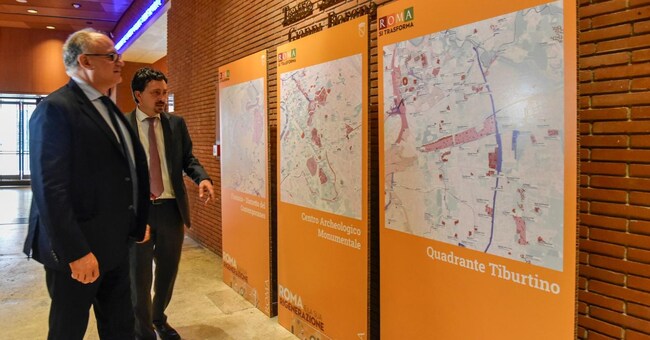
A transformation that interprets the great challenges of the contemporary world. Starting with rising temperatures (citing the case of the new mayor of Athens, who allegedly won the elections by promising to reduce the temperature in the city by five degrees in five years). Roberto Gualtieri, mayor of Rome, participates in the mid-term account of his junta, emphasising the centrality of urban planning in the political agenda. The Campidoglio's declared challenge is to catch up with other international cities. "Start again immediately," says Gualteri, "and open as many building sites as possible, without forgetting planning and vision. And in this sense he recalls the study and analysis work entrusted to the 'Laboratorio 050' led by Stefano Boeri.
Investments
."If Rome wants to bridge the housing gap, the infrastructure and mobility gap, the carbon neutrality gap," said Gualtieri at the event promoted by the Department of City Planning, "we need 100 billion in public and private investment over the next few years. We need to build 70,000 houses and, above all, we need to work together in a framework of urban regeneration that can also regenerate the city's social relations. Housing, sports and cultural policies must be part of this reflection. The public side remains enabling to avoid disorderly development. "Private investment will be decisive", as also announced in recent months at Mipim in Cannes .
Town planning councillor Maurizio Veloccia goes into the mid-term balance sheet: a balance sheet made up of building sites. From renderings to photos, from Tor Bella Monaca to Corviale, to Santa Maria della Pietà "building inside the former psychiatric hospital the largest European public city dedicated to health and well-being". Regeneration at the former school of Cardinal Capranica or in the former barracks of Porto Fluviale, "redeveloping neighbourhoods and addressing the issue of economic and social housing at the same time". Projects worth some 280 million euro that are now building sites.
Many initiatives tell of a Rome of normality, with services that work, maintenance, decorum: actions that might not make headlines if they were taken for granted. To which are added more ambitious projects. "While we are bringing drinking water to OSA," says Veloccia, "we are planning the Museum of Science (with a tender for the work to start by 2025) or financing the Park of the Dunes in Ostia (a total investment of 45 million) or the new Rome Technopole in Pietralata or the new Imperial Forum Project.
In the long list of projects mentioned by Veloccia there are the Bravetta Residence, the former Fiera di Roma "whose design winner will be announced in a few days", the former Alitalia, Via del Crocifisso next to St. Peter's Station, the Prenestino Service Centre, Piazza Navigatori and the so-called Bidet, the expansion of the Biomedical Campus in the Trigoria quadrant, the development of the Tiburtino Technopole, "Each of these projects," says the councillor, "exceeds 100, sometimes 2-300 million euro. Not only, therefore, hotellery in the buildings of the historic centre, which also provide answers to paradoxes such as having a historic building in Piazza S. Silvestro closed for ten years, or the Roma Stadium, on which the Municipality has carried out everything in record time and is now confidently awaiting the final project in order to be able to authorise it'.

Brand connect


Newsletter RealEstate+
La newsletter premium dedicata al mondo del mercato immobiliare con inchieste esclusive, notizie, analisi ed approfondimenti
Abbonati