
Rome shaped Vasari, an eclectic globetrotter
The artist arrived in 1532: his classical style, exchanges with foreign artists, close ties to the ruling classes and his travels brought him fame and led him to the Bella Maniera

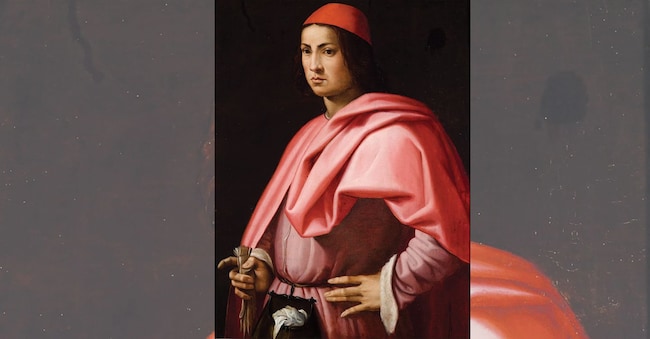
Rome as a coming-of-age story, as a cabinet of curiosities. This is how the city appeared to Giorgio Vasari when he arrived there in 1532, just over 20 years old, yet already rich in the culture and artistic knowledge he had acquired in the Florence of the Medici. Rome still bore the scars of the Sack of Rome by the Landsknechts, yet the atmosphere was effervescent, and Vasari flourished thanks to new acquaintances and his proximity to temporal and spiritual power. He was a master at networking, at growing and moving towards the modern Mannerist style, a full and conscious Renaissance, as revealed by the exhibition ‘Vasari and Rome’, curated by Alessandra Baroni, featuring over seventy works including drawings, prints, engravings, letters, medals, sculptures and paintings, sixteen of which are autograph works alongside seven drawings.
Rome is a city of pilgrims, “with the cultural and multi-ethnic vibrancy of the many strangers who pass through it as the supreme embodiment of an idea of classicism that is already giving way to the Bella Maniera”, as the curator writes. Vasari arrived in the retinue of Cardinal Ippolito de’ Medici, nephew of Lorenzo the Magnificent, who commissioned him to paint secular works, such as a Venus with the Graces and a Bacchanale of satyrs in the Logge di Raffaello, a balance between the classical and the first glimmers of the modern Mannerist style. And perhaps also the Christ Carried to the Tomb (1532, Uffizi), his oldest surviving work, full of echoes of a bygone era and the traits of Rosso Fiorentino. These were the years of intoxication with classicism, for the excavations had just yielded the Laocoön and the Belvedere Apollo, and how could one not be captivated ‘especially by what lay underground in the caves’? Those lines, that richness of colour influenced Vasari as much as Raphael’s mystical glows and backlighting, as shown by the Portrait of a Gentleman from Genoa or the refined Nativity in the Monastery of Camaldoli, an early work, painted ‘in the Flemish style’ (1538). It was there, up in the Casentino Forests, that the artist added the name of Bindo Altoviti to his list of patrons, a powerful Florentine banker of anti-Medici leanings, close to the new Pope Paul III Farnese.
In 1540–41, Vasari studied Titian in Venice, stopped off in Modena and Parma to view the works of Parmigianino and Correggio, and passed through Mantua where, at Palazzo Te, he was captivated by the interplay between architecture, sculpture and painting. He returned to Rome the following year, worked for Altoviti, and was commissioned by Cardinal Alessandro Farnese to paint the Allegory of Justice (now in Capodimonte), his ticket to joining the cardinal’s circle of scholars, who, in 1546, entrusted him with the decoration of the Sala dei Cento Giorni in the Palazzo della Cancelleria, Vasari’s first major commission. By now, his fame was widespread, and commissions came thick and fast: the monumental Resurrection for the monastery of Monte Oliveto in Naples and the Resurrection of Christ for Filippo di Averaldo Salviati demonstrate the evolution of his forms, captured in the many drawings on display, for Vasari, drawing was a process of growth: ‘There was nothing of note in Rome at that time […] which I did not draw in my youth; and not only paintings, but also sculptures and architecture, both ancient and modern’.
Numerous encounters and extensive travel also form the basis of the Lives of the Most Excellent Painters, Sculptors and Architects, published in 1550, but Paolo Giovio, in a letter written three years earlier, predicted that Giorgio would achieve greater lasting fame through the book than through his art. There was no shortage of work: Pope Julius III del Monte (1550–55) commissioned him to design the family tombs in San Pietro in Montorio and a Call of Saint Peter, which, however, once completed, did not satisfy him: Vasari kept it and took it to Arezzo, where it became the centrepiece of the family altar in the parish church of Santa Maria, but not before writing to Michelangelo – a colleague he greatly admired – asking him to intercede with the Pope to secure the agreed payment.
Next came the Sala Grande in the Palazzo Vecchio in Florence, and his rise as court artist to Cosimo, under whose rule he founded the Accademia delle Arti del Disegno (1563) and built the Uffizi Gallery, but it is always Rome that shapes his destiny, thanks in part to his exchanges with ‘foreign’ artists: Pope Pius V (1566–72) commissioned him to decorate the three chapels of the Torre Pia in the Vatican, dedicated to St Peter, St Stephen and St Michael, and the Sala Regia of the Apostolic Palace. And, for the first time in centuries, several paintings from the original decoration of the Chapel of St Michael are being exhibited together: the tondo depicting the Annunciation from the Móra Ferec Museum in Szeged (Hungary) and the two panels depicting the Evangelists Matthew and John, from Livorno. These years, from 1570 to 1572, marked the definitive consecration, and Pope Pius V also conferred upon him the honour of the ‘Golden Spur’, which glitters on Vasari’s chest in the portrait in the Uffizi painted by Jan van der Straet (1571–74). From classical forms to Raphael’s backlighting, to Michelangelo’s sculpted volumes, Vasari now interprets a mature Renaissance, ‘that third manner which we wish to call the modern, beyond the vigour and skill of the drawing, and beyond the most subtle rendering of all the minutiae of nature, [...] truly giving his figures movement and breath’. That is what certain works, certain drawings in this exhibition, still convey to us, 500 years on.


