
Rome, waste to energy plant in 2027 with greenhouse and roof garden. The promise: 'It will pollute less than a busy street'.
The new plant to be built in Santa Palomba, on the border with Pomezia, was presented at the Campidoglio. The investment is worth around one billion

4' min read
Key points
- Tariff dropped to 178.5 euro: savings of 40 million annually
- To estimate the value of environmental benefits
- Palermo (Acea): "We will use the best technologies"
- Four ancillary plants, roof garden and tower with belvedere
- Gualtieri: 'It will pollute much less than a busy street'
- From aluminium to copper, here are the materials that will be recovered
- Next steps
- Unindustria applauds: "Excellent news"
4' min read
There are two periods circled in red on the calendar: March 2025 for the start of work and summer 2027 for its completion. By that date, Rome's new waste-to-energy plant, capable of handling 600,000 tonnes of undifferentiated waste each year and recovering energy and materials, from steel to copper, should be operational. The project was officially presented yesterday at the Campidoglio, a little over two months after the first yes of the commission appointed by the Capitoline administration to the proposal to award the construction of the plant in the industrial area of Santa Palomba, on the border with Pomezia, to Acea Ambiente, the leader of a temporary consortium that also includes Hitachi Zosen Inova, Vianini Lavori, Suez Italy and Rmb.
Tariff dropped to EUR 178.5: savings of EUR 40 million annually
As reported in Il Sole 24 Ore on 3 August, the agreed tariff is more advantageous: from the current €220 per tonne, it has fallen to €185 in the submitted proposal (the only offer on the table, received in May) and has been further reduced to €178.5 in the winning proposal. A level that, according to the Campidoglio's estimates, should result in a dry savings of around EUR 40 million per year in terms of management and transport costs.
To estimate the value of environmental benefits
."The calculations already tell us of several tens of millions of euro," confirmed mayor Roberto Gualtieri, "but they do not include the environmental benefits. Benefits that, according to Gualtieri, will be huge, due to the reduction of methane and C02 emissions: "Today we go to the dump for 30% and take the rest of the undifferentiated waste to Holland and Northern Italy. The costs, including environmental ones, are high. Not to mention that in the savings we should also include the benefits of energy and material recovery that the waste-to-energy plant will make possible".
Palermo (Acea): "We will use the best technologies"
.It is precisely this aspect that makes the Roman waste-to-energy plant unique, as Acea's CEO Fabrizio Palermo pointed out: "For our company, this was a very significant commitment, a project on which we worked day and night together with the technicians, with the spirit of finding solutions that would benefit the citizens. The name itself, 'Circular Economy Park', testifies to the goal we had set ourselves. In order to achieve it, we have chosen the most avant-garde partners in the world: we will use the best available technologies and bring impressive results, including aesthetic ones.
Four ancillary plants, roof garden and tower with belvedere
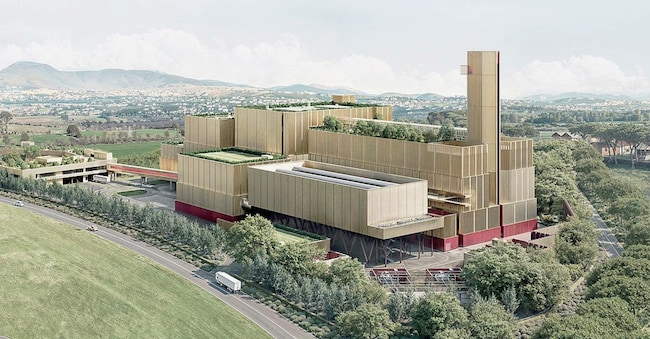
The waste-to-energy plant will extend over an area of ten hectares and will consist of a central building for waste disposal, furnaces and flue gas treatment, four ancillary plants - dedicated to bottom ash recovery, photovoltaics, district heating network and experimental CO2 capture - and a 'circular resource path' that makes the facility accessible to the community, with a viridarium among gardens and vegetable gardens, a 74-metre tower with a panoramic lift and belvedere, a roof garden, exhibition and educational spaces. The transferable electric power will be 65 megawatts, enough to power 200,000 households.


