
Compass Rose: Travel Notes and Life Lessons
A Paolo Conte LP as both a geographical and existential map: 40 minutes of sublime music and extraordinary poetic verses. An ‘Academy of Elsewhere’ at last discovered, starting with the cover art

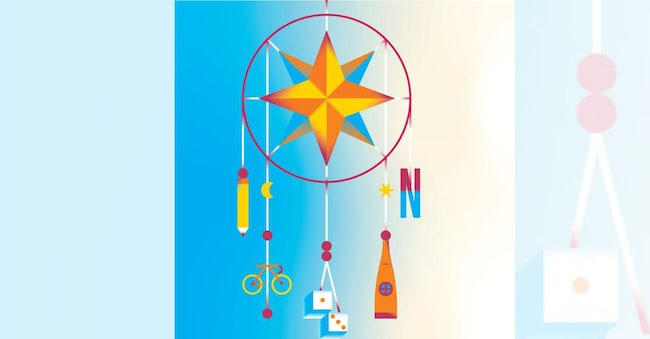
I’m obsessed with maps, I know: double and triple islands; I see in geographical representations – and in physical geography – traces of possible destinies: one can always imagine routes, escapes, stories from a border, a peak, a plain, a sea. If the map takes on a symbolic meaning, the whole thing becomes even more stimulating. The emotional map I have in mind has whisked me off on the most unexpected journeys: indeed, it has taught me precisely how journeys come about, woven from words and music, provincial life and nostalgia, existential distances, time and space fused by sensations, loves, friendships and passions. Geographies are stories: and vice versa. I would look at that compass rose, slightly off-centre, which Roberta De Tuddo had drawn and shaded in a delicate watercolour for Paolo Conte’s *Appunti di viaggio* – for me, the lawyer’s finest album – and each time it was an imaginative departure. The compass rose foretells all directions but chooses not a single one: in every quarter a wind blows from a cardinal point, with names that are exotic yet familiar; the same mechanism that, as soon as the vinyl was placed on the turntable and the needle set upon it, would set off inexorably – and always: destinations that seemed like exotic places, yet instead pointed straight to the soul. The record was released in 1982; I’d come across it some time later, towards the end of the decade – for me, my university years, when you finally have the tools to ‘understand and experience’ Monsieur Conte’s words and music. It always really annoys me to be put in a position where I have to say which is my favourite book, writer, film (even though I now have only a small handful to choose from), artist or singer – always a silly and pointless question – yet in Paolo Conte’s case I’m never in any doubt. It’s him, and that’s that.
And I’ll go further: in a repertoire of epic, timeless songs – classics, in a word – Conte has written and set to music at least a dozen of them, each one incredible in its own way (and I’m being conservative here, so as not to sound like an over-the-top fan). But if I’m asked which is my absolute favourite, I’ve now learnt to come to terms with myself and the question: I give in and say that no other track speaks to me or tells me more than that blessed track that opens that fateful album, ‘Fuga all’inglese’. The first of the ‘notes’ and certainly the most definitive: a metaphor for our existence, and more than that, a life lesson with which it’s hard not to agree. Conte’s surprising use of a Roland synthesiser, and that soprano sax ‘siren’ heralding the start, like a ship’s horn in the harbour; then the track gathers momentum, accelerating and ultimately revealing an ineffable truth – or rather, two; here they are: ‘Who knows if the flight from life / isn’t in fact the very quintessence / yes, but we can do without it’. I’ve never been convinced by those who claim that songs are poetry, and I consider the Nobel Prize in Literature awarded to Bob Dylan to be blasphemy (not because of the singer-songwriter’s skill or lack thereof, but precisely because literature is one thing, a medium distinct from songs), and yet Paolo Conte, in those songs, made me realise that there was a sublime way of using words and composing verses that the finest contemporary poets could only dream of. And what’s more, doing so with seemingly humble concepts that instead revealed ultimate truths. Listen to this, again from *Fuga all’inglese*: ‘Time passes all the same / Even under the sofas… / Yes, time passes under the sofas / Enemy number one / Of all the vacuum cleaners in the city / That’s where he keeps his academy / Beneath the glassy gaze / Of the Bohemian glasses’. The glassy gaze, the passing of time and the brilliant idea of an academy hidden beneath sofas – where accumulated dust, in turn, takes on its biblical dimensions – have always struck me as a verbal juggling feat with a certain shamanic quality.
Eight tracks on that album, not even 40 minutes long: and yet it is an academy – yes, but of another world – put into practice and laid bare before us. Just listing these eight gems is enough to leave one awestruck, listening in silent admiration, pondering and savouring them. Side A: ‘Fuga all’inglese’, ‘Dancing’, ‘Gioco d’azzardo’ and ‘Lo zio’; four tracks of practically equal length, give or take a second, featuring the most beautiful love song ever written by Conte, ‘Gioco d’azzardo’. Incidentally: a sublime exercise in divinatio – as a student of philology, I couldn’t resist – when I read in the cover credits that someone was playing the drums on ‘E non sai quanto’, a track that doesn’t exist but is, in fact, the most poignant final verse of ‘Gioco d’azzardo’. ‘Now it’s late / and I’ll just say / that it was all about love / and you don’t know how much’. They’d decided to change the title at the last minute and had forgotten to update the credits – that’s how philology works! Side B: ‘Hemingway’, ‘Diavolo Rosso’, ‘La frase’, ‘Nord’. A masterpiece of an LP, really, and a triumph not only of music but of words, phrases—no, linguistic thrills: I’ll jot them down haphazardly: a rosary. Beyond the delights of Harry’s Bar and the tenderness of Zanzibar, beyond the illusions of Timbuktu, listening closely you can see Shanghai at the end of Vienna’s boulevards, nostalgia with a taste of curaçao, backlit, time slips away all the while, come here with us for an orangeade; the darkness smells of hay and of distant lands, everything unravels, like film stock, this North-West decked out in stars, a distant city, all mother-of-pearl, wind, iron and fire, the red devil forgets the way, uncle, uncle, explain life, explain what it is, one day Gondrand will pass by… It’s an encyclopaedia, it’s a dream, a calm tornado that passes and sweeps everything away, a mellow voice, rumbling and a mysterious kazoo, muffled or urgent sounds, supreme elegance that you keep following: Travel notes, life lessons, inscrutable geographies, method and imagination. Thus you take flight, a compass rose that speaks of deep desires and points you in directions, changes, stubborn, contrary, marvellous courses: a map that describes the very centre of you.

