Legends

Route 66, a hundred years of legend: the road that changed America and the car

From Chicago to California, 2,448 miles that have become a global symbol. Route 66 will celebrate its centenary in 2026: established when part of the route was still unpaved and officially removed from federal maps in 1985, it lives on as an icon of motoring, travel and American culture

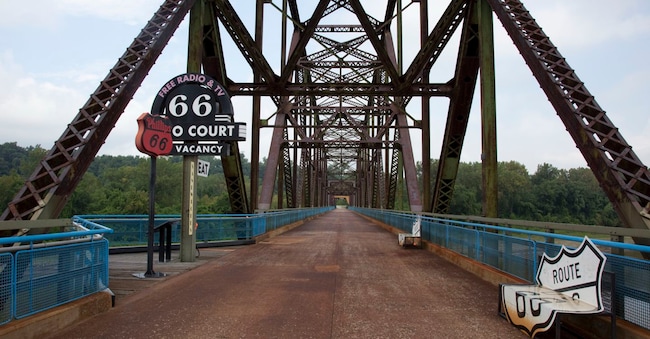
Route 66. Chain of Rocks Bridge, St. Louis, Missouri

4' min read

Translated by AI
Versione italiana

4' min read

Translated by AI
Versione italiana

Route 66, a number destined to become legendary. When it was officially established on 11 November 1926, no one could have imagined that a simple road designation would become one of the most recognisable symbols of the 20th century. US Highway 66 linked Chicago to California, with its terminus later moved to Santa Monica: some 2,448 miles, just under 4,000 km, across eight states and three time zones.

Even the number was almost chosen at random. The new road was originally to be called US 60, then US 62 was considered. On 30 April 1926, Cyrus Avery and B.H. Piepmeier proposed US 66 instead, as this number was still available. A bureaucratic decision destined to become a global icon. The road itself was also very different from the one that has entered the collective imagination. The route incorporated existing roads and included unpaved sections: it was not until 1938 that Route 66 became fully paved.

Loading...

Route 66, le foto della leggendaria strada americana

Photogallery17 foto

From the Great Depression to the ‘Mother Road’

In the 1930s, Route 66 ceased to be merely a piece of infrastructure. It became an escape route to the West for families devastated by the Great Depression and the Dust Bowl. John Steinbeck recounts that exodus in *The Grapes of Wrath*, and in 1939 he gave Route 66 the nickname that would come to define it forever: ‘Mother Road’.

But the freedom promised by the open road was not the same for everyone. In the America of segregation, African-American motorists had to plan their stops, refuelling and overnight stays carefully. From 1936 onwards, the Negro Motorist Green Book listed hotels, restaurants and petrol stations where Black travellers could stop without facing the widespread discrimination prevalent in many of the areas they passed through. It is a lesser-known chapter compared to that of diners and Cadillacs, but one that is essential to understanding the social dimension of Route 66.
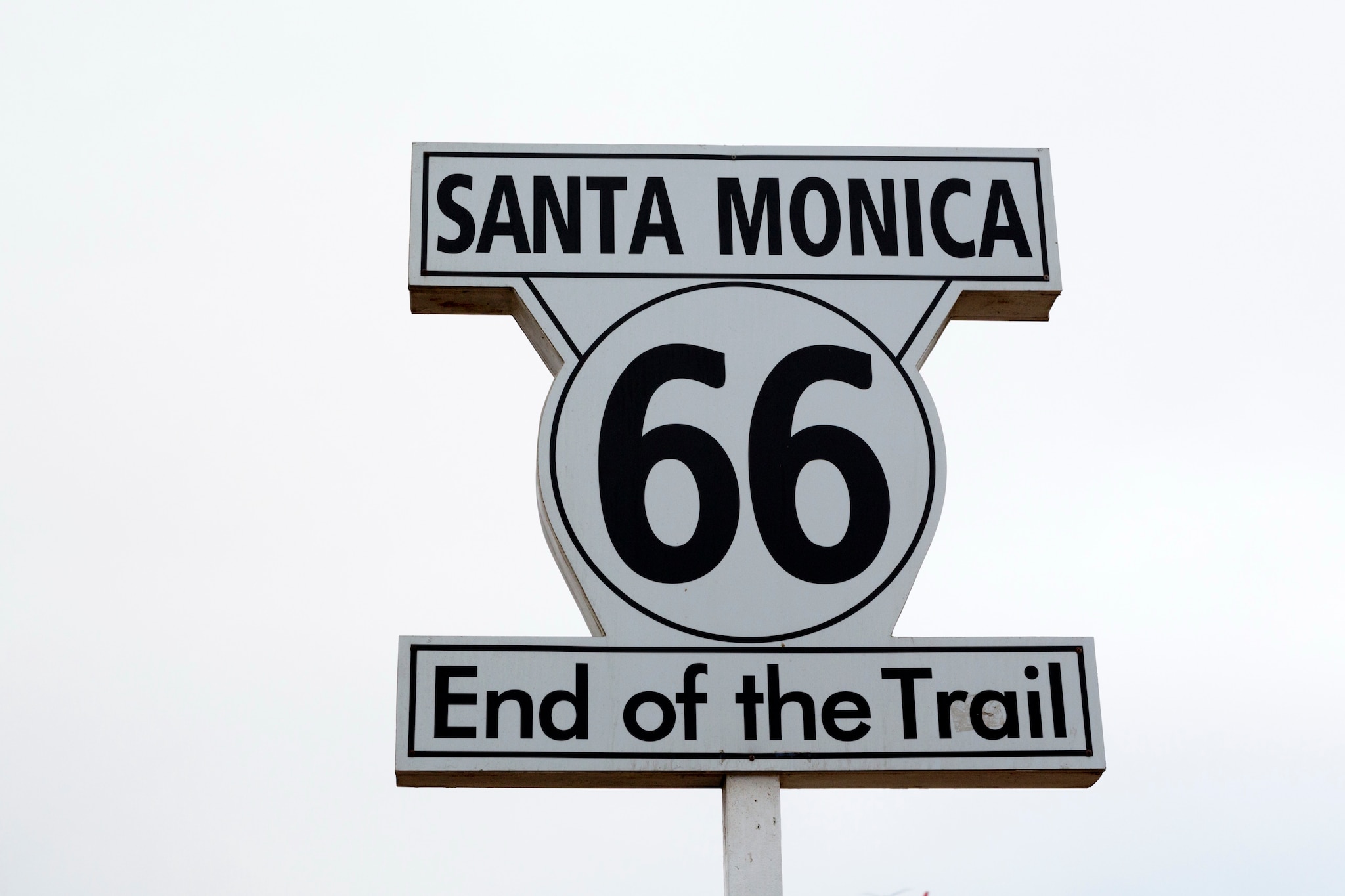
Route 66. Santa Monica “End of the Trail”

Motels, diners and petrol stations: the birth of the car economy

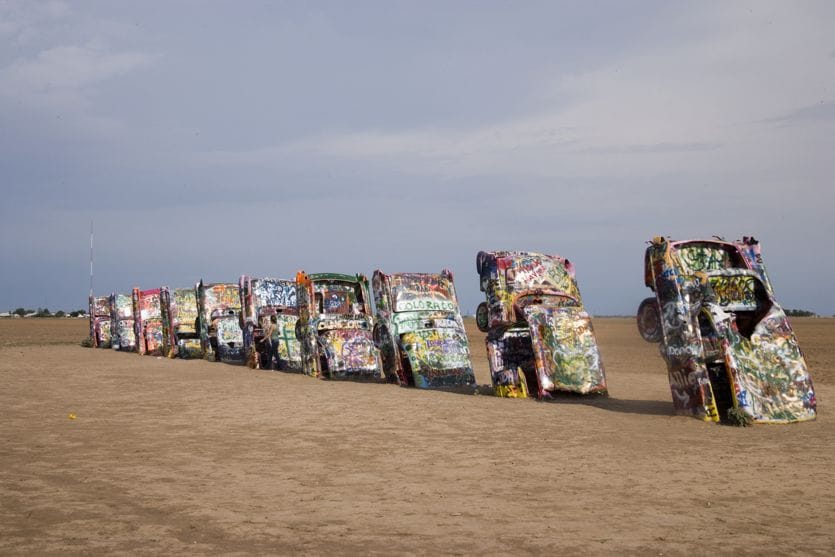
After the Second World War came the golden age. Car production, fuel availability and tourism all grew. Route 66 thus became the grand stage for American motoring. Along the route, an economy emerged designed for those who view the world through a windscreen. Motels, diners, drive-ins and petrol stations had to grab people’s attention in a matter of seconds. Gigantic signs and extravagant architecture began to appear: from the Wigwam Motel to the Blue Whale in Catoosa and the U-Drop Inn in Shamrock, right through to the Cadillacs embedded in the ground at Cadillac Ranch in Amarillo. In Kansas, Route 66 runs for just 13 miles, the shortest stretch of the eight states it passes through. In Adrian, Texas, the Midpoint Café symbolically marks the halfway point of the journey.
In 1946, the theme tune was also released. Bobby Troup wrote ‘(Get Your Kicks on) Route 66’, made famous by Nat King Cole and later covered by, amongst others, Chuck Berry and the Rolling Stones. From 1960 to 1964, the television series *Route 66*, featuring a Chevrolet Corvette as a central character alongside its drivers, cemented the bond between cars, travel and popular culture.

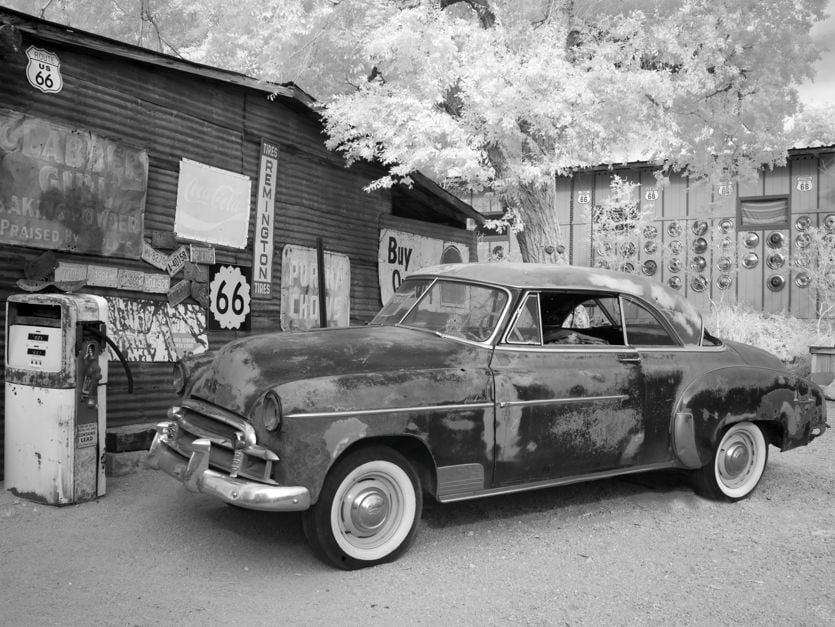
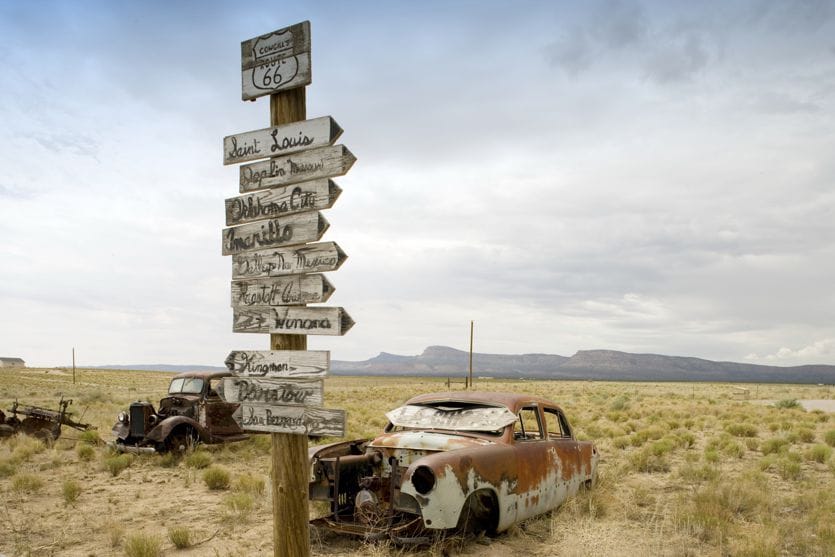
Route 66. Auto abbandonate lungo la Route 66, Truxton, Arizona

Motorways are replacing Route 66

It was the advancement of the motor car that heralded the decline of the Mother Road. With the Federal-Aid Highway Act of 1956, championed by President Dwight Eisenhower, the United States accelerated the construction of the Interstate Highway System. The new I-55, I-44, I-40, I-15 and I-10 gradually took over the traffic. These were faster, more modern routes, but they bypassed many towns and villages. For the motels, garages, petrol stations and restaurants built along the old Route 66, this meant suddenly losing a large proportion of their custom.

Williams, in Arizona, was the last town to be bypassed, in October 1984. On 27 June 1985, US 66 was officially removed from the federal highway system. It could have been the end. Instead, it marked the beginning of a new lease of life.

Route 66. Cadillac Ranch, Amarillo, Texas

The revival of Historic Route 66

One of the key figures in the rescue effort is Angel Delgadillo, a barber from Seligman, Arizona. Having witnessed traffic and the local economy collapse following the opening of the Interstate 40, in 1987 he helped found the Historic Route 66 Association of Arizona. Thus began the campaign to preserve and promote the old sections of the road under the banner of Historic Route 66.

The legend is gradually regaining popularity and is even reaching new generations. Even animated films are helping to revive it: Radiator Springs from *Cars* brings together the places, characters and atmosphere seen along the old highway, transforming the way we imagine it yet again.

Loading...

Route 66. Hackberry General Store, automobile e vecchia pompa di benzina

Route 66 turns 100 and meets the electric car

In 2026, Route 66 will mark a paradoxical anniversary: one hundred years since its inception and over forty since its official decommissioning. Yet around 85 per cent of the historic route is still passable. There is no longer a single continuous US 66: the journey winds its way along state and local roads, old alignments, slip roads and sections designated as Historic Route 66. The centenary is being celebrated across the eight states it passes through, with 11 November 2026 marking exactly one century since the highway’s official inception.

And it is hard to imagine a more striking contrast. The road of V8s, mechanical petrol pumps and neon signs is entering its second century in the age of electric cars and fast-charging points. But, in reality, it is simply another transformation. Because the legacy of Route 66 is not measured solely in its 2,448 miles, its Corvettes, its motels or its Cadillacs abandoned in the desert. The Mother Road has helped to change the very relationship between man and the car, transforming the vehicle from a mere means of reaching a destination into a tool for experiencing the journey itself.

From Chicago to Santa Monica, a hundred years on, Route 66 continues to remind us of something that motorways, algorithms and sat-navs tend to make us forget: the best route is not necessarily the quickest one. And this is probably why Route 66, despite having been wiped off the maps, has never really disappeared.

Copyright reserved ©
Loading...

Brand connect

Loading...

Newsletter

Notizie e approfondimenti sugli avvenimenti politici, economici e finanziari.

Iscriviti