
From Rubio to Yermak: here are the protagonists of the Ukraine-US-EU summit
From Andriy Yermak to Marco Rubio, from Björn Seibert to Jonathan Powell: in the rooms of the Palais des Nations, it is decided whether Donald Trump's plan can become the basis for an acceptable truce for Kiev

Key points
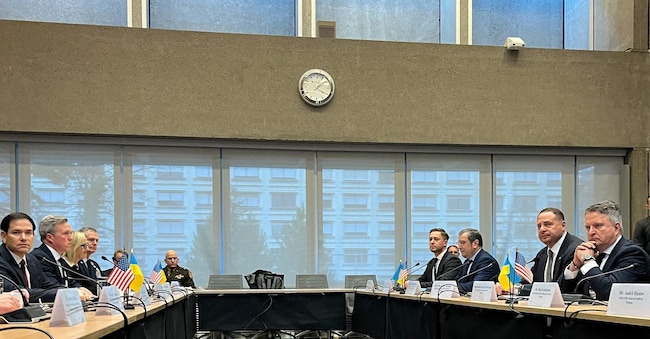
In the silent corridors of the Palais des Nations in Geneva, one of the most delicate negotiations of contemporary times began today, 23 November. The United States, the European Union and Ukraine are meeting around the same table to discuss whether there is a path to an end to the war.
The conflict, moreover, is now over three and a half years old, winter is looming and political impatience is growing on both sides of the Atlantic. It is in this climate thatWashington has put on the table a 28-point plan, anticipated by Reuters and discussed with increasing tension in European capitals. The document envisages significant concessions: Ukraine's renunciation of future NATO membership, structural limits on the Kiev Armed Forces, and the freezing of Russian control over Crimea and portions of the Donbass and Zaporizhzhia. A framework that President Donald Trump calls 'not final', but which many European partners already judge unbalanced in favour of Moscow.
The delegations
The Ukrainian delegation is led by Andriy Yermak, chief of staff and closest advisor to President Volodymyr Zelensky. Yermak, who in recent years has become the most recognisable face of Ukrainian diplomacy, arrives in Geneva with the posture of someone who knows that every word carries strategic weight. His position is clear: Kiev will not accept imposed agreements or solutions that sanction an irreversible loss of sovereignty.
The US deploys a diplomatic couple that reflects the mood in Washington: Marco Rubio, Secretary of State, and Steve Witkoff, special envoy. Rubio brings with him years of political battles on the European security front: he was among the main supporters of the broad architecture of sanctions against Russia. Now he must convince allies that the American plan is the only way to avoid an endless conflict. Witkoff, entrepreneur turned diplomatic advisor, is the man in charge of saying what others cannot say openly. He was among the architects of the Gaza plan and has a direct language, calibrated to flush out resistance and hypocrisy.
The face of the European Union is Björn Seibert, chief of staff to President Ursula von der Leyen. A reserved but influential figure, Seibert has been one of the main engineers of the European response to the war: sanctions, defence coordination, relations with capitals. In Geneva he brings Brussels' concern that a US-led agreement could bind the EU to a security arrangement it does not share. On the other hand, there are several European countries irritated at not being involved in the preliminary drafting of the American proposal.

