Nations Championship

Rugby: a poor start to the tour for Italy – Japan win 27–10

Too many mistakes for Quesada’s team, who were unable to hold their own against the Japanese side, even physically

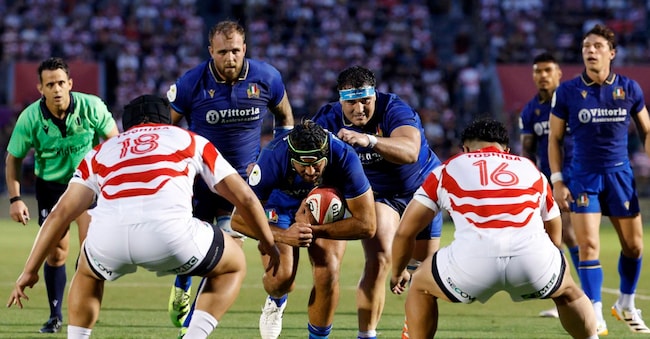
L'italiano Gianmarco Lucchesi (al centro) tiene in mano il pallone durante la partita del Rugby Nations Championship tra Giappone e Italia, disputata a Tokyo, in Giappone, il 4 luglio 2026. Il Giappone ha vinto la partita.  EPA/FRANCK ROBICHON

4' min read

Translated by AI
Versione italiana

4' min read

Translated by AI
Versione italiana

It was a terrible start for the Italian rugby team on the evening in Tokyo. Facing Japan – on paper the weakest team among those taking part in the newly launched Nations Championship – the Azzurri lost by a score (27–10, 17–10 at half-time) that could have been even more lopsided.

It was certainly an excellent performance by the home side, though they were up against a disorganised opponent prone to errors and wasted chances, and by no means physically superior – something one might otherwise have expected. All in all, only the throw-ins worked. For the rest, there were misunderstandings (starting with the initial double challenge by Ioane and Pani on a high ball, which was likely the cause of the latter’s injury), duels lost in key areas (the gap between the two teams’ central midfielders was almost embarrassing, with the home side’s No. 9 putting in a remarkable performance), largely ineffective pushing in attacking scrums and also – at the other end – a defence that showed determination and a spirit of sacrifice, but was unable to prevent the Japanese from maintaining prolonged periods of possession in areas of the pitch that were dangerous for the Azzurri.

Loading...

Too many mistakes by the Azzurri

The gap in the number of errors caused by fumbles says it all about the team’s struggles under coach Quesada: Italia’s tally was close to twenty, roughly four times the number of Japan’s ‘slips’. And this brings us back to a team that has rarely shown the necessary concentration, that has relied too often on individual efforts and has also lacked cohesion.

For the majority of the Italian squad, the lack of competitive match practice certainly played a part, given that some players had long since finished their club seasons and there had been no warm-up fixtures (Japan, by contrast, had played two friendly matches). But this mitigating factor, whilst valid, is not enough to explain such a disappointing performance. It is also worth noting that in the second half, when one might have expected a reaction and a change in attitude, Italia failed to score a single point. In the second half, at least debutant Malik Faissal stood out, confirming his ability in the air.

The most deceptive of the tries came almost straight away, with the ball emerging from a ruck and passing through the hands of several Italian players until Brex found a gap and scored a try, which was then converted by Paolo Garbisi. It was one of the very few occasions on which the home side’s defence failed to rise to the occasion.

Around the 10-minute mark, Japan levelled the score: a scrum on the 22-metre line, with captain Dearns breaking forward; after a series of powerful runs by his teammates, he regained possession and broke through.

The team and the crowd were thrilled; the red-and-whites were impressive in their pace and ball movement, with full-back Matsunaga – who was also spot-on with his kicks at the posts – scoring the second try just after the quarter-hour mark, collecting a pass from Hirose, who had made a splendid break.

The score went from 14–7 to 17–7 in the 25th minute following a set-piece, whilst Italia opted not to go for the posts and instead went for a try. To no avail. It was only as time ran out that they opted for the penalty kick; Garbisi found the posts and the half-time score stood at 17–10.

No reaction in the second half

The Azzurri’s response in the second half? None whatsoever. In fact, it was Japan who got off to the better start, scoring a fine try as early as the seventh minute. Three minutes in the 22-metre area, sixteen phases without a single mistake, a final burst from Gunter and another conversion from Matsunaga. About twenty minutes later, Matsunaga slotted another penalty, making it 27–10 – a score that would not change.

In his post-match comments, Quesada spoke of the need to analyse, together with his coaching staff, a match that clearly did not satisfy him. He highlighted, amongst other things, two aspects (“We lost possession 25 times and entered their 22-metre area eight times without managing to score”) and added: ‘The only positive aspect was the heart shown by our defence, in a very tough match in which it was important not to lose the will to make sacrifices. As for the rest, there isn’t such a big difference between us and Japan that we can assume a different level of match preparation doesn’t matter. We arrived seven days ago after a long journey and managed to get in only three training sessions. They had put in far more work.”

Another gruelling trip, this time to New Zealand, will see the Azzurri take on the All Blacks next Saturday, who today beat France 34–32 in Christchurch.

The match

Japan v Italia 27–10 (half-time 17–10). For Japan: 3 tries (11’ Dearns, 17’ Matsunaga, 47’ Gunter), conversions (Matsunaga), 2 penalty kicks (Matsunaga). For Italia: 1 try (5’ Brex), 1 conversion (P. Garbisi), 1 penalty (40’+2 P. Garbisi). Penalty kicks: Matsunaga 5 out of 5; P. Garbisi 2 out of 2

Copyright reserved ©
Loading...

Brand connect

Loading...

Newsletter

Notizie e approfondimenti sugli avvenimenti politici, economici e finanziari.

Iscriviti

Tutto mercato WEB