
Ruini, the last key figure in the Church’s involvement in Italian politics
As Vicar of Rome and President of the Italian Bishops’ Conference, he shaped the role of Catholics in politics during the transition from the First to the Second Republic

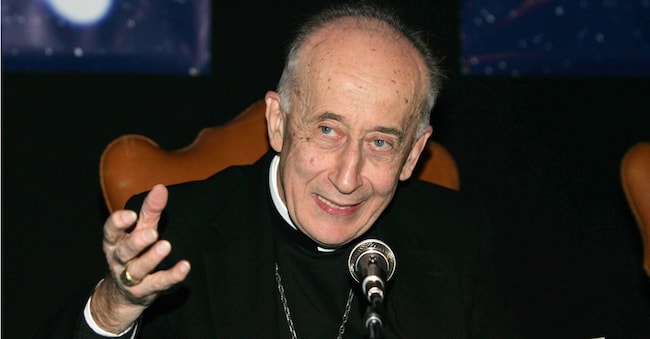
It was the Italian prelate – a cardinal, president of the CEI and Vicar for Rome – who, more than any other, dominated the national political scene for over 20 years. Camillo Ruini spoke his mind right to the end, clearly distancing himself from Pope Francis whilst emphasising his closeness to John Paul II and Benedict XVI, whose decision to abdicate he did not agree with. Born in Sassuolo, he served briefly as auxiliary bishop of Reggio Emilia – in that capacity he married Romano and Flavia Prodi, though his relationship with the professor was to prove very difficult – yet his political acumen soon took him to Rome, where Pope Wojtyla appointed him Secretary-General of the CEI; this marked the start of his rise to the upper echelons of the Church, and he gradually came to play a central role in national politics, with the imperative of being criticised, but never irrelevant.
Those were certainly different times. De Mita’s Christian Democrats were in power, governing alongside Craxi’s Socialist Party and the other parties: a period of profound change in Italian society, which had emerged from the great crisis of the 1970s. The Christian Democrat left held a majority, but by then any dialogue with the Italian Communist Party (PCI) was a distant memory, whilst reformist demands were mounting. Towards the end of the decade, there was a change in the majority; a new political line, the ‘CAF’, prevailed within the Christian Democrats, and Ruini was hailed as the cardinal of this new alliance, which was supposed to bring Arnaldo Forlani to the Quirinale. But things turned out differently, and following the Capaci massacre, Oscar Luigi Scalfaro was elected, with the ‘Tangentopoli’ scandal already underway. The Second Republic – or what it was and still is – was just around the corner, and new laws were needed.
The post-DC turning point
And indeed, Ruini was perhaps the first to realise what was happening, starting with the break-up of the Christian Democrats. And so he promoted the involvement of Catholics in the new political formations that were taking shape, in particular the emergence of Forza Italia and the CCD, whilst also keeping an eye first on La Margherita and then on the PD. Silvio Berlusconi capitalised on his proximity to the Catholic world, despite the fact that the system of values and interests espoused by the new party was decidedly at odds with it, but such is life. And indeed, when the Ulivo was formed in 1995 with Romano Prodi at the helm, a rift developed between the two that would never be mended. Indeed, the CEI would always take a stand against ‘the Professor’, despite him being one of the few leaders who genuinely attended church as a believer and practising Catholic – something he still does today.
From 1991 to 2007, he served as President of the CEI and Vicar of Rome, and was very close to both popes. One of the key developments of the 1990s was the ‘turning point’ for the CEI in 1995, with the 3rd National Ecclesial Convention held in Palermo, which marked the abandonment of the previous ‘religious choice’ in favour of the Cultural Project, strongly supported by Pope John Paul II, which aimed at a renewed commitment by Catholics to public life. The Church ceased to remain ‘on the sidelines’ following the demise of the Christian Democrats, promoting Christian values directly within civil society. This was the phase in which the Church encouraged the faithful not to isolate themselves but to influence the culture, politics and life of the country through a faith embodied in history. In short, the presence of the Church and of Catholics in the world of culture was established, especially with the advent of the new millennium – an alternative way of understanding the mission of the Catholic Church within the society of which it is a part (Italian society) – fuelling political debate on issues such as the defence of human rights and the right to life. The concept of ‘non-negotiable values’ emerged – a rallying cry for Ruinism and its political offshoots, on the right as well as to some extent on the centre-left – and the ‘devout atheists’ came to the fore, with their well-placed spokespeople.
Admittedly, this was contested by the secular elements of society and politics, who, whilst acknowledging that an interest in these matters was relevant to the Church’s mission, took issue with the bias and the claim to universality in some of the Cardinal’s statements, believing that, on certain matters, the Church’s message should not delve into the specifics of a sovereign state’s legislation, but should confine itself to general guidelines, without imposing the dictates of a particular ideology by law. The situation came to a head in 2005, during the referendums to repeal Law 40 on medically assisted fertilisation and scientific research into stem cells. Ruini acted as spokesperson for the CEI’s official position, calling on Catholics not to turn out to vote in order to prevent the 50 per cent quorum from being reached, in defence of the ‘right to life’. This move was interpreted in various ways by the political world: for the referendum’s organisers, it was an unacceptable interference by the Catholic Church in the political sphere, which is alien to it; for others, however, it was a legitimate opinion expressed by an important public figure. The referendum failed to reach the quorum, perhaps because – compounded by the fact that it was a summer Sunday and the questions were written in incomprehensible language – few people were interested in the matter. But for Ruini, it was a triumph.


