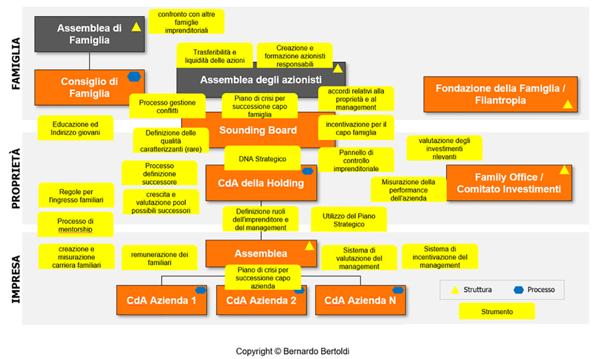
Rules are scattered throughout many of the structures shown in the diagram, but for some time the academy has suggested that the specific rules of the business family be written in a separate document. The practice began in the United States (a country overflowing with family businesses far more than is generally believed) and there the document is referred to as a 'family constitution'. When it was imported to Italy, the term 'family constitution' seemed too high-sounding and was changed to the more prosaic 'family pact'. Today there is much confusion, more among advisers of various kinds than among entrepreneurs, about what a family pact is and how it should be made. Moreover, since 2006, the legislator has introduced the 'family pact' into the Civil Code, which is very different in purpose from what others call it in the same breath (!).
The confusion of the (more or less experienced) editors is not the most serious threat to Italian family capitalism: the risk is to spend a lot of emotional energy (and a lot of money) in finding an agreement between different family members and then to let the agreements reached become a dead letter either because they are left in a drawer or, worse, because over time the written rules are disregarded. To avoid this beyond the rules, we need to work on values, traditions and culture.
Values are those principles to which all family members adhere. They are not just good intentions, such as being generous, respecting others, getting along, etc.; they are beliefs to which everyone adheres. The purpose of values is to take certain elements for granted in any discussion because they are accepted first and by all. If the principle is that the good name of the family is worth more than wealth, there will be no discussion about investing a lot of money in compensating customers or withdrawing a defective product from the market; if the principle is that the company must be rich and the family poor, there will be no discussion about dividend distributions; if the principle is that human dignity is a superior good, there will be no discussion about a large increase in costs related to aligning wages for disadvantaged countries or genders; if the principle is honesty, there will be no discussion about firing the best salesperson because he or she used inappropriate practices. Values must be applied consistently and taught rigorously: it is not enough to explain them, it is necessary to get to the point where every family member is intimately convinced of them. When this does not happen everything is always called into question, the management dynamic in the company and in the ownership becomes flooded and the solidity of the family falls apart.
Rules (lived and not kept in a drawer) and values handed down from generation to generation become traditions. Tradition has the great virtue of being little subject to change and allows current generations to ensure that what is important is preserved into the future. Keeping traditions alive over time requires celebrations, teachings, stories so that family members have examples and recurrences in which to understand and repeat those beliefs on which values are based and from which rules descend.
The rules and values that become tradition are the basis of family culture. Culture is something broader that penetrates all three spheres, it becomes the way in which family members disagree, agree or support each other; the way in which the family behaves as an economic entity and as an owner; the way in which the business operates and above all adapts to the changing external environment and competition.