
Russell puts Austria on ice: Mercedes remains the benchmark, Verstappen saves Red Bull, Ferrari takes a step back
In the hottest Grand Prix of the year, the Briton wins ahead of Verstappen and Antonelli, putting Mercedes back in the thick of the World Championship. Ferrari pays the price for the false hope of Barcelona: Leclerc eighth, Hamilton fifth, with the Scuderia still unable to control its own destiny

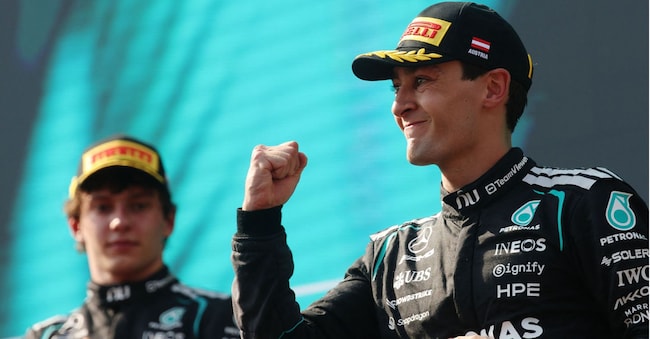
George Russell won the Austrian Grand Prix in the least spectacular and most gruelling of ways: by turning a controversial pole position into a race led from the front, with a command of the race that remained unshaken even by the formidable championship leader. Finishing ahead of Max Verstappen and Kimi Antonelli, the Briton has in fact put Mercedes back at the heart of the world championship following Ferrari’s coup in Barcelona two weeks ago – with their historic return to victory and, for the first time, Lewis Hamilton on the top step in a red suit. It wasn’t a perfect race for George – there were a few slip-ups – but it was a Sunday’s performance worthy of a mature driver: clear air when it mattered, pit stops at just the right moment, managing the margins and keeping his cool when the race looked as though it might slip from his grasp.
The one technical and physical factor common to everyone at the Grand Prix was the heat. At Spielberg, the race took place in temperatures of over 30 degrees, with the track surface scorching at over 50; brakes and tyres were constantly pushed to the limit. On a short, high-altitude circuit with heavy braking and aggressive kerbs, the true measure of the cars’ performance lay in their ability to prevent the tyres and rear suspension from overheating. It wasn’t the driver who looked most promising in qualifying who won: it was the driver who managed tyre degradation best today.
Russell started from pole position, secured amid Saturday’s chaos. Verstappen’s crash at Turn 9 as Q3 drew to a close would probably have warranted an immediate red flag: the Red Bull was stationary in the potential racing line. Instead, race control opted for a single yellow flag. Russell did what an experienced driver does when the regulations leave him a loophole: he lifted off just enough, buoyed by very strong previous sectors, and completed the lap. He got away with it, but the issue remains a political one. Antonelli, convinced that a double yellow was imminent, abandoned his attempt. Like him, others also gave up on their final attempt: even the McLarens, who this week were showing better form than just two weeks ago.
Given these circumstances, the start couldn’t have been too relaxed; on the contrary, it confirmed that the Austrian Grand Prix – Red Bull’s ‘home race’ – was not going to be a walk in the park. Russell held the lead, Hamilton overtook Leclerc at the start, but Verstappen immediately turned his Grand Prix around following the ‘embarrassment’ of his crash in qualifying, in front of a crowd very much on his side. The others: Ferrari had two cars close to the pole-sitter, but almost immediately lost the tactical edge of the pair: Hamilton was aggressive yet clean, Leclerc very quickly retreated into a defensive race, whilst Antonelli, having run wide in the opening corners, was forced to get his race back on track before he could even think of attacking his team-mate – a move he ultimately never managed to pull off.
Verstappen made the best comeback. Starting fifth, he overtook Antonelli and Leclerc, then put the pressure on Hamilton. The duel between Red Bull and Ferrari was the first real highlight of the race: a fierce, wheel-to-wheel battle, right on the limit. The Dutchman won the showdown – and not just any old overtaking manoeuvre: he transformed Red Bull from a struggling team on Saturday into a genuine threat on Sunday. On the other hand, Ferrari struggles on this circuit: with the altitude and a turbocharger that is perhaps underpowered, a lack of power seemed evident to many observers. By contrast, the reigning champion’s Red Bull performed much better during the race than in practice, restoring the team’s sporting reputation. Max wasn’t just racing for points: he was racing to prevent Red Bull from being seen as the fourth-strongest team of 2026. He succeeded.


