War in Europe

Russia-Ukraine, new EU sanctions on Moscow for deportation of Ukrainian children

Amid tensions over mediators, new European sanctions and prisoner exchanges, Brussels tries to carve out a direct role for itself in future talks between Kiev and Moscow

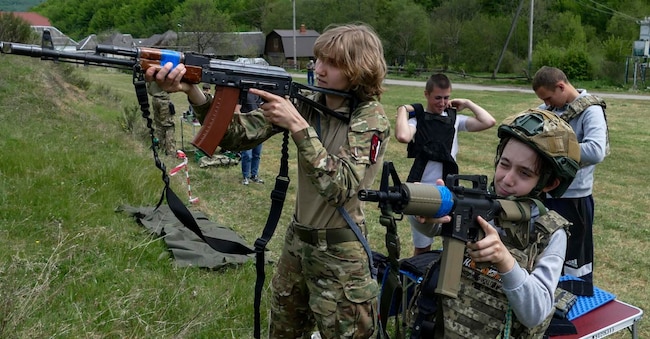
Alcuni bambini ucraini partecipano a una mostra volta a far conoscere loro alcune attrezzature militari nei pressi della città di Svaliava, nella regione della Transcarpazia, in Ucraina, il 9 maggio 2026, mentre è in corso l’invasione russa. Il programma patriottico per i bambini è stato organizzato dai cadetti della Resistenza Nazionale e dai militari della 42ª Brigata Meccanizzata delle Forze Armate ucraine. EPA/IGOR TKACHENKO EPA

6' min read

Translated by AI
Versione italiana

6' min read

Translated by AI
Versione italiana

The EU Council adopted this afternoon, 11 May, restrictive measures against 16 individuals and seven entities deemed responsible for actions threatening the integrity and independence of Ukraine, in particular the systematic illegal deportation, forcible relocation, indoctrination and militarised upbringing, of Ukrainian children, as well as illegal adoption and relocation to Russia and the temporarily occupied territories. Since the beginning of the conflict, it is estimated that Russia has forcibly relocated nearly 20,500 children. According to the Council, such actions aim to erase Ukrainian identity and violate the fundamental rights of the child.

The affected entities include institutions linked to the Russian Ministry of Education, such as the Pan-Russian children's centres Orlyonok, Vele Scarlatte and Smena, accused of running ideological re-education programmes and military-related activities for Ukrainian minors; as well as the Dosaaf centre in Sevastopol, the Nakhimov naval school and the military-patriotic club 'Patriot' in Crimea.

Loading...

The sanctions also affect officials and politicians from territories illegally occupied by Russia and various heads of youth summer camps and military-patriotic clubs and organisations, believed to be responsible for promoting patriotic and military education among young people. The measures include the freezing of assets, a ban on transit through the EU, and a ban on European citizens and companies from making funds or economic resources available to the listed entities.

In the background remain the fragility of the ceasefire announced by the Kremlin, the diplomatic contacts made by the United States, and the conviction, increasingly widespread in several European capitals, that the war cannot be ended without direct European involvement.

Ucraina, Zelensky denuncia: la Russia non rispetta cessate il fuoco

Opening the confrontation was the proposal made by Vladimir Putin, who pointed to former German Chancellor Gerhard Schröder as a possible European interlocutor in talks with Moscow. He claimed that Russia was never closed to dialogue with Europe. The reaction from Brussels, however, was immediate.

Arriving at the EU Foreign Affairs Council, High Representative for Foreign Policy Kaja Kallas called it "not very wise" to give Russia the right to choose the European negotiator. And she recalled Schröder's past as "high-profile lobbyist" for Russian state-owned companies, explaining that it is "clear" why Putin would want him at the table: "So he could sit on both sides". The reference is to the positions held by the former German chancellor after the end of his political career, from the chairmanship of the Nord Stream consortium to the board of directors of Gazprom, the Russian gas giant.

Foreign Minister Antonio Tajani also openly rejected the hypothesis of a choice imposed by the Kremlin. "Europe chooses the negotiator", he said in Brussels, insisting that the European representative should be identified collegially by the member states, the Commission and the European Council. Tajani was also keen to stress that the EU must necessarily be part of the negotiations because it is Brussels that imposed the sanctions against Moscow and any easing or withdrawal of the restrictive measures will still require a European decision. Among the figures considered authoritative, the Italia minister mentioned the President of the European Council Antonio Costa, calling him "a prestigious name".

Meanwhile, the debate has also heated up in Germany. According to Der Spiegel, the possibility that Federal President Frank-Walter Steinmeier could play a mediating role in possible negotiations between the EU and Russia is being discussed within the governing coalition. The German weekly reports that Berlin looks at Schröder with great distrust and that a Schröder-Steinmeier tandem 'could be an interesting option'. The name of former Chancellor Angela Merkel also emerged in the discussions. Der Spiegel notes that both Merkel and Steinmeier continue to be criticised in Ukraine for their previous policy towards Moscow, but also recalls that Merkel would be one of the few Western leaders truly respected by Putin. For the weekly magazine, the mere fact that the German government is discussing possible mediators shows how much political pressure has increased to find a negotiating way quickly.

Kallas confirmed that the issue will be formally addressed during the Gymnich informal summit of European foreign ministers, scheduled for 27 and 28 May. Before engaging in a dialogue with Moscow, he explained, Europe must clarify internally what the objectives and issues to be addressed in the confrontation with Russia are.

Ucraina, Kallas: "Non è saggio dare diritto alla Russia di scegliere il negoziatore"

On a military and diplomatic level, Brussels also views the ceasefire announced by the Kremlin on the occasion of Russia's Victory Day celebrations with increasing scepticism. Kallas called it"a cynical act", arguing that Moscow primarily wanted to secure the 9 May parade while continuing to hit Ukrainian civilian targets. According to the head of European diplomacy, Kiev respected the truce 'unconditionally', as it had done before.

The Ukrainian authorities claim thatRussian drones, artillery and bombs struck the Kharkiv and Kherson regions during the ceasefire, leaving at least two dead and seven injured, including a 14-year-old boy. The Russian Defence Ministry, however, stated that the army would 'strictly observe' the ceasefire and accused Ukraine of repeatedly violating it.

The temporary ceasefire had been announced on 8 May by US President Donald Trump and was to last from 9 to 11 May, coinciding with Russian celebrations of victory in World War II.

Volodymyr Zelensky reported that Ukraine continues to have "almost daily contacts" with the United States. According to the Ukrainian president, the secretary of the Ukrainian National Security and Defence Council Rustem Umerov recently met with US emissaries Steve Witkoff and Jared Kushner. The talks also reportedly discussed possible formats for future meetings between leaders aimed at ending the war.

Washington is also involved in mediating a large prisoner exchange between Russia and Ukraine. Kiev confirmed that it had handed over a list of one thousand names to Moscow as part of a possible thousand-for-one exchange. The Ukrainian Coordination for Prisoners of War explained that the lists were compiled according to the criterion of length of detention, giving priority to prisoners imprisoned since the beginning of the large-scale invasion. Zelensky stated that the US has taken a mediation role 'at the appropriate level' and that Kiev expects active US involvement to ensure the implementation of the agreement.

On the ground, Kiev claims to have consolidated its position. Arriving at the Foreign Affairs Council, Ukrainian Foreign Minister Andrii Sibiha stated that Ukraine had 'stabilised the frontline' and would now be able to 'completely close its airspace'. According to Sibiha, Ukrainian defences are able to shoot down up to 90% of drones and other flying targets launched by Russia. The minister also spoke of 'very effective' long-range special operations against Russian targets.

Sibiha also relaunched the idea of a stronger European role in the negotiations. Kiev, she explained, considers it necessary to maintain American leadership in the peace process, but believes that Europe can develop a 'complementary role', not an alternative role, to the US.

From Helsinki, meanwhile, come increasingly optimistic assessments of the Ukrainian position. Finnish Foreign Minister Elina Valtonen supports that in recent months Kiev has shown that it has 'the best cards'. According to Valtonen, Ukraine has not only managed to hold the front and regain part of the territories illegally occupied by Russia, but has also strengthened its international political position. The Finnish minister recalled the agreements made by Kiev with some Gulf countries, which were interested in Ukrainian expertise in air defence and drone warfare. "The Ukrainians' capabilities are highly appreciated all over the world, she said.

Valtonen also thinks that the Russian economy is going through a much more difficult phase than in the past. In his opinion, the temporary increase in oil and gas prices linked to the war with Iran would only give Moscow a brief respite. The Finnish minister also emphasised the growing domestic discontent in Russia, pointing out that the war was supposed to last "two weeks" and that instead the conflict has now entered its fifth year.

Finnish President Alexander Stubb also considers a real peace by 2026 unlikely. In an interview with the Corriere della Sera he outlined three possible scenarios: prosecution of the war, truce followed by an agreement, or collapse of one of the two sides, 'probably Russia'. According to Stubb, if US policy towards Ukraine and Russia does not coincide with European interests, then Europe must prepare to talk directly with Moscow.

Copyright reserved ©
Loading...

Brand connect

Loading...

Newsletter

Notizie e approfondimenti sugli avvenimenti politici, economici e finanziari.

Iscriviti