The war

Ukraine: Germany accuses Russia of a drone attack on Leipzig Airport. Von der Leyen: ‘We will respond’

A drone incursion into Estonian and Latvian airspace has also put NATO on alert. The European Commissioner for Economic Affairs is calling for greater international commitment to providing economic support to Kyiv

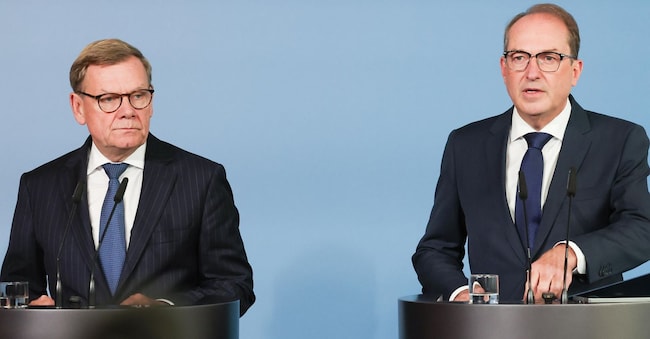
Il ministro dell’Interno tedesco Alexander Dobrindt (R) e il ministro degli Esteri tedesco Johann Wadephul partecipano a una conferenza stampa sull’incidente del drone all’aeroporto di Lipsia, a Berlino, Germania, il 1° settembre 2026. Il 5 agosto è stato rinvenuto un drone carico di esplosivo nei pressi di un aereo cargo ucraino, mentre un altro velivolo è entrato in collisione con un oggetto volante non identificato nelle vicinanze poco prima di atterrare in sicurezza. L’aeroporto, situato nella Germania orientale, riveste un ruolo fondamentale nel trasporto di rifornimenti militari da parte delle Forze armate tedesche e degli alleati della NATO. Funge inoltre da base per la compagnia aerea ucraina Antonov Airlines.  EPA/FILIP SINGER EPA

5' min read

Translated by AI
Versione italiana

5' min read

Translated by AI
Versione italiana

Germany has accused Russia of an attempted drone attack on a Ukrainian cargo aircraft at Leipzig/Halle Airport in August. Berlin may be preparing new sanctions against Moscow in coordination with its allies. Airport staff had found a drone equipped with explosives and a detonator at the airport, but Germany had previously refrained from attributing responsibility to Russia, describing the incident simply as part of a hybrid war being waged against Europe.

Foreign Minister Johann Wadephul, announcing new measures against Russia in response to the hybrid attacks in Leipzig, stated that ‘Russia has consciously decided to cause even greater damage to our relations’. The minister also emphasised that Moscow shows no willingness to return to peace and a constructive relationship. “This state of our relations is not in the German government’s interest. We expressly deplore it,” he remarked. Since the start of the war in Ukraine, “we have always emphasised that our aim is to end the war in Ukraine, restore peace in Europe, and return to a constructive relationship. But this depends on Russia showing at least some willingness. And we must conclude that Russia is showing no such willingness”, he concluded.

Loading...

Germany closes Russian consulate in Bonn. Moscow: ‘We will respond’

Furthermore, in response to the attempted drone attack on Leipzig Airport, Germany will order the closure of the Russian consulate in Bonn and the Russian House in Berlin. This was announced by Foreign Minister Wadephul, who added that Germany would also push for tougher sanctions against Russia, entry checks for Russian citizens and increased pressure on the so-called ‘ghost fleet’.

On the Russian side, the spokesperson for the Russian Foreign Ministry, Maria Zakharova, responded: “Moscow will respond to all anti-Russian decisions” taken by Germany. The comment came after the Interfax news agency reported on the measures announced. “Berlin itself is completely compromised both by its involvement in the Ukrainian conflict and by its involvement in terrorist attacks against civilians,” added Zakharova. The Russian Foreign Ministry spokeswoman then commented on Berlin’s decision to close the Russkij Dom, the ‘Russian House’: ‘It has long been a source of concern for them, so they were looking for something to latch onto.’

Kremlin spokesperson Dmitry Peskov also commented on the matter, stating that the allegations made by Germany are completely unfounded. “It is difficult to comment on the matter, as when such serious allegations are made, they must be backed up by evidence. If I am not mistaken, no evidence has been presented to support them. It is clear that Germany is moving towards further escalation,” said Peskov.

Support from Germany’s allies

“This morning I spoke with Chancellor Merz to discuss the hybrid attack on Leipzig Airport. I assured him that the EU stands in full solidarity with Germany in the face of this attack by Russia. We will keep the EU united despite these serious and increasingly intense acts. The German government has taken decisive action. And the message is clear: hybrid attacks will not go unanswered.” Ursula von der Leyen wrote this in a statement, explaining that the issue will be on the agenda tomorrow at her meeting with NATO Secretary-General Mark Rutte.

NATO Secretary-General Mark Rutte also expressed solidarity with Germany. ‘I have just spoken to Chancellor Merz. NATO stands in full solidarity with Germany following the Russian hybrid attack in Leipzig on 14 August. The evidence is unequivocal. And I welcome the measures announced by Germany in response.’ NATO Secretary-General Mark Rutte wrote this on social media, reiterating that “NATO will continue to strengthen its ability to deter and defend all Allies against any threat, including malicious actions such as those seen in Leipzig and elsewhere across the Alliance. Russian attempts to intimidate us, to undermine our unity and our resolve to support Ukraine, are futile and will fail.”

Support for Berlin also came from the British Government, with Prime Minister Andy Burnham making it clear that he stands alongside his German ally. On behalf of Italia, Foreign Minister Antonio Tajani expressed solidarity with Minister Wadephul and the entire German Government. ‘These threats will not halt Europe’s commitment to freedom and democracy. We will respond united to any attempt by Moscow to destabilise Europe. This evening in Ireland, we will address the issue of hybrid threats with our EU foreign ministers. We want peace in Ukraine, and it is Russia that must stop,” Tajani wrote on X.

Kallas: ‘Wave of cyberattacks from Russia – they want to scare us’

“Russia is hitting Europe with an ever-increasing wave of cyberattacks; they want to scare us. But today we have decided to step up our support for Ukraine, bolster our defences, and we are discussing the most substantial package of sanctions yet.” This was stated by the EU High Representative, Kaja Kallas, at the conclusion of the informal Defence Council meeting. “Russia’s war is becoming increasingly ruthless and destructive, but unfortunately it does not seem to be coming to an end at all. The Russian army is on its last legs on the ground, which is why it is killing civilians from the air. This is planned terrorism,” she emphasised. “Russia is also targeting Europe with a wave of increasingly kinetic hybrid attacks. In doing so, Russia aims to intimidate us to dissuade us from supporting Ukraine. It will not succeed. Air defence remains the top priority, but interceptor missiles are in short supply everywhere. I would like to thank the Member States for reviewing their stocks. In particular, Patriot missiles nearing the end of their service life should be sent to Ukraine. Member States are also considering the possibility of reprioritising orders and turning to partners. ‘Every interceptor we supply to Ukraine means one fewer Russian missile hitting a Ukrainian school, home or hospital. And every bit of support we give to Ukraine strengthens European security,’ he emphasised.

Ucraina, 1.641° giorno di guerra

Photogallery15 foto

Drones intrude into Baltic airspace

Further tensions over a possible spread of the Russian-Ukrainian conflict to the Baltic States. According to reports by the Estonian national broadcaster ERR, a number of drones triggered a night-time air raid alert in Latvia and subsequently entered Estonian airspace, where NATO fighter jets from the Baltic Air Policing mission continued to search for them. The news has been reported by press agencies in both Baltic countries. At 3.11 am, the Estonian Defence Forces issued an air threat warning for several counties. Lieutenant Colonel Uku Arold, head of the Strategic Communications Department of the Estonian Defence Forces, stated that the drones had violated Estonian airspace and that Turkish Air Force fighter jets, stationed at Amari Air Base in Estonia as part of NATO’s rotational air defence mission, had been scrambled in response. “There were drones moving parallel to Estonia’s eastern border and also to Latvia’s, before entering Estonian territory, which is why we raised the alert,” said Arold. The alert was lifted before 6 am, according to ERR. Foreign Minister Margus Tsahkna also stated that the drones had “entered Estonian airspace” during the night. In response to the situation, NATO fighter jets took off from Amari airbase. Subsequently, the Estonian Defence Forces lifted the air alert. As Tsahkna emphasised, NATO reacted swiftly and exactly as expected: ‘The Alliance is vigilant and ready to protect allied territory,’ the minister reiterated.

Loading...

Dombrovskis: ‘Our international partners must play their part on Ukraine’

The European Union remains steadfast in its ‘commitment’ to Ukraine, ‘including the €90–100 billion aid packages planned for this year and next, as well as further long-term financing initiatives’. The European Commissioner for the Economy, Valdis Dombrovskis, speaking on the sidelines of the G20 Finance Ministers’ Meeting in Asheville, North Carolina, “therefore urged our international partners to play their part by increasing their contributions and ensuring the necessary financial backing for the commitments made”.

US President Donald Trump’s remarks yesterday, expressing an openness towards Russia regarding Moscow’s representative at the G20 Finance Ministers’ Meeting in North Carolina, were significant. “We like to get on well with everyone. One of the reasons I’m so successful is that I get on well with everyone,” said Trump from the Oval Office, responding to questions about the Russians’ presence at the G20 Finance Ministers’ meeting in Asheville.

Copyright reserved ©
Loading...

Brand connect

Loading...

Newsletter

Notizie e approfondimenti sugli avvenimenti politici, economici e finanziari.

Iscriviti