The war

Putin: ‘Western military exercises in the Baltic Sea constitute an escalation.’ Zelensky: first FP-7 missile launched

The official priorities listed by Moscow are social spending, support for those taking part in the ‘special military operation’, defence and security needs, commitments to health and education, and the achievement of a leading position in technology

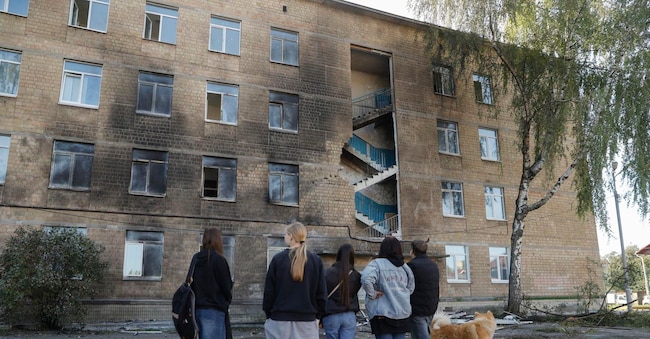
epa13274596 Alcuni bambini del posto si trovano vicino al luogo in cui un drone russo ha colpito un edificio scolastico in una zona residenziale di Kiev, in Ucraina, il 1° ottobre 2026, nel corso dell’invasione russa. Non sono state segnalate vittime né feriti nell’attacco, che ha provocato un incendio circoscritto, poiché gli studenti e il personale si erano riparati all’interno di un rifugio antiaereo durante l’attacco.  EPA/SERGEY DOLZHENKO EPA

4' min read

Translated by AI
Versione italiana

4' min read

Translated by AI
Versione italiana

Russian President Vladimir Putin has described Western military exercises in the Baltic Sea and attempts to stop Russian ships as an “escalation”. “The exercises in the Baltic Sea, one after another, and the attempts to stop our ships and vessels: all this represents the escalation I spoke of in my speech. All of this is an escalation,” the Russian leader remarked during the plenary session of the 23rd Valdai International Discussion Club meeting. This was reported by TASS.

Putin also dismissed today as “absurd” the proposal to suspend long-range attacks between Russia and Ukraine. Specifically, the proposal to halt Ukrainian air strikes on Russian refineries and Russian air strikes on Ukrainian ships in the Black Sea. This is according to Russian news agencies.

Loading...

Zelensky: first FP-7 missile launched

Ukrainian President Volodymyr Zelensky announced in a social media post that the “Ukrainian FP-7 tactical ballistic missile” had been deployed for the first time. “Thank you for this achievement. Now we move on to production. Glory to Ukraine!”, he added.

EU to provide 45 billion to Ukraine in 2027. Moscow: unlimited defence spending

This morning, a drone struck a school building in the Solomiansky district of Kyiv, according to an announcement by the capital’s mayor, Vitali Klitschko. “A fire has broken out,” he wrote, adding that “the children were in the shelter”. Emergency services are on their way to the scene.

For its part, the Russian Ministry of Defence announced that it had carried out drone strikes overnight against several sites in Ukraine. According to Moscow, a ‘transport and logistics centre’ in Kyiv was hit. The ministry reports that the building housed a workshop for the production of naval drones.

In Odessa and the surrounding region, Russia also claims to have struck the “Hosting-UA” data centre, which is alleged to have processed intelligence for the Ukrainian army. Finally, again in the Odessa Oblast, specifically in the port of Kornomorsk, the Russian Ministry claims that a ‘bulk carrier’ transporting military equipment and dual-use cargo destined for the Ukrainian forces was struck.

Last night, between 8 pm and 8 am Moscow time (7 pm–7 am Italian time), ‘Russian air defence forces intercepted and shot down 330 Ukrainian fixed-wing drones over the territories of the Bryansk, Belgorod, Smolensk, Kaluga, Tula, Kursk, Tver, Lipetsk, Oryol, Tambov, Astrakhan, the Moscow region, the Republic of Crimea and over the waters of the Black Sea”, the Russian Ministry of Defence reported.

EU: ‘We condemn Russia’s irresponsible nuclear rhetoric’

“We reiterate our position on Russia’s war of aggression against Ukraine. As regards the communication to NATO, NATO has responded clearly and we welcome that response. Naturally, we condemn Russia’s irresponsible nuclear rhetoric. We will not fall into Russia’s trap and will not play into Moscow’s tactics based on intimidation and scaremongering.” This was stated by the EU Commission spokesperson Christian Wigand at a press briefing, in response to Russia’s declaration to NATO that it was prepared to use its “entire arsenal” following alleged exercises simulating the isolation of Kaliningrad.

EU: 45 billion allocated for Kyiv in 2027

“Today, thanks to joint and coordinated efforts, we have identified the means to meet Ukraine’s budgetary and defence needs for 2026. We have also reaffirmed the measures necessary to ensure the timely allocation of these funds,” according to a joint statement from Brussels and Kyiv. “For 2027, we have agreed to proceed swiftly with the allocation of €45 billion as part of the support loan to Ukraine, subject to compliance with the agreed conditions. We will also begin work to identify further budgetary and defence requirements”, the statement reads.

“All parties agreed that the other partners should also fulfil their financial commitments and step up their efforts in light of the significant challenges facing Ukraine,” the statement concluded, announcing that it had been agreed to hold monthly meetings to coordinate our joint efforts. The Ukrainian President Volodymyr Zelensky commented, noting that “the dialogue with the European Commission has yielded good results in addressing Ukraine’s financial and defence needs for 2026 and 2027”. “We have agreed on the format, the timetable and the steps needed to ensure comprehensive coverage,” he explained on X.

Loading...

Russia: Mishustin presents the 2027–2029 budget to the Duma, with no limits on defence spending and cuts across the board

Russian Prime Minister Mikhail Mishustin has presented the budget for the next three years, 2027–2029, to the new Duma. The projected annual deficit is around two per cent (5,300 billion roubles in 2027, 5,100 in 2028 and 5,300 in 2029), despite further tax increases, including the introduction of taxes on passive income. The official priorities listed by the government are social spending, support for those taking part in the ‘special military operation’, defence and security requirements, commitments to healthcare and education, and the achievement of a leading position in technology.

In fact, military spending will reach a record 17,100 billion roubles (202.58 billion dollars) – 50,000 billion over three years – compared with the 12.1 billion budgeted for the current year (the actual amount spent is classified, but the total deficit for the current year will reach a record 7,345 billion roubles, equivalent to 3.2 per cent of GDP, far exceeding the 3,785 billion budgeted, which was 6 per cent of GDP).

Defence spending planned for next year has been increased by 27 per cent compared with the figure set out in the three-year budget forecast (13,500 billion roubles). Social spending – including pensions, maternity leave and support for war veterans – is, however, set to be cut by 7 per cent next year compared with the forecast, whilst education spending will be cut by 6 per cent and health spending by 6.8 per cent (according to Reuters). The allocations set out under the ‘national economy’ heading – namely new construction investments or subsidies – have fallen by 7.4 per cent. According to Vyotstka, 34.9 per cent of expenditure remains classified. It is a “balanced budget, an important condition for maintaining macroeconomic stability and reducing inflation”, the government wrote in its presentation.

Copyright reserved ©
Loading...

Brand connect

Loading...

Newsletter

Notizie e approfondimenti sugli avvenimenti politici, economici e finanziari.

Iscriviti