Pulse

The Sahel powder keg brings a record number of migrants to the Canaries

First they emigrated from the Maghreb, now they flee from the Sahel, say national security data. The number of asylum seekers from Mali (+726 per cent) and Senegal (+254 per cent) increased dramatically in 2024

by Lola García-Ajofrín (ElConfidencial), Alberto Magnani (Il Sole 24 Ore)

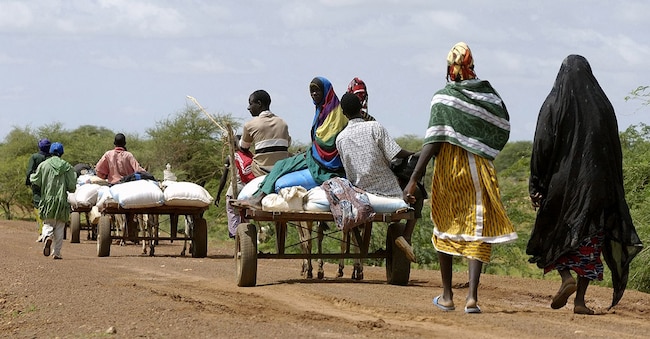
 Sahel (Photo by Philippe ROY / Aurimages via AFP)

8' min read

8' min read

The injured - sometimes even with amputated limbs - who arrive at the reception centres of the Spanish Commission for Refugee Aid (CEAR) have a different profile than before. They usually have two characteristics: asylum seekers - people seeking international protection - are increasingly numerous, and a very high percentage come from Mali, explains Raquel Santos, CEAR's director of programmes, to El Confidencial. "They are really vulnerable kids, they arrive very tried" from all they have suffered on the journey, Santos continues. In many cases, she says, 'the journey by sea is only a small part of the journey they have made'. This vulnerability is compounded by their level of literacy, which leads them to be doubly foreign and alien. In 2023 there has been 'a paradigm shift' with respect to the type of people arriving in Spain by sea, according to reveals the 2024 Department of Homeland Security (DSN) report, published on 22 May. Before, they were mostly Maghrebians, mostly Moroccans, while now they flee from the countries of the Sahel, that vast strip of semi-desert territory that acts as a 'border' between North and Sub-Saharan Africa. This trend started in 2023 and was consolidated in 2024. In the early 2025, the main nationality of asylum seekers remains Malian, although arrivals have decreased.

More than 15,000 Malians have fled to Spain

.

In 2024, 15,261 Malians arrived on Spanish shores. After Mali, the most represented countries of origin were Senegal (11,864), Algeria (9,552), Morocco (6,945), the Republic of Guinea (3,890), Mauritania (2,804), Gambia (2,545), Ivory Coast (1,006), plus other sub-Saharan countries (5,185). Overall, therefore, arrivals from sub-Saharan Africa rose from 62 per cent to 72 per cent of the total in 2024. 2024 also saw record numbers of arrivals by sea to Spain, the largest number since 2018. If in 2014, 4,552 people had arrived irregularly by sea and 7,068 by land, in 2024 there were 61,372 by sea and 2,647 by land, a 10.3 per cent increase in arrivals by sea compared to the previous year (55,618 in 2023). The majority (over 73 per cent) arrived in the Canary Islands. This is higher than almost two decades ago, when the so-called 'cayucos crisis', named after the boats used by fishermen from Senegal and Mauritania, occurred in 2006. The explosion of asylum claims by people from Mali and Senegal reflects two distinct migration phenomena. The migration from Mali stems from a broader crisis developing in the western part of the Sahel, trapped between political instability, violence and food insecurity, as well as the consequences of climate change. Mali and its two neighbours, Burkina Faso and Niger, find themselves in a similar vicious circle, between the increase in violence of armed groups affiliated with jihadist networks and the indirect response to them through coups by military juntas, always justified under the pretext of curbing the proliferation of terrorist groups, and mismanaged by corrupt governments prone to Western interests. Mali led the way with coups in 2020 and 2021, quickly followed by Burkina Faso (2022) and Niger (2023). The counter-offensive implemented by the military does not seem very effective. Burkina Faso alone recorded on its territory one fifth of the victims of terrorism included in the Global Terrorism Index, an annual report by the Institute for Economics and Peace. The situation is no better in Niger and Mali itself. West Africa has become the epicentre of terrorist attacks worldwide.

Loading...

"Burkina Faso, Mali and Niger are among the 10 countries most affected by terrorism in the world, according to the Global Terrorism Index 2024," points out Ottilia Anna Maunganidze, of the Institute for Security Studies (ISS). And, as Maunganidze explains, violent extremism 'has a direct impact on people's livelihoods, who may be forced to leave their land'. The spread of these regimes is not directly affecting migration flows, however their 'failure to deliver on promises of greater security and protection can be seen as a factor driving people to migrate', Maunganidze continues. Political and economic insecurity is intertwined with the progressive impoverishment of agricultural harvests, accelerated by climate change, causing migration or displacement.

Most displaced people remain in Africa

.

The ongoing conflict in the central Sahel region (Burkina Faso, Chad, Mali and Niger), exacerbated by the growing climate crisis, has displaced more than five million people, according to the UNHCR, coinciding with the record number of arrivals in the Canary Islands. However, most of the displaced people in the Sahel have migrated 'within Africa', Maunganidze points out.

In the first half of 2024 alone, some 130,000 Malians sought refuge in Mauritania. And since 2021, more than 150,000 people from Burkina Faso have sought asylum in the countries of the region. In turn, in Burkina Faso, the number of internally displaced persons with limited possibilities of return could reach 3.65 million by the end of 2025.

Changing routes (more arrivals in the Canaries)

.

In this context, migration routes have also changed. In 2024, Mauritania was the main departure point to reach Spain by sea, with over 25,000 people, the same number as Morocco and Algeria combined, according to the CSP. Thousands of people who previously crossed the Mediterranean Sea from North Africa in search of a future in Europe, now, on the advice of traffickers, attempt the Atlantic crossing from Mauritania and Senegal to the Canary Islands. Thus, departures from the central Mediterranean route decreased by 59 per cent between 2023 and 2024, while in the Atlantic they increased dramatically. And human trafficking networks in Senegal and Mauritania have become professionalised. This change in routes was partly caused by the escalation of the conflict in northern Mali. In August 2023, the two sides that had signed the 2015 peace agreements clashed again: the Malian forces, backed by the Russian paramilitaries of the Wagner Group (which announced its withdrawal from Mali in early June 2025), and the rebel movements in the north of the country. The change in routes is also a consequence of Tunisia's tightening of migration policies after negotiations with the EU and reports of abuses in Libya, explains a report by the Global Initiative Against Transnational Organised Crime.

Over 10,000 dead on the deadliest route

And so the Canaries have become the most active and deadliest sea route to Europe. 10,457 people died trying to reach Spain by sea in 2024, according to Caminando Fronteras. 9,757 of these deaths occurred in the Atlantic, the world's deadliest route. To the deaths at sea 'we have to add the deaths in the desert', says Augustin Prince, a 24-year-old Cameroonian who fled his country during protests in the Anglophone regions of Cameroon and, after a journey of almost a year, passed through CEAR facilities once he arrived in Spain. In the Niger desert he saw one of the boys he was travelling with die. He told his story in the book El viaje de Prince.

At the same time, more and more women arrive on Spanish shores 'with many profiles of violence', explains Lidia Hernández, state coordinator for humanitarian assistance or human action. "Many have suffered sexual violence, violence during the journey, female genital mutilation," adds Santos. The different profile of the people arriving has also increased the number of requests for international protection in Spain. After Germany, Spain is the second EU country to receive the highest number of asylum applications (165,398), according to the interior ministry. In total, Malians submitted around 17,000 asylum applications in the EU+, more than twice as many as in 2023. Most applications by Malian nationals in the EU were submitted in Spain (10,650), followed by Italy (3,258) and France (2,772). Senegalese applications (14,000) in Europe also doubled compared to the previous year. However, in perspective, the number of Malian refugees in Europe is ten times lower than that of Syrian nationals, who continue to be the most numerous asylum seekers in Europe, despite the fall of the Al Asad regime (December 2024) marking a significant change. Some countries temporarily suspended the processing of Syrian asylum applications and around 270,000 Syrians returned to their country in early 2025, despite UNHCR warnings of the danger of forced returns. Applications from Afghans also decreased, according to the European Asylum Agency (EUAA).

A quarter of refugees arrive by plane

.

A quarter of asylum applications in the EU+ are submitted by citizens of countries that do not require a visa, i.e. who arrive by plane. Syrians, Afghans, Turks, Venezuelans and Colombians were, in order, the citizens who filed the most asylum applications in Europe. For the third consecutive year, around one million asylum applications were submitted in the EU+. In the case of Spain, the percentage of Colombians applying for asylum decreased in 2024 (-25 per cent), but the percentage of Malians (+726 per cent) and Senegalese (+254 per cent) increased.

"They are often unaware that the reason they have left their country may entitle them to apply for international protection," says Santos, who explains that once the emergency services have been activated, these people can spend up to six months in a CEAR reception centre before integrating into society. These six months are a race against time, during which the primary needs, i.e. food and health care, are taken care of first. Then a team of psychologists, lawyers and social workers steps in. The applicants must use the time spent in the reception centres to attend language and vocational training courses.

Overfishing threatens employment in Senegal

.

In Senegal, it is not jihadism but fishing that drives young people to leave. Here, the most common reasons for emigrating are poverty and lack of work, in a climate of tension towards the authorities, which resulted in the electoral victory of the tandem formed by Sonko, the main opposition leader, and Faye, his number two. In March 2024, after three years of protests, the Senegalese elected Bassirou Diomaye Faye, a former anti-system tax inspector who presented himself with a path-breaking programme and promises of transparency, as president.

In the days leading up to the vote, there was an air of change in the streets of Dakar, which exploded into jubilation when the results were announced. Today, the enthusiasm has faded, due to the more moderate line of Faye and Sonko, while discontent due to poverty persists and a new emergency calls for Europe: the so-called overfishing, which threatens local fish stocks. According to a US report, one in six Senegalese work in the fishing industry. For the time being, the new Senegalese government has not renewed the fishing agreement signed with the EU that, as of 2019, allowed European vessels to fish in Senegalese waters. In this corner of Africa, steadily increasing foreign industrial fishing has a 'growing environmental and socio-economic impact', according to a report by the Environmental Justice Foundation. Artisanal fishermen are particularly affected by destructive methods such as bottom trawling, intensive fishing and illegal overfishing practised by European and Chinese industrial fleets. These fleets, which often operate under opaque joint agreements, deplete fish stocks and exacerbate food insecurity". "It bothers me a lot when [foreign nations] complain about immigration, because they are the real pirates and what they have done is worse than illegal immigration," criticises Karim Sall, president of AGIRE, a Senegalese organisation operating in the Joal-Fadiouth marine protected area. "We risk our lives to leave, and they come here to steal our fish," he complains. For Sall, "it is theft", because, he says, "they plunder our resources to feed their people while we suffer". 

*This article is part of the European collaborative journalism project "Pulse"

Copyright reserved ©
  • Alberto Magnani

    Alberto MagnaniCorrispondente

    Luogo: Nairobi

    Lingue parlate: inglese, tedesco

    Argomenti: Lavoro, Unione europea, Africa

    Premi: Premio "Alimentiamo il nostro futuro, nutriamo il mondo. Verso Expo 2015" di Agrofarma Federchimica e Fondazione Veronesi; Premio giornalistico State Street, categoria "Innovation"

Loading...

Brand connect

Loading...

Newsletter

Notizie e approfondimenti sugli avvenimenti politici, economici e finanziari.

Iscriviti