
Salsomaggiore, spas aim to double attendance by 2030
Qc Terme and Cdp invested 44 million in the renovation of the complex

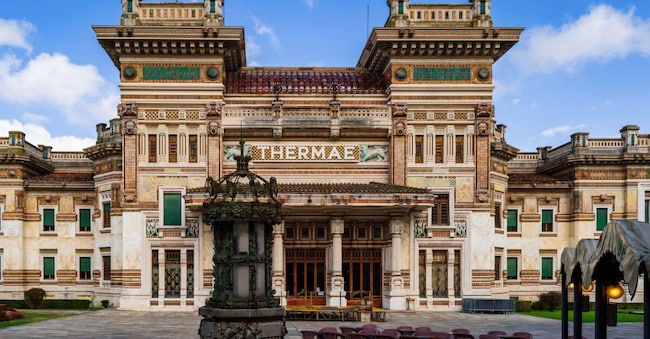
A plan to relaunch Salsomaggione Terme. It is the one that starts with the rebirth of the Art Nouveau-style Thermae Berzieri complex after a renovation project that lasted just over two years. A project realised by Cassa Depositi Prestiti Real Asset SGR, a CDP Group company, through the Fondo Nazionale del Turismo (National Tourism Fund), financed by CDP and the Ministry of Tourism in partnership with QC Terme, a leading wellness tourism company. A public-private partnership operation developed with a total investment of 44 million euro.
The objective is to relaunch thermal tourism in the Parma area in order to multiply tourist numbers by 2030. The plan was presented yesterday during the 'La Rinascita delle Thermae Berzieri' (The Rebirth of the Berzieri Thermal Baths) discussion, attended by, among others, Daniela Santanchè, Minister of Tourism, Tommaso Foti, Minister of European Affairs, the NRP and Cohesion Policies, together with local and regional authorities.
According to the plan, the reopening of the spa could lead to a turnaround in tourist flows: based on conservative assumptions made by Cdp, a potential of 391,000 presences per year in accommodation facilities is estimated for 2030, up sharply from 200,000 in 2024 and above the current accommodation capacity of just over 300,000 presences per year.
"This project is an example of our philosophy of intervention on the real estate front, which can be summarised as reuse, regenerate and return, i.e. make the property usable again with a significant impact on the area in terms of economic and social wellbeing that we expect to see in Salsomaggiore in the future," said Antonino Turicchi, CEO of Cdp Real Asset SGR.
The estimated economic impact on the territory is 105 million per year, 46 million of which are related to increased consumption. The impact on employment is expected to exceed 850 people, including direct employees, i.e., those working in hotels, spa and wellness services, as well as indirect and induced employment. In order to take full advantage of these opportunities, a second phase should be opened with the adaptation of the hotel offer. A step that requires investments of about 40 million for the construction of new facilities or the renovation of existing ones.

