
Salvatori: 80 years of ideas and craftsmanship in marble
From the revival of Albe d’Or – which was all the rage from the 1920s to the 1950s – to finishes that mimic bamboo, stone is back in the spotlight

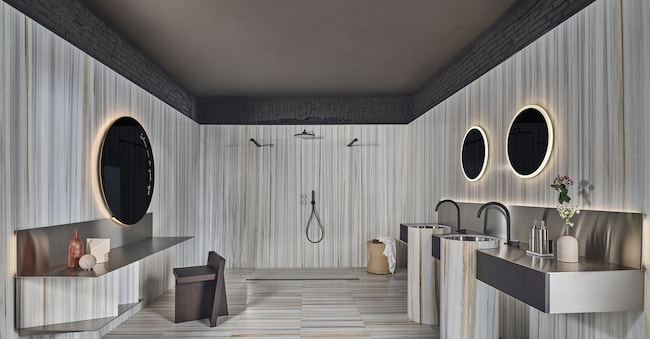
‘Eighty years, for those who work with a material that lasts for millennia, are but a heartbeat. We do not design for ourselves: stone outlives us. Our task is to give it a form that is beautiful today and will still be beautiful in a hundred years’ time, and to pass it on to future generations.’ In a year marking an important anniversary for Salvatori, Gabriele Salvatori, CEO of the company founded in the province of Lucca, at the foot of the Apuan Alps, reflects on a journey that weaves together memory, material and a tangible sense of poetry. ‘My earliest memory isn’t of a quarry: it’s a sound and a smell. The factory in Querceta, the damp dust, the sound of the blades. I come from a marble-working background on my grandfather Guido’s side, and I started working in the factory at the age of 13, alongside Giulietto, the oldest worker, a man who ‘was on first-name terms with the marble’.”
The craft that comes to life
‘There was an expression he used,’ says Salvatori: ‘the craft that gets under your skin’: ‘He meant that on the day you cut yourself, or trap a finger between two slabs — it happened to me — you realise that, from that moment on, you carry that material within you.’ It’s the beginning of a different perspective: “Marble is perhaps the only building material that is quarried, cut, laid, and remains there for millennia. No blast furnaces, no glazes, no resins. The pyramids, the Colosseum, the Acropolis are still standing. It has veins, irregularities, flaws, and our craft, ultimately, is having learnt that that flaw is its signature’. An example? To mark its 80th anniversary, Salvatori has revived Albe d’Or, a rare marble used between the 1920s and 1950s and soon forgotten. Today, its vertical golden veins against a silver-grey background feature in Patricia Urquiola’s The Small Hours collection, Elisa Ossino’s Tratti wall tiles and the Baia shower tray range.
Salvatori now describes himself as a ‘natural stone publisher’: ‘We know how to work with it like few others, and we pay attention to its aesthetics like a design house, not like a quarry. Our guiding principle is moderation: nothing in excess.’ Eighty years of family history allow us to think in terms of generations, not financial quarters. “How have we changed the way we view stone? We have shifted the focus from the block to the surface, from quantity to artistic expression. And we have taught — first to ourselves — that nature’s irregularity is not a flaw to be hidden but the most precious quality a material can possess.”
When imperfection becomes design
For Salvatori, the future sees stone returning to the structure itself, not merely as a finish: building as in days gone by, but with today’s knowledge. The approach? Innovation applied to a history stretching back millennia, all the more powerful for its ability to subvert convention. ‘In the late 1990s, at a Korean restaurant in SoHo. I found myself looking at a placemat made of pressed bamboo stalks and thought: why does a stone surface have to be either polished or left rough?’ Thus Bamboo was born, a surface that treats marble like a fabric, like a design project. “That was the moment we stopped being a stone manufacturer and became a design house.”
‘Almost thirty years on, it’s still one of our best-selling tiles.’ Such turning points in the company’s history are the result of an intuition, a place, a flash of inspiration: ‘13 April 2008. I set off in search of a stone measuring two centimetres by two, which I’d spotted by chance. Three flights and a ten-hour drive to the border between China and Myanmar, where the ‘quarry’ is a man with a foot-powered jackhammer. I fill my suitcase with stones and return to Querceta. Two days later, I showed it to Giorgio Armani: he rang me that morning and said, ‘This is my greige’”, to describe the hybrid between grey and beige. Born out of a request from the illustrious fashion designer, it is an example of the beauty of imperfections – namely, tiny quartz inclusions that everyone considered a flaw, but which Armani described as ‘like strands of hair resting on a silk georgette shawl: “Hence the name, and hence a flaw that has become a signature.” We move on to Milan Design Week 2010, the year of the great success of John Pawson’s Stone House, built entirely from Lithoverde, a recycled natural stone composed of 99 per cent offcuts and 1 per cent natural resin: ‘The most sustainable material is the one you don’t have to make again. Stone has stood the test of time for 6,000 years without blast furnaces, without glazes, without resins’. Durability, he reminds us, is the first form of sustainability.
Brand connect


Newsletter RealEstate+
La newsletter premium dedicata al mondo del mercato immobiliare con inchieste esclusive, notizie, analisi ed approfondimenti
Abbonati